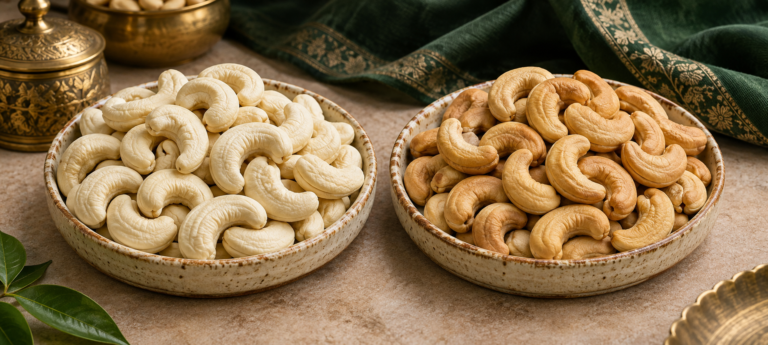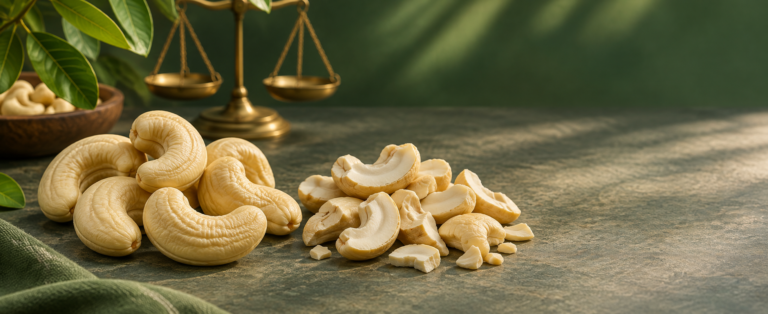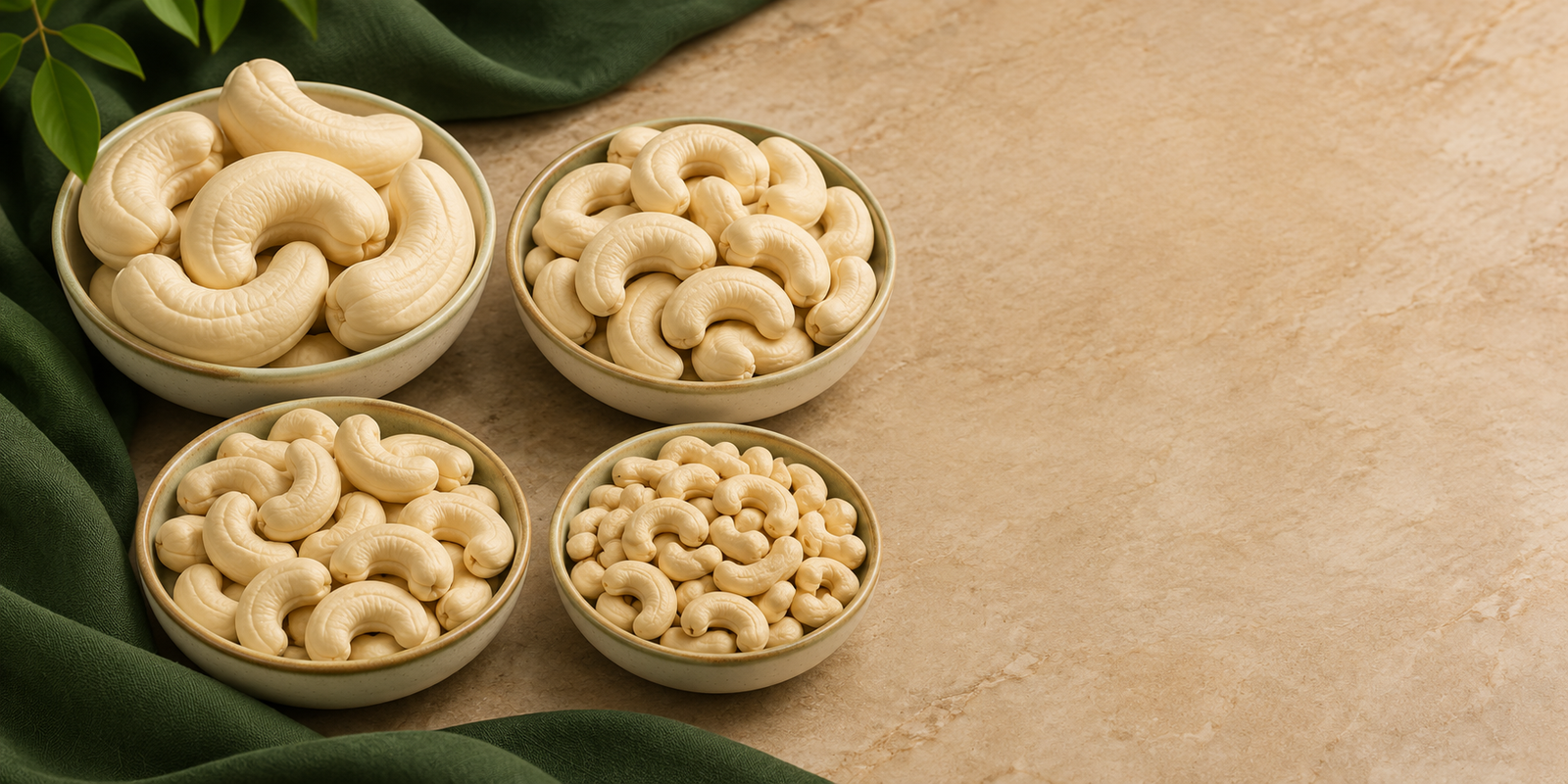
W180, W210, W240 and W320 are four grades of white, whole kaju. Their main difference is kernel size. W180 is the largest of these four. W210 comes next, then W240 and W320. A smaller number indicates fewer, larger cashews in the same weight.
For a Delhi wholesale buyer, the best grade depends on the finished product. A large whole cashew can help a gift box look different. A smaller whole cashew may work better when every sweet needs one piece. If the kaju will become paste, paying extra for a large whole kernel may serve no purpose.
How many whole kaju are in 454 g?
The letter W identifies the white whole cashew category. The number relates to the number of whole kernels in 454 g, or roughly 1 pound. More kernels in that weight indicate smaller average pieces.
The All India Cashew Association specifications use these size ranges:
- W180: 170–180 whole kernels per 454 g; the largest of these four.
- W210: 200–210 per 454 g; smaller than W180.
- W240: 220–240 per 454 g; smaller than W210.
- W320: 300–320 per 454 g; the smallest of these four.
A W320 cashew is still a whole cashew. First quality on a wholesale quote does not identify the W size. Its number identifies a grading band, separate from broken pieces and packet weight.
The count is a range, never an exact promise of 320 kernels. Individual cashews vary in size. A few pieces from one bag cannot settle a dispute about an entire batch.
Which grade should you buy for your product?
Start with the part your customer will see or use. A bigger kernel earns its place when size is part of what you sell. For cooking and food production, count, usable weight and recipe needs may matter more.
W180: For products that need very large whole cashews
W180 is worth considering for gift boxes and display packs where the full cashew is the main attraction. Its larger pieces can be shown alone or alongside other dry fruits. The buyer can see the size difference at first glance.
Ask yourself one question before paying more: will your customer value the extra size? Put a W180 sample inside your actual gift box. If the pack design hides most of each cashew, the larger grade may have little value. Compare the final packed result with W210 before choosing.
W210: For a large kernel below W180 size
W210 is smaller than W180 but remains larger than W240. It deserves a separate quote when a buyer wants large whole cashews but finds W180 unnecessary for the pack.
For a gift box, compare equal weights of W180 and W210 in the same tray. Check how much size difference a customer can see. Then compare the two quotes. Never assume W210 costs less. Compare the actual quotations.
W240: For retail packs where whole-kernel size is visible
W240 can be a sensible option for 250 g or 500 g retail pouches that feature whole cashews. The pieces are smaller than W210, but their size remains distinct from W320. A shop can compare packed samples before ordering a full batch.
A 250 g portion of W240 works out to roughly 121–132 whole kernels, using the trade size range. The number is an estimate before allowing for broken pieces or mixed sizes. Pack an actual 250 g sample and check if customers would notice a useful difference from W320.
W320: For more whole pieces within the same weight
W320 has more individual whole cashews per kilogram than the other three grades. That can help when the job calls for one whole piece per serving and a smaller cashew is acceptable.
For example, W320 works out to roughly 661–705 whole kernels per kilogram. W240 works out to about 485–529. If a sweet needs one whole cashew on top, the smaller grade may cover more sweets from the same weight. The result depends on how many intact kernels remain and the size your sweet requires.
W320 can also suit retail packs sold as whole kaju. But if your kitchen chops every piece, ask about kaju tukda as well. A whole-kernel grade brings little benefit after the shape disappears.
Is W180 better quality or better tasting than W320?
Kernel size alone cannot establish taste, freshness or food safety. W180 can contain larger kernels while a different W320 batch may have better storage and handling. The grade number alone cannot settle that comparison.
Check colour, broken pieces and unwanted smell across the samples. Reject mouldy or rancid cashews. The AICA trade specification also calls for kernels free from insect damage and objectionable material.
A seller may offer white wholes, scorched wholes or pieces. Those are different categories. Always check the full grade description on the quote, not only a number such as 240 or 320. A visual check can flag problems, but it cannot measure moisture or confirm every food-safety requirement.
How can you check the size of a W240 or W320 sample?
You can make a rough size check with a kitchen scale and a counted sample. Ask for a sample from the batch offered for your order. A sample from unrelated stock tells you less about what may arrive.
Take 100 g of intact whole kernels and count them. If you count 70, the rough count per 454 g is 70 × 454 ÷ 100 = 318. That falls inside the W320 size band.
If your sample contains pieces, separate them first. Weigh only the intact kernels used for the count. Counting fragments as whole cashews can make the grade seem smaller than it is.
Treat the result as a screening check, not formal grade proof. A small handful may contain more large or small kernels than the rest of the batch. For a major order, agree on the sample size, grade specification and batch reference with the seller.
Does a white whole grade allow broken kaju?
Even white-whole deliveries can contain broken pieces. A shipment can include a permitted share of broken kernels under its stated trade specification. Handling and transport can add damage too.
The AICA online grade chart shows a 5% broken limit for these grades. Its February 2025 directory shows 8% for white wholes. The figures differ. Neither should be treated as a universal promise for every order.
Before paying, ask the seller to write the allowed broken share in the quote. Confirm how it will be measured and what happens if the delivery exceeds it. A gift-pack seller may need a tighter condition than a kitchen that can use broken pieces.
Can the cheaper W320 quote cost more after breakage?
Yes. If you sell intact whole cashews, a low price per kilogram can hide a higher cost per usable kilogram. First compare offers for the same grade and intended use. Then check how much of each batch meets your packing needs.
For example, imagine two W320 offers that meet your agreed breakage limit. Both prices are hypothetical, not NutDana selling prices. Seller A quotes ₹950 per kg, with 95% suitable whole kernels. Seller B quotes ₹980 per kg, with 99% suitable whole kernels.
Seller A costs ₹950 ÷ 0.95 = ₹1,000 per usable kg. Seller B costs about ₹980 ÷ 0.99 = ₹990 per usable kg. The higher quoted rate costs less for the intact kernels you can sell.
Use actual accepted-whole weight when making the calculation. Compare two W320 offers per usable kilo if their breakage differs. If your business can use broken pieces elsewhere, they still have value. In that case, account for their use before rejecting the lower-priced offer.
Comparing W240 against W320 is a separate decision. First confirm both sizes work for your product. Only then compare their delivered cost, usable yield and the selling price your customer accepts.
What changes the final cost for a Delhi wholesale buyer?
The grade is only one part of a wholesale quote. Ask for the white-whole grade, net kaju weight, offered batch, permitted breakage, GST treatment and delivery charge. Compare the final payable amount, not only the rupees printed beside each kilogram.
For a Khari Baoli purchase, include your pickup and transport cost. For a delivered order, confirm the charge to your actual Delhi address. Also check that quoted net weight refers to the cashews, excluding any bucket or carton.
If the order will be packed into 250 g or 1 kg retail units, test a sample in the intended pouch. A loose handful cannot show how full your pouch will appear. Check the actual pack before placing a larger order.
What should you confirm before ordering?
Begin with your finished product, not the largest W number. For a gift box that needs very large whole cashews, compare W180 with W210. For retail packs, compare W240 with W320 in the actual pouch. For one-piece sweet toppings, check both the required size and the number of intact kernels available per kilogram.
If every cashew will be crushed or ground, ask for a quote on suitable kaju pieces too. Share the grade, quantity, intended use and Delhi delivery location when requesting a quotation. Ask for the written batch and breakage terms before payment.
You can send those details through our Delhi wholesale cashew nuts page. We can discuss the grade that serves your use and the current offer, subject to availability.