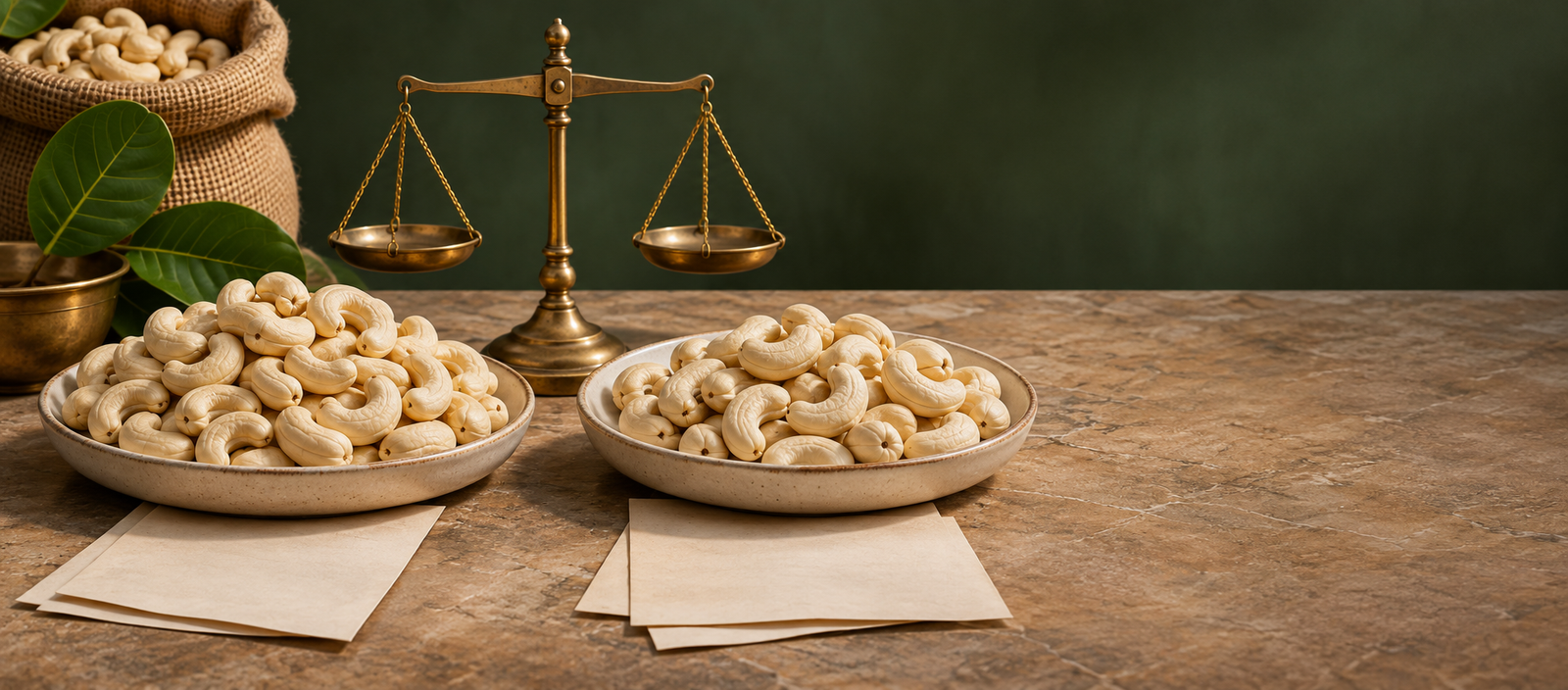
Our advice at NutDana: Choose the W320 quote that costs less for the kaju your business can sell or use. For whole-cashew packs, use the total cost at your Delhi shop. Divide it by the kilos of good, unbroken kaju. A ₹900 per kg quote can cost more than one at ₹930 when the cheaper batch has more broken pieces. If you make kaju katli, good pieces may count as usable kaju. Your answer depends on what you sell.
Which W320 quote actually costs less?
Compare the full cost at your shop, then work out the cost of each usable kilo. A price printed beside “W320” tells you only the starting rate. GST, packing, transport and the amount of whole kaju received can change the result.
Take two example quotes for 10 kg net W320 kaju delivered in Delhi. Seller A charges ₹9,000 in total. Seller B charges ₹9,300. Both amounts already include delivery and all payable charges. The amounts are for the calculation only.
Now suppose the first batch has 500 g broken kaju. You receive 9.5 kg whole. The second has 100 g broken, leaving 9.9 kg whole. Seller A costs ₹9,000 ÷ 9.5 = ₹947.37 per kg of whole kaju. Seller B costs ₹9,300 ÷ 9.9 = ₹939.39.
For a shop selling whole W320 packs, Seller B is cheaper. You pay ₹300 more in total but get 400 g more whole kernels. If every kernel were good and whole, Seller A would win. The amount of breakage changes the answer.
How much broken kaju would change the winner?
For the same two quotes, Seller A can have only about 419 g broken before its whole-kaju cost reaches Seller B. The limit assumes Seller B has 100 g broken and both orders contain 10 kg net kaju. At 400 g broken, Seller A leaves 9.6 kg whole. Its cost becomes ₹937.50 per whole kg, slightly less than Seller B. At 500 g broken, Seller B wins.
Treat any breakage figure shared before delivery as an estimate or an agreed limit. The final cost depends on the weight and condition of the kaju received. A stated breakage percentage cannot replace a delivery check.
Does W320 mean every cashew will arrive whole?
No. W320 is a white whole cashew size grade. A kilo of whole W320 has roughly 660 to 706 kernels. W320 never refers to 320 pieces in 1 kg. Size and breakage need separate checks. The W320 grade guide explains the size code. The grade code cannot tell you the exact whole-kaju weight in a delivery.
Indian cashew-kernel grading guidance separates whole cashews from pieces. Published white-whole trade charts can show different broken-piece limits. The W320 code alone sets no specific limit in your purchase agreement. Write the agreed maximum on the quote.
For 250 g whole-kaju packs or gifts, extra broken pieces reduce the kilos you can pack as whole W320. A sweet shop making paste can use good pieces differently. Tell the seller which use you have in mind before choosing between quotes.
What must appear in the two Delhi quotations?
The quotations should describe the same product and the same delivery job. Otherwise, a price difference may come from what each seller has included. Put the following details on each written quote:
- Grade and form: W320 white whole kaju, with any tukda shown separately.
- Net kaju weight: the kilos of cashews inside the tins or buckets, without packing weight.
- Final bill: kaju price, GST treatment, packing charges, transport and any other amount payable.
- Delivery point: your Delhi PIN code, or the pickup location and expected pickup cost.
- Breakage and batch: agreed broken-piece limit, batch details if available, and the action if goods differ from the quote.
- Time and payment: price expiry, batch availability, payment date and expected delivery date.
The same ₹/kg number has little value when one seller quotes before GST and the other quotes the total payable. A free-delivery claim also needs a destination and minimum order condition. For a mithai shop buying for a weekend order, delivery after production starts can make the cheaper offer unusable.
Does GST change the cost for a Delhi business?
Yes. A business that qualifies for input tax credit under the GST rules may claim eligible GST on business purchases. A shop without that right bears the GST as a cost. Two buyers can therefore have different costs from the same invoice.
First compare the full cash amount due. If your business can claim GST credit, make a second comparison after deducting only the credit you can claim. Use the same method for each seller. Your accountant can check your eligibility and invoice details. Never remove GST from one quote while leaving it in the other without a reason.
How should net weight change the calculation?
Net weight is the cashew weight alone. A 10 kg bucket should contain 10 kg of kaju when the label or sale terms state 10 kg net. The empty bucket, lid and inner bag count as packing, not kaju. The Indian net-quantity rules exclude packaging weight.
Short weight and broken pieces affect the calculation in different ways. Suppose you pay ₹9,000 for 10 kg net, but find only 9.8 kg of kaju. Within that 9.8 kg, another 500 g is broken. Your whole-kaju weight is 9.3 kg, not 9.5 kg. That puts the cost at about ₹967.74 per whole kg before any agreed credit or refund.
Weigh the kaju separately from its bucket. See how to check the net weight of a 10 kg kaju bucket if the quote uses that pack. For several tins, check the quantity across the order. Save the invoice and packing details when the weight differs from the amount sold.
Can a small W320 sample settle the price comparison?
A sample can show the kind of whole kernels and pieces present in the portion checked. It cannot promise the same result across every tin. The useful sample comes from the batch offered for your order, with its grade and batch details linked to the quotation.
For a practical check, separate sound whole kaju and broken kaju on a clean tray. Weigh the groups on a kitchen scale. Suppose a 500 g sample contains 25 g broken. The broken share is 5%. If the full 10 kg order has the same share, around 500 g would be broken. The result is an estimate. Delivery may differ.
Look at more than one pack when an order comes in several containers. Breakage may differ across packs. If the offered batch sells out or a new batch replaces it, the old sample cannot prove the condition of the new supply. Review the replacement batch before paying for it.
Are all broken or damaged cashews usable?
No. Clean broken kaju and spoiled kaju are different. A sound broken kernel may work for kaju katli, sweets or fillings. Mouldy, insect-affected or bad-smelling cashews cannot go into food. Whole shape cannot make a bad kernel acceptable either.
Indian food standards for cashew kernels require clean, safe kernels free from mould, insects and rancidity. A home visual check cannot establish every food-safety measure. If you see mould, insects, wet patches or an unusual smell, stop using the affected goods and raise the issue with the seller.
For a whole-kaju buyer, count the sound, unbroken kernels in the main calculation. Put spoiled goods away from clean tukda. Counting all small pieces as waste can overstate a loss; counting every piece as good can understate it.
Which quote wins if your shop can sell kaju tukda?
The result can reverse when you earn money from sound pieces. Seller A has 500 g of good broken kaju, while Seller B has 100 g. If your shop sells the pieces separately, their value reduces the cost left against whole cashews.
Suppose you recover ₹600 per kg of tukda after packing and selling expenses. The 500 g from Seller A brings ₹300. The 100 g from Seller B brings ₹60. After that recovery, Seller A has ₹8,700 left against 9.5 kg whole, or ₹915.79 per whole kg. Seller B leaves ₹9,240 against 9.9 kg whole, or about ₹933.33. Now Seller A wins.
₹600 is an example value, not an offered tukda price. Use actual money you expect to earn, after selling costs. If your shop has no buyer for the pieces, their resale value may be zero. Only count tukda sales your shop can reasonably make.
For kaju katli, the answer is different again. If your recipe can use sound whole and broken kernels alike, compare the cost per kilo of all suitable kaju. Buying W320 wholes may make little financial sense when the recipe needs pieces. If you buy only to grind the nuts, a quote for good kaju pieces may be worth comparing too.
What if the delivered batch differs from the sample or quote?
Written terms help settle a delivery problem. Approving a sample alone does not promise the seller will reserve that batch. The quotation should name the grade, net weight, allowed breakage and what the seller will do if delivery differs.
When your Delhi delivery arrives, photograph the closed packs and labels before opening. Check the batch marking, net kaju weight and condition. If several buckets have different results, note the weight and issue for each one. Contact the seller with the invoice, photographs and measured difference before mixing the kaju with other goods.
A refund, replacement or price adjustment depends on the order terms and the problem found. Get any promised remedy in writing before paying.
What would NutDana recommend before you choose?
Choose on the cost of kaju your business can actually use. If you sell whole W320 packs, a lower delivered cost per kilo of good whole cashews wins. If you sell tukda as well, count its money value after selling costs. If you make sweets, measure how much good kaju your recipe can use.
When requesting a NutDana quote, share the quantity in kg, your Delhi delivery PIN code and the purpose of the order. State the grade, expected whole-kaju share and packing needed. Request a written total covering tax, packing, delivery, batch availability and the agreed response to short weight or excess breakage. The team can share the current price and available terms for your enquiry.
Visit our Delhi cashew wholesale page to request a W320 quote with your order details.