For a Delhi dry fruit shop, start by comparing W320 for regular whole-kaju packs. W240 may earn more when buyers pay extra for larger kernels. W450 may work better for shoppers with a lower budget. No grade has a fixed profit margin. Compare the buying cost, retail price, usable whole kaju and packs sold. The winning grade earns enough on each sale and sells at a price customers accept.
Which kaju grade suits my retail customers?
Match the whole-kaju grade to the packs customers already buy. Our starting advice changes with the type of sale:
- W320: Compare first for regular 250 g and 500 g whole-kaju packs.
- W240: Price separately for larger-kernel gift packs and premium counters.
- W450: Check for smaller whole-kaju packs with a lower selling price.
- W180: Buy for confirmed large-kernel orders, such as premium gifts.
Price the packs your own shoppers request. Add a second whole-kaju grade after paid sales show a reason for it. Avoid buying every grade before checking those prices.
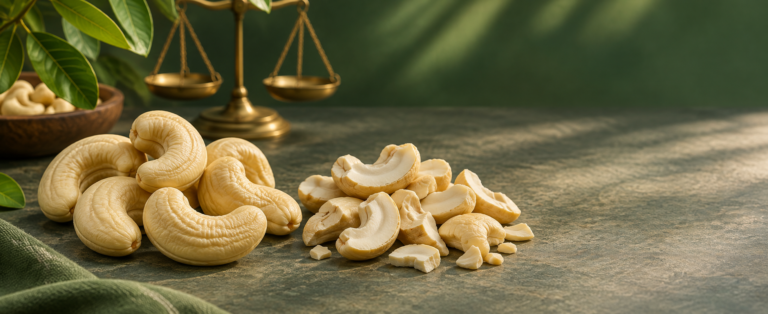
Kaju tukda serves a separate buyer need. Sell sound pieces under an accurate pieces label, never as whole W320. A lower price for broken kaju alone cannot prove a larger profit.
Does a higher kaju grade number show lower quality?
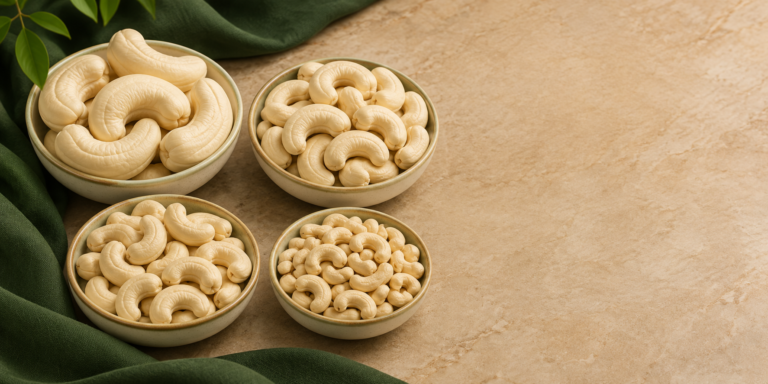
No. Grade numbers identify whole-kernel size, never freshness or food safety. W240 kernels are larger than W320. W450 kernels are smaller. The AFI cashew grading table gives whole-kernel counts per pound. Approximate upper counts per kilogram are:
- W240: 530 kernels.
- W320: 706 kernels.
- W450: 990 kernels.
The limits describe size groups. Actual counts vary across batches. A larger kernel may earn a higher retail price where buyers value its size. A smaller kernel can still meet the same food safety requirements.
Some Indian wholesale quotes use W400. The AFI table shows W320 and W450, with no W400 entry. Ask the seller for a sample and actual kernel count before comparing a W400 offer.
How much profit does each kaju grade earn in a 250 g pack?
Calculate the full cost of each pack before selecting the grade. Include the kaju, transport, pouch, label and any loss during sorting. Gross profit is money left after pack costs, before rent and wages.
Gross profit per pack = retail selling price − total pack cost.
Gross margin = gross profit ÷ retail selling price × 100.
Here is a sample calculation for 250 g whole-kaju packs. Assume delivery costs ₹10 per kg. Each pouch and label costs ₹8. Assume zero broken pieces in the sample packs. Compare all amounts on the same tax basis.
- W240: Buy at ₹950/kg; sell 250 g at ₹320. Pack cost ₹248, gross profit ₹72, margin 22.5%.
- W320: Buy at ₹850/kg; sell 250 g at ₹280. Pack cost ₹223, gross profit ₹57, margin 20.4%.
- W450: Buy at ₹770/kg; sell 250 g at ₹250. Pack cost ₹203, gross profit ₹47, margin 18.8%.
All prices above are sample figures, never current NutDana rates or confirmed Delhi retail prices.
For W320, 250 g of kaju costs ₹212.50. Delivery adds ₹2.50. Packing adds ₹8. The total reaches ₹223. Selling at ₹280 leaves ₹57 before rent, staff costs and other shop bills.
A markup and a margin use different totals. ₹57 ÷ ₹223 = 25.6% markup. ₹57 ÷ ₹280 = 20.4% margin. Compare margins across grades using the selling price as the base.
When does W240 earn more profit than W320?
W240 must earn a higher retail price than its extra buying cost. In the sample, W240 costs ₹100 more per kg. Each 250 g pack therefore costs ₹25 extra in kaju.
A W240 pack priced at ₹320 earns ₹40 more in sales than W320 at ₹280. After the ₹25 extra kaju cost, W240 earns ₹15 more per pack. If W240 sells for ₹300, its price advantage falls to ₹20. W320 then earns ₹5 more per pack.
Those results assume matching delivery, pouch and sorting costs. For a Delhi gifting shop, ask buyers to choose between two properly priced pack samples. Count paid purchases. Compliments alone cannot cover the extra cost.
Can W450 earn a higher margin than W320?
Yes, when its lower buying price outweighs its lower selling price. The sample W450 pack earns 18.8% margin at a ₹770 buying price. At ₹750 per kg, its 250 g pack costs ₹198, including the same delivery and pouch charges.
Selling that pack for ₹250 leaves ₹52, or 20.8% gross margin. W320 earns 20.4% in the sample. W450 now wins on percentage, while W320 still earns ₹5 more for each pack sold.
A smaller whole-kaju grade can suit a price-led counter. Check customer sales before buying a larger quantity. More margin on paper cannot replace money from paid packs.
How do broken pieces reduce profit from whole kaju?
Pay attention to the weight you can actually pack as whole kaju. Suppose a W320 order contains 10 kg at ₹850 per kg. After sorting, you have 9.5 kg suitable for your promised whole packs.
Your ₹8,500 purchase then costs about ₹895 per kg of usable whole kaju, before delivery and packing. The remaining 500 g may have value as sound pieces. Count any money from those pieces separately after sale. If the pieces earn money, the overall batch earns more than whole-pack sales alone.
Trade specifications allow some broken kernels within a whole-kaju lot. Check when broken W320 still counts as whole. A kernel with a very small chip can also count as whole. Agree on the permitted broken share before ordering. Your retail promise may require stricter sorting.
Separate all kaju with mould, insects or a stale, bitter smell. The FSSAI standard for cashew kernels sets food quality requirements. Unsafe pieces have zero resale value.
What if W240 earns more per pack but W320 sells more?
Total weekly gross profit depends on paid sales, as well as profit per pack. Under our sample costs, six W240 packs earn ₹432. Fifteen W320 packs earn ₹855. W320 earns more money across that week despite its smaller profit on each pack.
The sales counts are sample figures. Check your own receipts across the same number of days. Compare the number of packs sold, total gross profit and kilograms left unsold.
An order of 10 kg can make 40 packs of 250 g with zero sorting loss. At six W240 sales per week, those packs need nearly seven weeks to sell. At fifteen W320 sales per week, they need under three weeks. Compare your own sales with the minimum quantity your seller accepts. Slow stock locks up money for longer.
Should a retailer sell loose kaju, 250 g packs or 500 g packs?
Compare the selling amount per kg after weighing and packing costs. Suppose each pouch and label costs ₹8. Packing 1 kg into four 250 g pouches costs ₹32. Two 500 g pouches cost ₹16.
At ₹280 for 250 g, four packs bring ₹1,120 in sales. At ₹530 for 500 g, two packs bring ₹1,060. The smaller packs bring ₹60 more revenue, but spend ₹16 extra on pouches. They therefore earn ₹44 more per kg before other shop costs, if every pack sells.
Loose kaju avoids pouch costs but still needs weighing and handling. Check how much customers actually buy in one visit. Retail packs need the required label details. Review current FSSAI food labelling rules and applicable packaged-goods requirements before printing retail labels.
Is a Khari Baoli pickup cheaper than Delhi delivery?
A cheaper wholesale rate can become costlier after a pickup trip. Add travel, loading and local transport to the kg price.
Suppose collecting 10 kg from Khari Baoli costs ₹200. The trip adds ₹20 per kg. It adds ₹5 to every 250 g pack. A pickup quote ₹10 below delivery still costs ₹10 extra per kg after the trip.
Compare the same grade, net weight and agreed quality. Ask for the full amount reaching your shop, including any delivery charge and GST treatment. Compare GST in the same way for every quote. Ask your accountant which GST costs you can recover.
What should a retailer confirm before paying for wholesale kaju?
Ask for a written quote covering the product and the cost reaching your shop:
- Exact grade: Whole W240, W320, W450 or a written kernel count for W400.
- Batch sample: Ask if a sample from the offered batch is available.
- Whole and broken share: Agree on the acceptable amount and what happens if the delivery differs.
- Net weight and quote: Confirm kaju weight without the container, price per kg, GST treatment and final delivery cost.
- Order size and delivery: Confirm the minimum for each grade, expected date and invoice details.
Compare two quotes with the same conditions. Ask your seller how they will address an underweight or wrong-grade delivery. Retain the quote and batch details for comparison when goods arrive.
What should a Delhi shop confirm before ordering?
Send us your shop area, preferred grade, retail pack size and planned buying quantity. Add the selling price you expect for 250 g or 500 g. Ask for the current whole-kaju grade quote, delivery charges and sample availability.
Start with NutDana wholesale cashews in Delhi. Compare the full pack cost against your actual selling price before buying a larger lot.