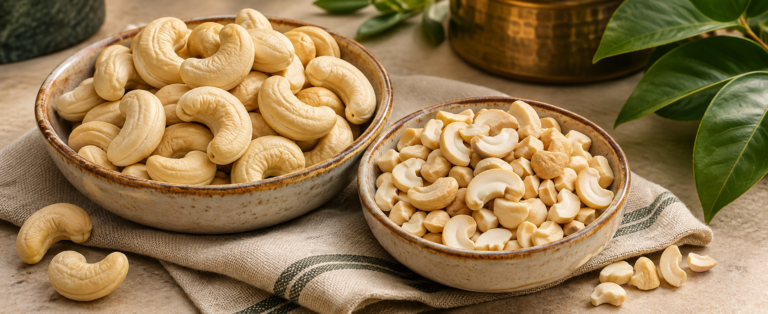
White W320 kaju can cost more because buyers want whole cashews with an even, light colour. Scorched 320 cashews can match that size, but extra heat during processing leaves them darker. The better purchase depends on what your customer will see and eat.
Our advice at NutDana: Pay for white W320 when its colour earns its place in your product. Consider scorched whole kaju when your recipe accepts its colour and taste. Compare samples from the offered batches before choosing the lower quote.
Are white W320 and scorched W320 the same size?
Yes, they can be the same size. The difference is the colour grade. For the size code, see our W320 cashew guide. White W320 refers to light-coloured whole kaju. Scorched whole 320 has a darker shade from excess heat during processing.
The AFI trade specification lists roughly 660 to 706 whole W320 cashews per kg. Scorched whole 320 can follow the same size band. Cashew grading separates size, colour and whole or broken form. The Bureau of Indian Standards cashew manual treats white and scorched as different colour grades.
A seller may write W320, WW320 or SW320 in a quotation. SW320 refers to scorched whole 320 in commonly used trade charts. Ask for the full grade name when the quote only reads 320 kaju. Without a full grade name, 2 quotes can describe different goods.
Watch another similar code. SWP refers to small white pieces, while SW320 refers to whole scorched cashews. Heavily darkened or spotted wholes may belong to a different class called scorched whole seconds. Ask for the full class name before accepting a cheaper quote.
Why does white W320 attract a higher quote?
White W320 has a brighter, more even look. Customers notice an uneven look when they can see every whole cashew. Shops selling loose kaju, transparent pouches and gift packs may prefer white kernels. A seller can therefore ask a higher price for a lot that meets that buying need.
Scorched whole kaju becomes darker during roasting or drying in cashew processing. Its colour may range from ivory to light brown. A scorched lot can still contain whole kernels of the expected size. The shade alone cannot tell you how the kaju will taste in your product.
There is no fixed Delhi price difference between white W320 and scorched 320. Actual quotes can vary with the batch, quantity, broken-kernel content and total order charges. Compare the same net weight and packing terms. Ask the supplier to state the colour grade for each quoted price.
When is paying extra for white W320 worth it?
Pay the extra amount when pale, even-looking kernels are part of what you sell. A dry fruit shop promising light, even-looking kaju needs a close match from pack to pack. White W320 is also a good starting choice for gift boxes where every whole kernel remains visible.
For a Delhi retailer filling 250 g pouches, place the white and scorched samples in the same pouch type. Look through the front of each pack. A few darker kernels may stand out more in a small pouch than in a large container. Compare the actual look before ordering several kg.
White W320 can also be worth the cost for visible sweet toppings. A whole kaju on a light-coloured barfi or mithai tray draws attention. If your current sweet uses white whole nuts, an abrupt colour change may alter the finished look. Approve a sample beside your regular product before changing grades.
When should a buyer consider scorched whole 320?
Consider scorched 320 when its darker shade works in the final food. A spiced cashew snack, a coated nut or a dish with a dark gravy may hide part of the colour difference. Taste still counts. Extra processing heat can alter flavour, and the grade name alone cannot confirm the result.
For a seasoned snack, compare both samples after adding the same spice mix. Check the finished colour, smell and taste. For a gravy, compare two small portions after cooking. A lot that works in a dark dish may look wrong in a light cashew sauce.
Is scorched W320 suitable for kaju katli?
It depends on the finished katli. A light kaju katli can show darker cashew powder. Grind equal samples of white W320 and scorched 320. Make both sweets with the same recipe, then compare their colour and taste after cooling.
If the scorched sample changes the colour beyond what you sell, choose a lighter grade. If both versions meet your standard, compare the total cost. A Delhi mithai shop can run this small test before buying bulk kaju.
Should a sweet shop buy whole W320 for grinding?
Whole W320 deserves another price check when every kernel will become powder. Ask for a quote on suitable white kaju pieces as well. You may save money while preserving the pale look your sweet needs. Compare the samples after grinding before changing your regular purchase.
Buy whole kernels when you need the whole form, its size or its appearance. For powder, judge the result in the finished sweet. Broken pieces still require the same checks for freshness, damage and food safety.
How should you compare the white and scorched samples?
Ask for samples from the actual batches offered in the quotes. A sample from an older lot cannot confirm the colour of the next delivery. Write the grade and batch number on each sample pack before checking them.
Use the same method for both samples:
- Check the colour. Spread equal amounts on a clean white plate under normal daylight. Compare how many kernels fall outside your accepted shade.
- Check whole pieces. Separate broken kernels. A lower price loses value when your product needs complete whole kaju.
- Check smell before tasting. Reject stale smells, visible mould or insects. Compare flavour only after completing your food safety checks.
- Check the finished food. Make equal portions using your normal recipe. Compare colour and flavour after the food cools.
Agree on the acceptable shade and broken-piece limit before payment. Ask for the sample batch on the invoice or order confirmation. If that lot sells out, request another sample from the replacement batch.
Photos help with a first comparison, but light and phone screens can change the shade. A physical sample is a stronger basis for approving colour. For a large order, check the delivered lot against the approved sample before using it.
Can cheaper scorched W320 cost more in your recipe?
Yes. The cheaper quote can lose its advantage when part of the delivery falls outside the colour your product needs. Compare the cost for the amount you can actually use in that product.
Suppose you compare a 10 kg order at example prices. White W320 costs ₹900 per kg, or ₹9,000 for 10 kg. Scorched whole 320 costs ₹840 per kg, or ₹8,400 for 10 kg. The first saving appears to be ₹600.
Imagine that your light kaju sweet accepts only 9 kg of the scorched lot. The other 1 kg is too dark for that sweet. Dividing ₹8,400 across 9 suitable kg makes the effective cost about ₹933 per kg. White W320 remains ₹900 per suitable kg when all 10 kg meet your requirement.
For that sweet, white W320 costs less per suitable kg. A darker snack that accepts the entire scorched lot reaches a different result. If the rejected 1 kg can be sold or used elsewhere, subtract its value before deciding.
Add delivery, pickup and packing charges when comparing Delhi quotes. Check if GST appears separately on each invoice. A price per kg is only one part of the amount your business pays.
Does scorched colour mean the kaju is spoiled?
Scorched is a recognised colour grade. Spoilage and contamination are separate faults. White and scorched cashews both need sound kernels, safe handling and acceptable moisture.
Indian food safety rules for cashew kernels require kernels free from rancidity, foreign smells or tastes, mould and insects. The same standard sets a maximum moisture level of 5%. A white colour alone cannot prove those conditions. A scorched label cannot excuse a bitter burnt flavour, mould or insect damage.
Reject a lot showing mould or live insects. Ask for supporting test details when moisture or another quality value is part of your purchase terms. Looking at a nut or biting it cannot establish an exact moisture percentage.
A second concern is dark spotting. A mildly scorched whole lot and a lot sold as scorched whole seconds can look different. Ask which class the seller has quoted. Compare the offered sample with the exact class written on the quote.
What belongs on the W320 quote?
Tell us what you plan to sell before comparing prices. A transparent dry fruit pack, a whole-nut topping and kaju katli have different colour needs. We can discuss the grade you want, while the actual quote and sample must identify the offered lot.
For a Delhi bulk kaju enquiry, ask for these details in writing:
- Full grade name: white whole W320 or scorched whole 320.
- Batch-linked sample, agreed colour range and permitted broken pieces.
- Net weight in kg, price per kg, GST included or charged separately, and any packing charge.
- Pickup or delivery cost, payment terms and proposed dispatch date.
Choose white W320 for visible light-coloured whole kaju. Compare scorched 320 for food where a darker kernel meets your accepted result. Check white kaju pieces too when your recipe uses powder.
Share your product use and required quantity when asking about bulk cashew wholesale in Delhi. Request the full grade description, current batch details and a written total before confirming your purchase.