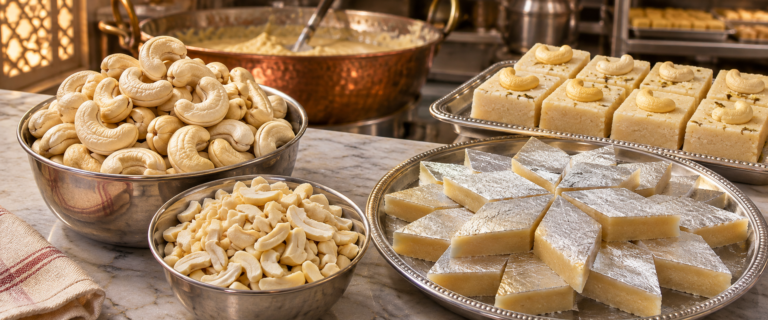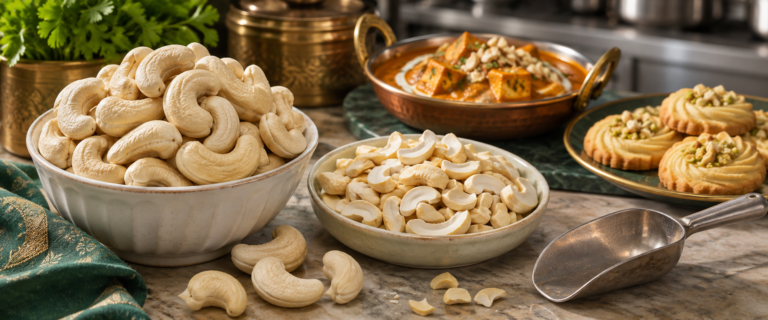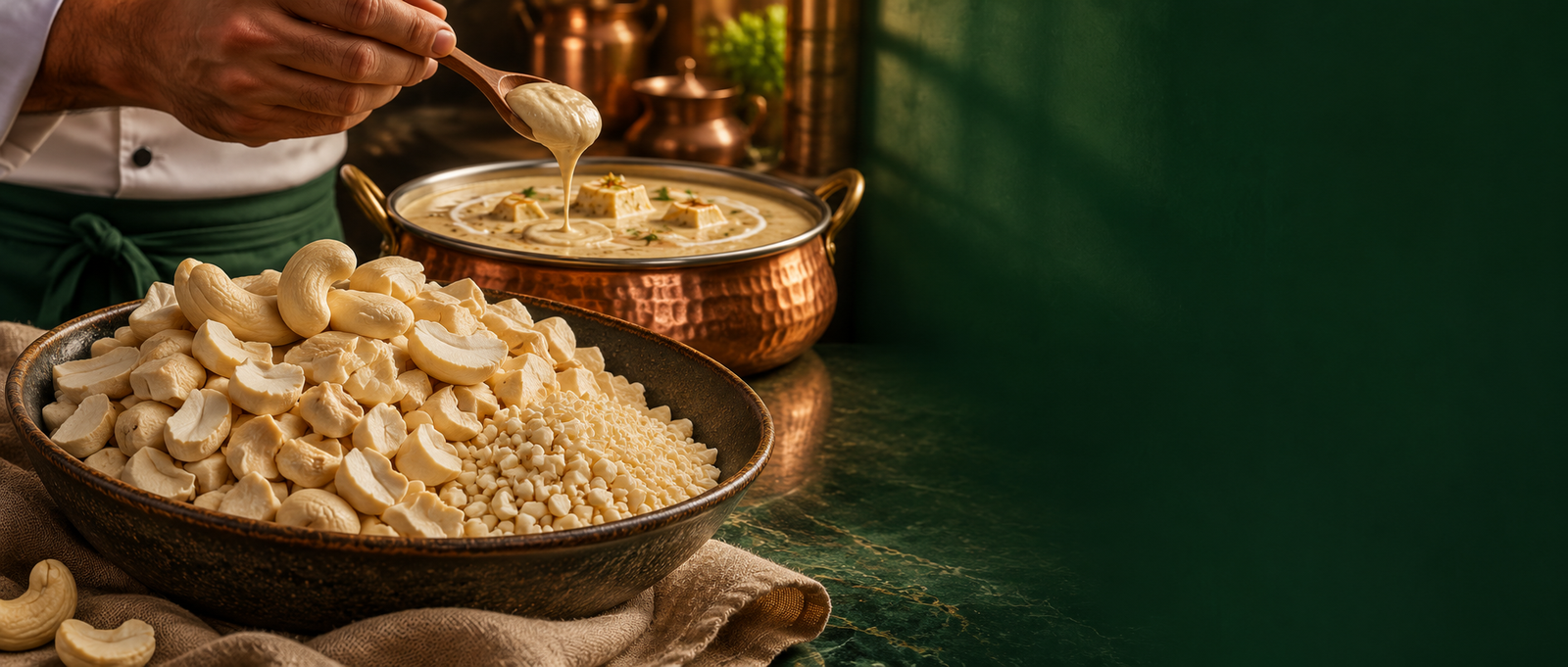
The useful comparison is the gravy your kitchen serves, not the appearance of a handful of dry cashews. Begin with the dish, test the offered batches, and put the accepted result beside the full quote. That keeps a larger grade from becoming an unnecessary cost in a paste.
Which cashew grade suits each dish?
Choose by what the cashew does in the dish. A larger piece brings no visible benefit after grinding. Colour, freshness and the cooked result still matter. Our cashew grades guide explains the common names; the Indian cashew grading chart separates whole, split and piece grades by size and appearance.
- Pale gravy such as shahi paneer or malai kofta: Start with white SWP for the paste. Test a white BB sample if you want to compare a smaller piece.
- Tomato or browned-onion gravy: Start with SWP. A scorched piece grade may also work if a cooked sample has the colour and taste you need.
- Fine cashew paste: Compare SWP with BB using the same grinder, soaking method and cooking time.
- Biryani or pulao topping: Look at larger pieces or clean halves that remain visible after service.
- Kaju curry with whole kernels: Use a whole grade such as W320 or W240 if the whole shape is part of the dish.
This is a starting guide, not a promise that every batch of one grade cooks alike. If you want a quick answer to the grade question, see our Ask the Expert answer on cashews for gravy. The steps below help a kitchen choose and order its actual batch.
Can broken cashews make a smooth gravy?
Yes, clean broken cashews can make a smooth paste. The grinder removes the visible difference between a whole kernel and a piece, but the recipe and equipment still decide the final texture. An uneven grind, too little liquid or too little cooking time can leave a paste gritty. Do not assume a whole W320 kernel will fix those problems.
For a fair test, weigh the same amount of dry cashew for each sample. Soak or cook both in the same way, add the same water, and grind for the same time. Taste the gravy after it has simmered, not only the raw paste. If both pass, compare their delivered cost. Broken cashews can be suitable quality when their condition and grade meet your recipe.
SWP or BB for cashew paste?
SWP means Small White Pieces; BB means Baby Bits. Under the published grade sizes, SWP is retained by a 2.80 mm sieve, while BB passes that sieve and is retained by a 1.70 mm sieve. Those size rules help describe the pieces. They do not tell you how fresh a particular lot is or how much fine powder you will receive.
Try SWP first when the gravy must stay pale. Compare BB if all the cashew will be ground and the offered BB batch looks clean. Check the bottom of the sample bag: a heavy layer of fine powder can behave differently in your process and may hide unwanted fragments. Ask the seller to state the grade and any powder allowance on the quote. The loose name kaju kani does not settle whether the goods are SWP, BB or another size.
Do not choose BB or SWP by a fixed rule about how many days an opened bucket lasts. Buy a quantity your kitchen can store and use well. Seal the pack after each use and check the actual lot for stale smell or other faults.
How do you make a smooth paste from cashew pieces?
Use the method already tested in your kitchen. Some white-gravy recipes cook cashews with onion before grinding; others soak the cashews first. Either way, give the pieces enough liquid to move through the grinder, then add more water a little at a time. Too much water at once can thin the sauce and increase cooking time.
Grind until the paste meets your dish’s texture standard. If the sauce still feels gritty, check the grinder and pass a small test portion through a suitable strainer. Compare SWP and BB only after giving both the same preparation. Record the dry kaju weight and water used so another cook can repeat the result.
Should a white gravy use scorched cashew pieces?
Usually start with white pieces for a white gravy. Scorched grades have a darker colour range than white grades; the AFI cashew specifications describe those appearance classes. A scorched batch may make a pale sauce look darker. It may suit a tomato or browned-onion gravy if your test dish tastes and looks right.
Cook two small pots with equal recipes, changing only the cashew sample. Check them in the light where you plate the dish. Taste for an unwanted burnt or stale note. Scorched colour is a grade description; mould, insects, foreign matter and a rancid smell are separate reasons to reject a lot. A dark gravy cannot make spoiled cashews acceptable. For the difference between colour classes, see white versus scorched W320.
When are larger pieces worth buying?
LWP means Large White Pieces. It may make sense when you need the same grade for both a paste and a visible garnish, but check whether its piece shape actually suits the garnish. If everything is ground, compare LWP with SWP on the cooked result and cost before paying for a larger size.
For a visible topping, ask to see the halves or large pieces from the batch offered. A seller’s “two piece” or “four piece” name may not identify a standard grade. Two-piece cashew and splits are not always the same thing, and four-piece kaju does not always mean LWP. Put the agreed grade or piece description on the order.
How should a chef test the offered batch?
Request a sample from the lot offered for the order. A sample from another batch cannot prove what will arrive. Keep its grade, pack or batch reference and the seller’s quote together; our same-batch sample guide explains what to record.
- Inspect the dry pieces. Open the sample, smell it and spread pieces from the top and bottom on a clean plate. Reject visible mould, insects, foreign matter or a stale oily smell.
- Measure equal amounts. Use the same dry cashew weight, other ingredients, liquid, soak time, grinder and heat for both tests.
- Cook the complete dish. Check colour, smoothness and flavour after simmering. A pale sauce may expose a shade difference that a dark sauce hides.
- Test at service. Hold and serve each sample as your kitchen normally does. Note any separation, grittiness or colour change that affects the served dish.
- Write down the result. Record the recipe, batch references, dry kaju used, acceptable yield and any extra sorting or grinding work.
If both grades pass, choose by the cost of the usable cashew and the work each requires. If neither passes, change the batch or method before placing a large order.
What does cashew cost per pot of gravy?
Use your recipe’s dry cashew weight, not a general “per plate” figure. For example, if one pot needs 500 g of cashew and a quote is ₹800 per kg delivered, the cashew in that pot costs ₹400. These numbers are an illustration, not a NutDana price or a recommended recipe. Tax and delivery should be included once in the amount you compare.
If you sort out unusable material, calculate cost using the weight your kitchen accepts. A ₹780 delivered kilo with 950 g accepted for your recipe costs about ₹821 per usable kilo; an ₹800 kilo with 990 g accepted costs about ₹808. The second quote is better in this example. Unsafe material must be rejected, never treated as a normal sorting allowance.
Keep the cooking result beside this calculation. A cheaper cashew that needs extra labour or changes the sauce may cost more per accepted pot.
How much cashew should a caterer order?
Add the litres of each cashew-based gravy, then multiply by the dry cashew weight in your own recipe. If a kitchen plans 60 litres at 125 g per litre, it needs 7.5 kg of dry cashew for that gravy. Add other cashew dishes separately. The 125 g figure is only an example; use the amount your chef has tested.
Check suitable stock already on hand before ordering. Allow for your usual preparation loss and any approved reserve, then ask what net weight and pack sizes are available. A “10 kg bucket” should be checked for net cashew weight; the bucket itself is not edible weight. Do not buy a second grade only to meet a presumed minimum. Ask the seller for the current minimum for each grade.
What should the order and delivery check include?
Ask for a written quote that identifies what you tested. A useful quote states the grade and colour, available batch reference, net kilos, pack type, price, tax, delivery charge, delivery place and expected date. If the kitchen needs a sample from the same lot, settle that before approval. The cashew pieces guide can help you compare the named sizes.
At delivery, inspect the seal, label, grade, net weight and batch details before opening everything. If a pack does not match, photograph its label and contents and contact the seller before mixing it with other stock. Store accepted cashews sealed, cool and dry, away from steam and strong smells. Move only the amount needed for the day’s work into a clean, closed container. Tell serving staff which dishes contain cashew so guests can ask about allergens.
How should an opened pack be stored?
Close the main pack promptly after taking out cashews. Keep it off a damp floor and away from the tandoor, dishwashing steam and direct sun. Use a smaller, clean, airtight container for daily work instead of leaving the bulk pack open beside the stove. Mark when the pack was opened so older stock is used first.
If you keep a sealed pack in a cold room, avoid opening it while the pack is still very cold in a warm, humid kitchen; moisture can collect on the cashews. Follow your kitchen’s food-storage procedure and check each opened pack before use. A stale oily smell, insects or mould means the lot needs review, regardless of its grade.
For a Delhi restaurant or catering order, send NutDana your dish, tested grade, dry cashew needed, delivery PIN and required date. Ask for current batch availability and a complete quote through our restaurant cashew enquiry.