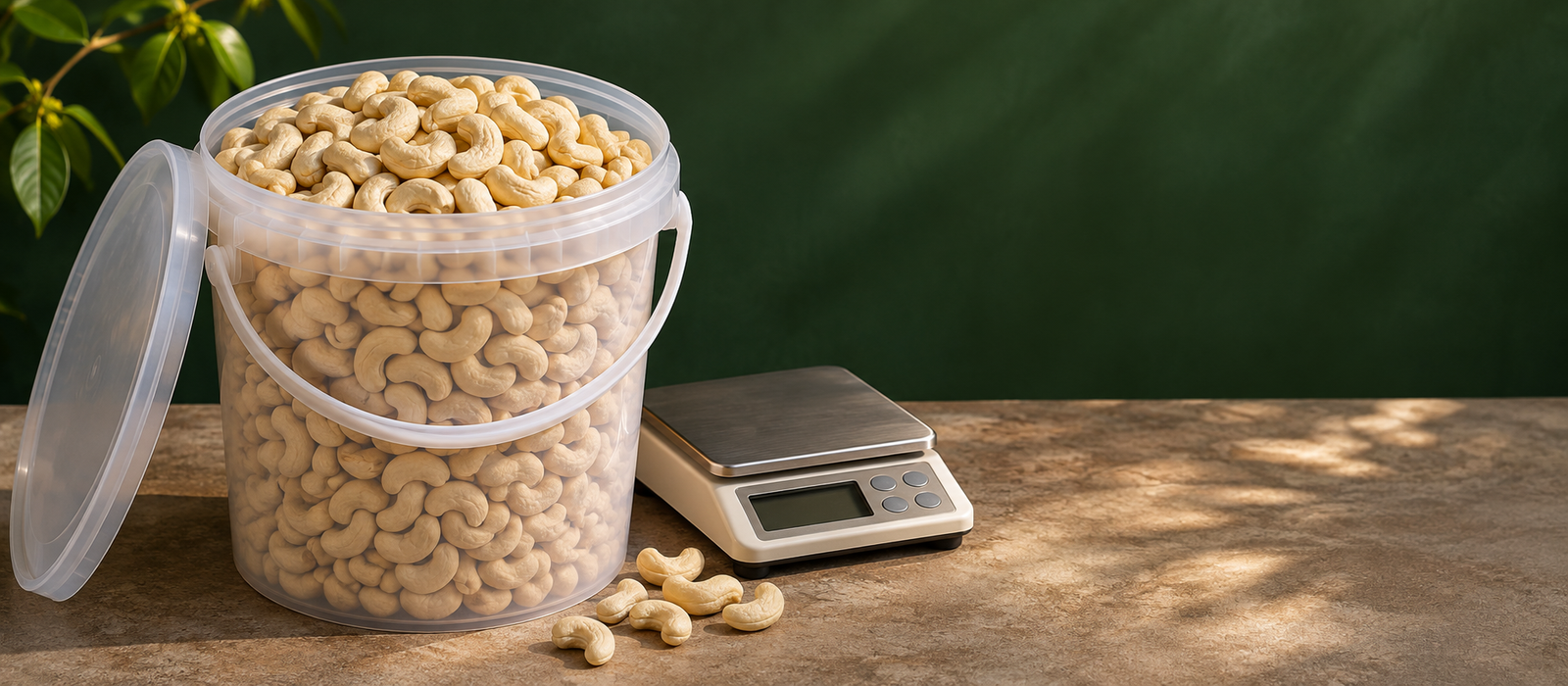
No. When a kaju bucket states “Net Weight: 10 kg”, you should receive 10 kg of kaju alone. The plastic bucket, lid, handle, seal and inner bag have their own weight. A sealed bucket holding 10 kg net kaju will weigh more than 10 kg in total.
However, “10 kg bucket” can also be the name of an empty plastic container. It does not prove how much kaju a seller has packed inside. At NutDana, our advice is to compare the written net kaju weight, not the size of the bucket.
Does every 10 kg kaju bucket contain 10 kg of cashews?
No. Read the words printed beside the number. Three terms can change the answer:
- Net Weight: 10 kg: The pack claims 10 kg of kaju, excluding plastic and inner packing.
- Gross Weight: 10 kg: Kaju and packing together weigh 10 kg. The kaju alone weighs less.
- 10 kg capacity names the size of the container. It does not tell you the actual kaju weight.
A “10 kg” mark moulded into plastic may describe the empty bucket. The food label can show a different quantity for the cashews inside. If you see only “10 kg bucket” on a photo or quotation, the net quantity remains unknown.
The height of the kaju inside is also a poor weight check. A partly filled bucket can look large. You need a stated net quantity and a weight reading, not a guess from the fill level.
What should NutDana write on my Delhi wholesale kaju quote?
Your quote should name the kaju grade, net kg per bucket and total net kg. Those numbers tell you what your business is paying to receive. A W320 quote comparison shows how weight changes the effective cost.
For a 2-bucket W320 order, useful wording would be: “W320 whole kaju, 2 buckets, 10 kg net kaju per bucket, 20 kg net total.” That line is an example of a precise request, not a claim about a particular NutDana shipment.
If you order W320 and kaju tukda together, each grade should have its own quantity. Two grades written under one total weight make it harder to check how many kilos of each arrived.
The price per kg also needs a stated basis. A rate for 10 kg net kaju refers to the cashews. A rate for one filled bucket weighing 10 kg gross refers to a smaller amount of kaju. The same price can produce a different cost per usable kg.
Packing charges are separate from weight. A seller may include the bucket in the quoted price or charge for it separately. Either way, the billed kaju quantity should remain specific. If a message only reads “W320, 10 kg bucket”, a useful reply is “Is the 10 kg for kaju alone, without the bucket and inner bag?”
How much does a bucket with 10 kg net kaju weigh?
More than 10 kg, because the packing adds weight. The weight of the full bucket is called gross weight. The empty bucket and its packing have a tare weight.
Suppose the sealed bucket weighs 10.7 kg. Once empty, the bucket, lid, handle, seal and inner bag weigh 0.7 kg together. The kaju weighs 10 kg after subtracting the empty packing. These are example weights, not a NutDana bucket specification.
Now suppose another sealed bucket weighs 10 kg in total. Its empty packing weighs 0.6 kg. That leaves 9.4 kg of kaju, which is 600 g short if the order promised 10 kg net.
Never assume every blue plastic bucket has the same empty weight. The lid, handle, plastic thickness and inner bag can differ. A bucket weight copied from another supplier may produce a wrong answer. Use the actual empty packing weight whenever possible.
Can I check a sealed kaju bucket without opening it?
You can weigh the sealed pack, but gross weight alone cannot prove net kaju weight. An accurate check also needs the weight of the empty packing. If that figure is unknown, the stronger method is to weigh the kaju after opening.
At your Delhi shop or godown, photograph the label and seal first. Include the batch code if one appears on the pack. Place a suitable scale on a flat surface. It must support the full bucket. Check that the display reads zero before weighing.
If a courier has wrapped the bucket in a carton, remove the outer shipping material before checking the bucket weight. A parcel scale counts the carton, tape and any extra packing too. None of those items belongs in the kaju net weight.
If you cannot open the pack during delivery, note its sealed gross weight. Compare the written net quantity with the agreed packing details. Save the photos until you can check the kaju itself. A sealed weight of 10.5 kg, for example, is not proof of 10 kg net without a reliable tare figure.
What is the right way to weigh kaju after opening?
Use a clean, dry food-safe container and a suitable weighing scale. Place the empty container on the scale and press zero or tare. Then add the kaju. The reading should show the cashew weight alone.
If your scale cannot hold 10 kg at once, weigh smaller portions. Add every reading to get the total. Include pieces left at the bottom of the bucket or inside the bag. Spilled pieces and kaju remaining in the liner can affect the result.
You can also weigh the emptied bucket. Include its lid, handle, seal and inner bag. Subtract that weight from the gross reading taken before opening. Both methods should lead to a similar result when the scale is working properly.
For a pickup from a Delhi wholesaler, request a weight check before the bucket is sealed. The seller can weigh the kaju on its own or use the scale after accounting for the empty bucket. Watching the whole process is more useful than seeing a filled bucket placed on a scale once.
Can bucket weight change the actual kaju cost per kg?
Yes. Your actual kaju cost depends on the cashew weight, not the packed bucket weight. A mithai shop can use cashews in its recipe, but the bucket is packaging.
Consider a seller billing for 10 kg of kaju when the gross bucket weighs 10 kg. If its empty packing weighs 0.6 kg, the buyer receives only 9.4 kg of kaju. Another offer with 10 kg net contains 600 g more cashews at the same total charge.
If the buyer pays the same amount intended for 10 kg but receives 9.4 kg, the effective cost per kg becomes about 6.4% higher. That calculation uses example weights, not current NutDana prices. It shows why a lower-looking bucket quote may cost more for each kg of kaju received.
A separate bucket charge does not change the net weight. It changes the total bill. Compare the total amount payable against the actual kg of kaju, with the packing amount shown separately if one applies.
What if several 10 kg kaju buckets arrive together?
Check the net weight per bucket, not only the total delivery weight. If 3 buckets were quoted at 10 kg net each, your order calls for 30 kg net kaju. Their combined gross weight should be higher because each bucket adds packing weight. If you approved a particular batch, match each bucket to that batch too.
Different grades need their own checks. If the order contains W320 whole cashews and kaju tukda, compare the label and net quantity for each grade. A combined weight cannot tell you the split between them.
Use the empty packing weight that belongs to each bucket. Do not subtract the tare from one type of bucket across every pack. If one bucket has a different lid or liner, its empty weight may be different.
What should I do if my 10 kg kaju bucket is underweight?
Recheck the scale first. The display must start at zero, and the tray weight must be removed. Make sure all kaju from the bucket was weighed. For the gross-minus-tare method, include the lid, handle, seal and inner bag in the empty packing weight.
If the difference remains, compare the measured net kaju weight with your quote and invoice. Photograph the label, seal, scale reading and empty packing. Save any packaging that was torn or damaged during transit. A broken seal or spilled kaju should be reported separately from a weight difference inside an intact pack.
For a NutDana order, send us the order details, grade, stated net weight, measured weight and photographs. Mention which bucket has the issue if several arrived. Contact us before mixing those cashews with another batch or using them in your kitchen.
NutDana advice: For wholesale kaju in Delhi, state your order as “10 kg net kaju per bucket, excluding plastic and packing.” Add the grade and number of buckets. You will have a specific weight to compare with the delivery, without counting the bucket as kaju.