

IS 7750 is the Bureau of Indian Standards (BIS) standard for cashew kernels, with grade tables that count whole kernels per 500 g. A kernel is the nut inside the shell. The current edition, IS 7750:2013, sets 28 kernel grades and the tests a lot must pass. A cashew factory follows IS 7750 to print the ISI mark on its packs.
Facts on the IS 7750 cashew kernel standard
The table lists the main details of the current edition.
| Fact | Value |
|---|---|
| Full name | Cashew Kernels: Specification (First Revision) |
| Publisher | Bureau of Indian Standards (BIS), New Delhi |
| Committee | FAD 10, fruit and vegetable products |
| Current edition | IS 7750:2013 |
| Amendments | None up to 18 November 2026 |
| Short name on BIS records | Kaju |
From the 1975 edition to the 2013 revision
The first edition of IS 7750 came out in 1975. Its allowance for broken and smaller kernels appears in the W400 Cashews entry.
The 2013 revision had one aim: to match the export grade chart of the Cashew Export Promotion Council of India (CEPCI). A BIS notice in the Gazette of India put the 2013 text in force on 31 January 2014. The same notice withdrew the 1975 text that day. BIS reaffirmed the 2013 text, or confirmed it with no change, in 2018 and again in 2022.
Rules every kernel must meet
Clause 3 of IS 7750:2013 sets the same base rules for all 28 grades:
- Factories get the kernels through roasting, shelling and peeling.
- Each kernel holds the cashew shape, and the lot is reasonably dry.
- The lot has no rancid (stale-tasting) kernels, living insects or moulds.
- Stones, dirt and other foreign matter are practically absent.
Four more rules set a number. Each one uses a test from another Indian Standard.
| Rule | Limit | Test taken from |
|---|---|---|
| Moisture | Up to 5% of the weight | IS 4624, the dehydrated peas standard |
| Acid in the kernel oil, counted as oleic acid | Up to 1.25% | IS 16117, the chilgoza pine nut standard |
| Plant waste: stalks, shell bits, fibre and peel | Up to 1.0% of the weight | IS 1797, the spice test standard |
| Sieves for piece grades | Holes of 4.75 mm, 2.80 mm and 1.70 mm | IS 460 Part 1, wire cloth test sieves |
In a 500 g sample, 5 g of stalks and shell bits reaches the 1.0% limit. The moisture check shows how to test a lot for the 5% limit. For residues and other contaminants, IS 7750 points to the limits in the Food Safety and Standards Act, 2006.
The 28 grades in IS 7750
Annex A, the grade part of the standard, sorts the 28 grades into six tables. Each colour group gets one table for whole kernels and one for broken kernels. On the Indian export chart, which the 2013 revision matches, the three colour groups are:
- White: white, pale ivory or light ash kernels
- Scorched: kernels darkened from too much heat in roasting or drying
- Dessert: deep scorched, deep brown, blue, speckled, shrivelled or black-spotted kernels
| Table | Group | Grades | Number |
|---|---|---|---|
| A-1 | White wholes (W) | W150, W180, W210, W240, W320, W450, W500 | 7 |
| A-2 | Scorched wholes (SW) | SW, SW180, SW210, SW240, SW320, SW360, SW450, SW500 | 8 |
| A-3 | Dessert wholes | SSW (scorched wholes seconds), DW (dessert wholes) | 2 |
| A-4 | White pieces | B (butts), S (splits), LWP (large white pieces), SWP (small white pieces), BB (baby bits) | 5 |
| A-5 | Scorched pieces | SB (scorched butts), SS (scorched splits), SP (scorched pieces), SSP (scorched small pieces) | 4 |
| A-6 | Dessert pieces | SPS (scorched pieces seconds), DP (dessert pieces) | 2 |
The standard writes each code with a hyphen, such as W-320. Two of its sizes, W150 and SW360, have no row on the Indian export chart. It has no W280 or W400, two sizes in ISO 6477, the world cashew standard.
Kernel counts per 500 g
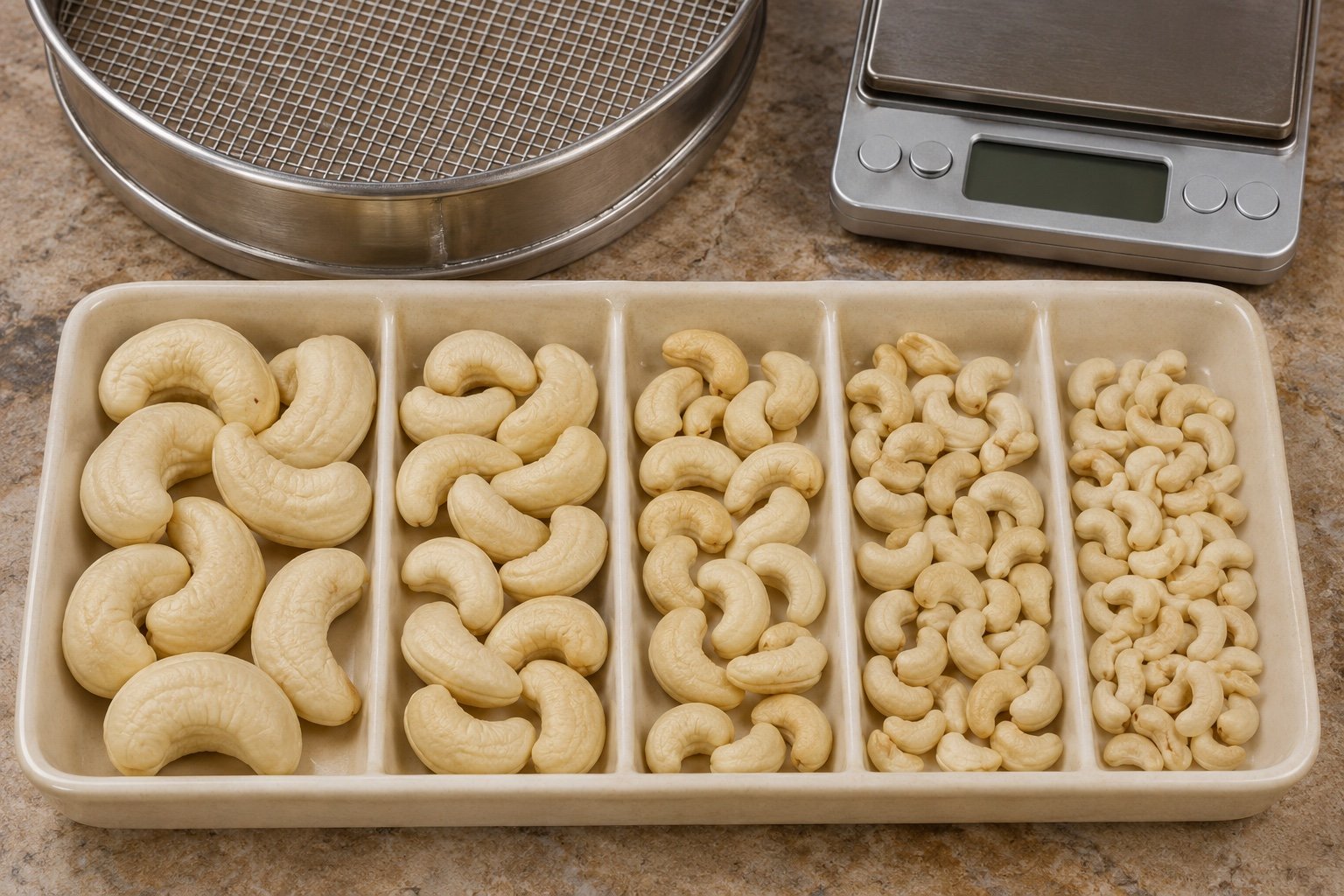
IS 7750 counts whole kernels in 500 g. The Indian export chart counts them in one pound, which the trade rounds to 454 g. The per-pound column converts each 500 g band: count x 453.6 ÷ 500.
| Grade | IS 7750, per 500 g | Per pound (worked out) | Export chart, per 454 g |
|---|---|---|---|
| W150 | 140 to 165 | 127 to 150 | No grade |
| W180 | 175 to 200 | 159 to 181 | 170 to 180 |
| W210 | 220 to 230 | 200 to 209 | 200 to 210 |
| W240 | 240 to 265 | 218 to 240 | 220 to 240 |
| W320 | 330 to 350 | 299 to 318 | 300 to 320 |
| W450 | 440 to 490 | 399 to 445 | 400 to 450 |
| W500 | 495 to 550 | 449 to 499 | 450 to 500 |
| SW360 | 375 to 400 | 340 to 363 | No grade |
The code number still comes from the pound. W320 marks up to 320 kernels in a pound, or 330 to 350 kernels in 500 g. A 1 kg bag of W320 holds twice the 500 g band, which works out to 660 to 700 whole kernels.
W180 differs most from the export chart: its lowest count falls about 11 kernels per pound below the chart. Cashew Count per Pound covers the per-pound system.
Broken and smaller kernels in a lot
Each grade allows a small share of broken kernels or kernels from the grade below. The next lower size grade (NLSG) holds kernels one size smaller, as the lower-size kernels entry sets out.
- Every white and scorched whole grade: up to 5% broken kernels
- W150 to W450: up to 5% of NLSG kernels and SW kernels together
- W500: up to 5% SW kernels, with no smaller white size below it
- SW180 to SW450: up to 7.5% of NLSG kernels and SSW kernels together
- LWP, SWP and BB: no broken kernels
In a 10 kg tin of W320, up to 500 g may be broken. Another 500 g may be W450 or SW kernels. For the piece grades, a 4.75 mm sieve holds back LWP. A 2.80 mm sieve holds back SWP, and a 1.70 mm sieve holds back BB.
IS 7750 beside the export chart, FSSAI and ISO 6477
Four rule sets cover cashew kernels, and each one has a different job.
| Rule set | Issued from | Job |
|---|---|---|
| IS 7750:2013 | BIS | Product standard; the ISI mark needs a BIS licence |
| Indian export grade chart | Central government, under the Export (Quality Control and Inspection) Act, 1963 | Grades for export checks; 26 grades; counts per 454 g |
| FSSAI cashew kernel standard | Food Safety and Standards Authority of India | Food law standard for cashew kernels sold as food |
| ISO 6477:1988 | International Organization for Standardization | World standard with 24 grades; counts per kg and per pound |
Each export lot needs a certificate from an Export Inspection Agency under a 1986 order, S.O. 782. FSSAI added its cashew kernel standard in an amendment published on 31 December 2020. In July 2026, the Codex Alimentarius Commission agreed to start a world food standard for cashew kernels, on a proposal from India.
ISI mark licences for cashew kernels
Clause 4.2.2 lets a pack bear the BIS Standard Mark, called the ISI mark. A factory needs a BIS licence for that mark. The licence follows Scheme I of the BIS (Conformity Assessment) Regulations, 2018.
The licence record holds four dates:
- 11 September 2020: the BIS Raipur Branch Office received the first application in India for an IS 7750 licence.
- 6 November 2020: BIS put the first product manual for cashew kernels on its website.
- May 2021: BIS issued the revised manual, PM/7750/2.
- 16 June 2021: BIS granted the first IS 7750 licence in India, to a unit in the Birkoni Industrial Area of Chhattisgarh.
The BIS record for IS 7750 provides current licence details. A licensed pack shows the ISI mark and a licence number that starts with CM/L. Check that number in the BIS register rather than relying on a printed mark alone.
What a factory needs for an IS 7750 licence
The BIS product manual lists what a factory must have for the licence:
- An in-house lab with its own staff and a plan to check its tools for accuracy
- A magnifying glass, a hot air oven and a Soxhlet set to draw oil from ground kernels
- A grinder with a 250-micron sieve and a balance that reads to 0.01 g, for the moisture test
- A grading balance of at least 750 g that reads to 1 g, with the Annex A sieves
- Written records of every test
The manual counts all kernels of one grade from one roasting batch as one control unit. Staff test each control unit in these amounts:
| Check | Samples |
|---|---|
| Look, mould and insects, foreign matter | 1 sample every 4 hours |
| Plant waste | 3 samples |
| Acid in the kernel oil | 1 sample |
| Moisture | 1 mixed sample |
| Grade | 3 samples |
For the licence test, BIS takes about 500 g of one grade. A pass on white kernels also covers scorched and dessert grades. A pass on wholes covers pieces of the same colour.
Other BIS standards for cashew
BIS also publishes these cashew standards:
| Standard | Subject |
|---|---|
| IS 840:2026 | Cashewnut shell liquid (CNSL), the oil in the shell, third revision, in force from 23 February 2026 |
| IS 6658:2013 | Cashew testa, the thin brown skin, for tanning |
| IS 10619:1983 | Seasoned, spiced and sweetened cashewnuts, made from IS 7750 kernels |
| IS 11076:1984 | Pallet loads of cashew kernels for export |
| IS 14326:2024 | Cashew fenny |
The namkeen standard, IS 15271:2003, also cites IS 7750.
How to check an IS 7750 claim on a pack
Four checks on a 500 g sample test the claim at a shop or a warehouse.
- Look for the ISI mark with a CM/L licence number beside it.
- Read the grade, the net quantity and the country of packing. Clause 4.2.1 asks for all three.
- Count the whole kernels in 500 g. A W240 pack needs 240 to 265.
- Weigh the broken kernels apart. Up to 25 g in 500 g meets the 5% limit.
The bulk buying checklist adds smell and other checks for large orders.
IS 7750 questions
Is the ISI mark compulsory on cashew kernels?
No. Clause 4.2.2 makes the mark optional. The BIS review page lists its certification as “None”.
Is IS 7750 the same as ISO 6477?
No. It is an Indian text with no link to an international standard. ISO 6477 counts kernels per kg and per pound, while the Indian text counts them per 500 g.
Does IS 7750 cover roasted and salted cashews?
No. The roasting in the standard is the factory step that loosens the shell before peeling. Seasoned, spiced and sweetened cashews follow IS 10619:1983.
Is IS 7750 only for cashews sold in India?
No. Its scope covers all kernels from cashew nuts, with no line between home sales and export. An export lot also needs the inspection certificate under the 1986 order.
Where can I read the IS 7750 text?
BIS sells the full standard and shows a free preview of its scope. Public.Resource.org placed a scan of the 2013 text on Internet Archive.
Sources and further reading
- IS 7750:2013 Cashew Kernels: Specification, scan from Public.Resource.org
- BIS: IS 7750:2013 preview, scope and references
- BIS: Know Your Standards record for IS 7750:2013
- BIS: Product manual for cashew kernels, PM/7750/2, May 2021
- BIS Raipur Branch Office: first application letter, 11 September 2020
- BIS: first IS 7750 licence circular, June 2021
- Gazette of India, 22 February 2014: BIS notice S.O. 625
- Export Inspection Council: Order S.O. 782, 1 March 1986
- USDA report on the FSSAI Tenth Amendment Regulations, 2020 (APEDA copy)
- All India Radio News: India at the 49th Codex Alimentarius Commission, July 2026