

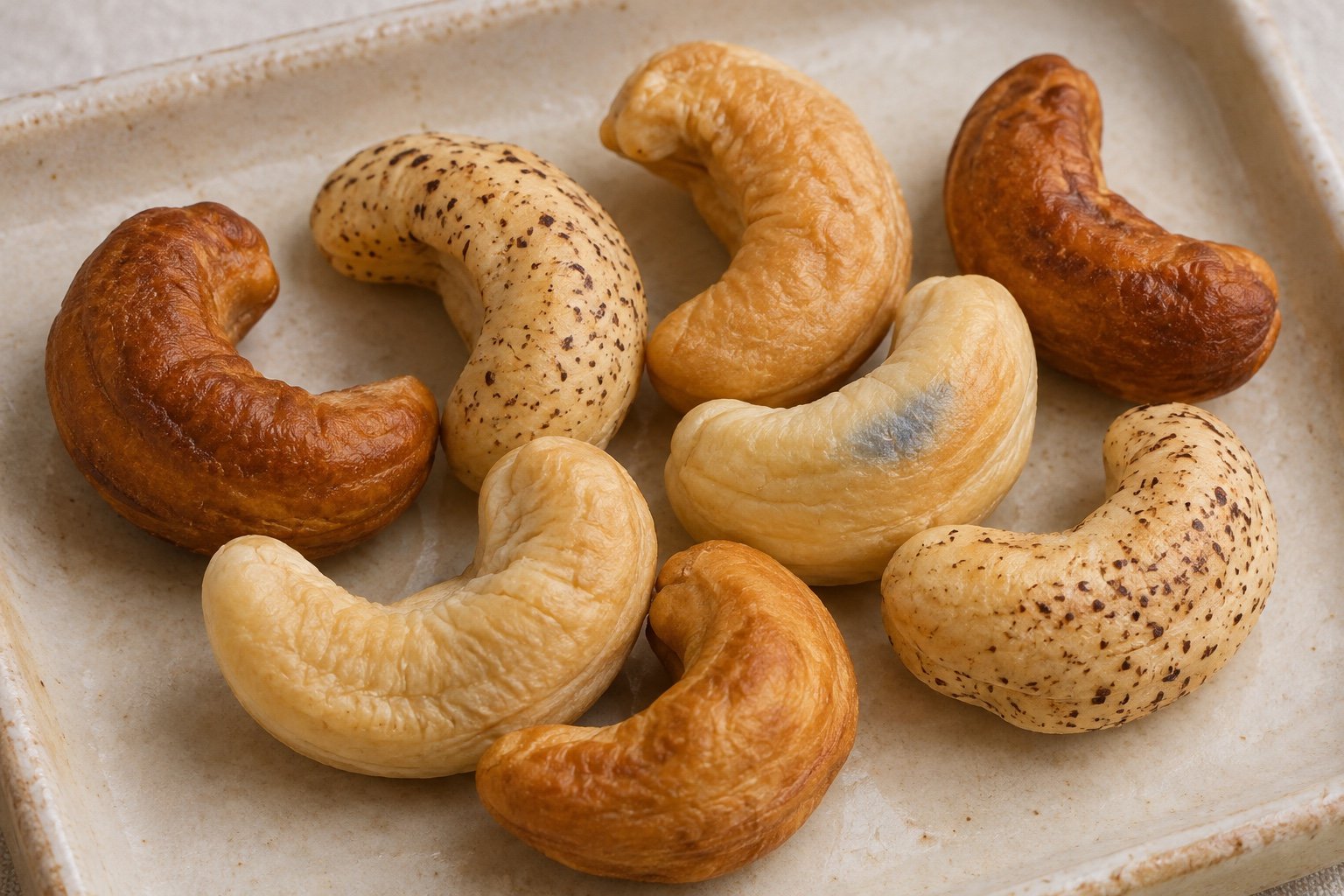
Dessert whole cashews (DW) are whole kernels with deep scorching, deep blue colour or black spots. On the Indian trade grade chart, DW is the lowest colour grade for whole kernels. The kernel is the nut inside the shell.
What are dessert whole cashews?
DW is a colour grade that takes whole kernels of every size. It is one of the darker whole grades on the cashew grades chart, below SSW cashews. Under the Indian trade grade chart, a DW lot may hold up to 5% broken kernels and no lower grade.
Marks that place a kernel in DW
The Indian trade chart names six marks for DW: black spotted, deep scorched, deep blue, deep brown, discoloured and speckled. Black spots appear in no other whole grade on that chart: a whole kernel with black spots goes to DW, whatever its size. The scorching and the blue go deeper than in SSW, the grade above DW, where kernels may be over-scorched or light blue.
Where DW marks come from
Heat and iron can mark a kernel deeply enough for DW. Insects lower kernel quality on the farm, and some marks come from other causes.
- Heat: overheating during roasting, shelling or drying darkens the kernel, and the deepest scorching goes to DW.
- Iron: when the water for moistening raw nuts contains iron, the iron reacts with the thin brown skin, the testa, and leaves bluish black patches.
- Insects: tea mosquito bug, thrips and apple and nut borers attack tender nuts, and heavily damaged nuts yield fewer good kernels.
- Other causes: a published study found shrivels, brown patches and black spots in kernels of nuts with no insect damage.
From raw nut to a DW lot
DW kernels come from the same raw nuts as white wholes, and grading decides which kernels end up in DW. APEDA’s estimate uses an average kernel recovery of 23% of raw nut weight. Factories then sort the kernels for shape, colour and size. DW kernels leave at the colour sort and have no size count. In 2024-25, Indian farms produced 802,349 tonnes of raw nuts, according to the Directorate of Cashewnut and Cocoa Development. Crop and trade figures count all grades together, with no separate DW share.
Dessert wholes in six standards
Six standards describe a dark-coloured whole grade close to DW, but their rules differ. The East African NC 1:2018 draft names LDKW, lower dessert wholes, for the same faults in a worse form. The US AFI specification caps kernels with specified dark lines, swirls, loops or pitted spots at 60% of a dessert lot. The standards also differ on broken kernels in a 1 kg bag: the Indian trade chart and Vietnam TCVN 4850 allow 50 g, while UNECE DDP-17 allows 100 g. Vietnam generally permits up to 5% of the next lower grade if one exists; DBW has no lower whole grade in its table.
| Standard | Grade name | Marks allowed | Limit |
|---|---|---|---|
| Indian trade grade chart | DW, Desert Wholes | Six marks, from deep scorched to black spotted | 5% broken; no lower grade |
| ISO 6477, 1988 | Grade X, Dessert | Scorched, discoloured, speckled, shrivelled; deep black spots | 5% broken and lower grade combined |
| NC 1:2018 draft | DW, then LDKW below it | Scorched, discoloured, speckled, shrivelled | 5% broken and lower grade combined |
| UNECE DDP-17, 2013 | Class II, scorched seconds or dessert | Deep brown, deep blue, amber, light brown, light blue, discoloured, black-spotted; unripe, blemished or stained kernels | 10% broken |
| US AFI, 2023 | Dessert Blemished Wholes | Deep yellow, brown, amber, light to deep blue; dark lines, swirls, loops or pitted spots | Marks on 60% of kernels at most |
| Vietnam TCVN 4850, 2010 | Grade 20, DBW, dark blemish whole | Deep brown or black speckles | 5% broken; no lower whole grade listed |
Other limits on a DW lot
Beyond colour and broken kernels, the standards set limits on moisture, skin left on the kernel and surface damage. UNECE DDP-17 allows more skin, surface damage and failed kernels in Class II, its dessert class, than in Class I.
- Moisture: up to 5% under the Indian trade chart and ISO 6477, and 3 to 5% under the US AFI specification. The moisture check shows how to test a lot.
- Testa left on the kernel: up to 5% of kernels in UNECE Class II against 3% in Class I. Vietnam TCVN 4850 sets 1.5% for every grade.
- Surface damage such as scrapes: up to 5% of kernels in UNECE Class II against 2% in Class I.
- Kernels that fail the UNECE minimum requirements: up to 12% in Class II against 9% in Class I.
DW beside SSW and blemished wholes
The grade just above DW differs from one standard to the next:
- Indian trade chart: SSW cashews sit above DW, and an SSW lot may hold up to 7.5% DW. Scorched whole cashews sit above SSW.
- ISO 6477 and NC 1:2018 draft: scorched wholes seconds, grade IX in ISO 6477
- US AFI: Lightly Blemished Wholes, the lighter blemish grade, with light brown lines on up to 40% of kernels
- Vietnam TCVN 4850: blemish wholes (BW), which come in sizes, while dark blemish wholes (DBW) have no size count
- UNECE DDP-17: none, with dessert and scorched seconds sharing Class II
Broken DW kernels and their pieces grades
Broken kernels with dessert marks get four codes on the Indian trade chart, each starting with D.
- DB, dessert butts: kernels broken across
- DS, dessert splits: kernels split along their length
- DP, dessert pieces: pieces that a 4.75 mm sieve holds back
- DSP, dessert small pieces: pieces smaller than DP
Only DP has a row of its own on the list. DB, DS and DSP appear only as lower grades inside other lots. Scorched butts (SB) may hold up to 7.5% DB, and scorched splits (SS) up to 7.5% DS. DP may hold up to 7.5% DSP, and scorched small pieces (SSP) up to 5% DSP.
DW in Indian rules and records
Indian export rules, customs notices and the national standard all name the grade or govern how it ships.
- 1986 — Export Inspection Council rules and packing directions (One grade per carton and a grade label on every tin, for DW as for every grade)
- 2012 — Jawaharlal Nehru Custom House, Public Notice 63 (Importers must declare a full description; the notice lists “Desert wholes (DW)” as a category, with SSW under the same heading)
- 2013 — IS 7750:2013, the Bureau of Indian Standards cashew kernel standard (Covers dessert wholes)
- 2021 — BIS product manual for IS 7750 (A licence test on one scorched grade can also cover dessert grades)
Other names for dessert wholes
Five names point to DW, and ISO 6477 already used “Dessert” for grade X in 1988.
- Indian trade chart and NC 1:2018 draft: Desert Wholes (DW), the same grade with a different spelling
- ISO 6477: Dessert, grade X
- US AFI: Dessert Blemished Wholes
- UNECE DDP-17: dessert, part of Class II
- Vietnam TCVN 4850: dark blemish whole (DBW), the closest grade, with no grade named dessert
How to check a DW lot
A 200 g sample, a scale and a count of 100 kernels help check a DW lot against two standards. The bulk buying checklist covers moisture and defect tests for large orders.
- Scoop 200 g from the top, centre and base of the bag.
- Set aside broken kernels, including any kernel with more than one-eighth missing.
- Weigh the broken kernels. More than 10 g goes over the 5% limit of the Indian trade chart.
- Count 100 whole kernels and mark those with dark lines, swirls or pitted spots. More than 60 goes over the AFI cap.
Frequently asked questions
Are dessert cashews sweet?
No. Dessert names a colour grade of plain whole kernels, with no sugar added.
What foods use dessert whole cashews?
The same foods as any whole kernel: snacks, sweets and baked goods.
Does NutDana sell dessert whole cashews?
No. NutDana stocks white grades only: W180 to W450 wholes, white splits and white pieces.
Sources and further reading
- All India Cashew Convention: Cashew kernel grade chart
- TNAU Agritech: Cashewnut cultivation and processing
- Vanitha and Balasubramanian: Vulnerable stages of cashewnuts for pest infestation and the pest influence on kernel quality, Journal of Entomology and Zoology Studies, 2020
- Northern Corridor NC 1:2018 Cashew kernels: Specification (WTO notification)
- ISO 6477:1988 Cashew kernels: Specification, sample pages
- INC: Cashew technical information, with UNECE DDP-17 (2013) tables
- AFI: Cashew kernel specifications, updated September 2023
- VINACAS: TCVN 4850:2010 Specification for cashew kernels, Vietnamese and English
- APEDA: Cashew market dashboard, November 2025
- CBI: The European market potential for cashew nuts
- All India Cashew Convention: DCCD area and production statistics
- Export Inspection Council: 1986 notification
- Jawaharlal Nehru Custom House: Public Notice 63/2012, cashew kernels
- Bureau of Indian Standards: Product manual for cashew kernels, IS 7750:2013, May 2021