

Broken cashew kernels are cashew kernels with more than one-eighth of the kernel broken off. Picture a kernel cut into eight equal parts: if more than one part is missing, the kernel counts as broken. Grade lists sort them into three shapes: butts, splits and pieces. A kernel is the part of the cashew nut that people eat, taken out of the shell. Indian shops sell broken kaju as kaju tukda, from the Hindi word for a piece. Export traders call the whole group brokens.
Butts, splits and pieces
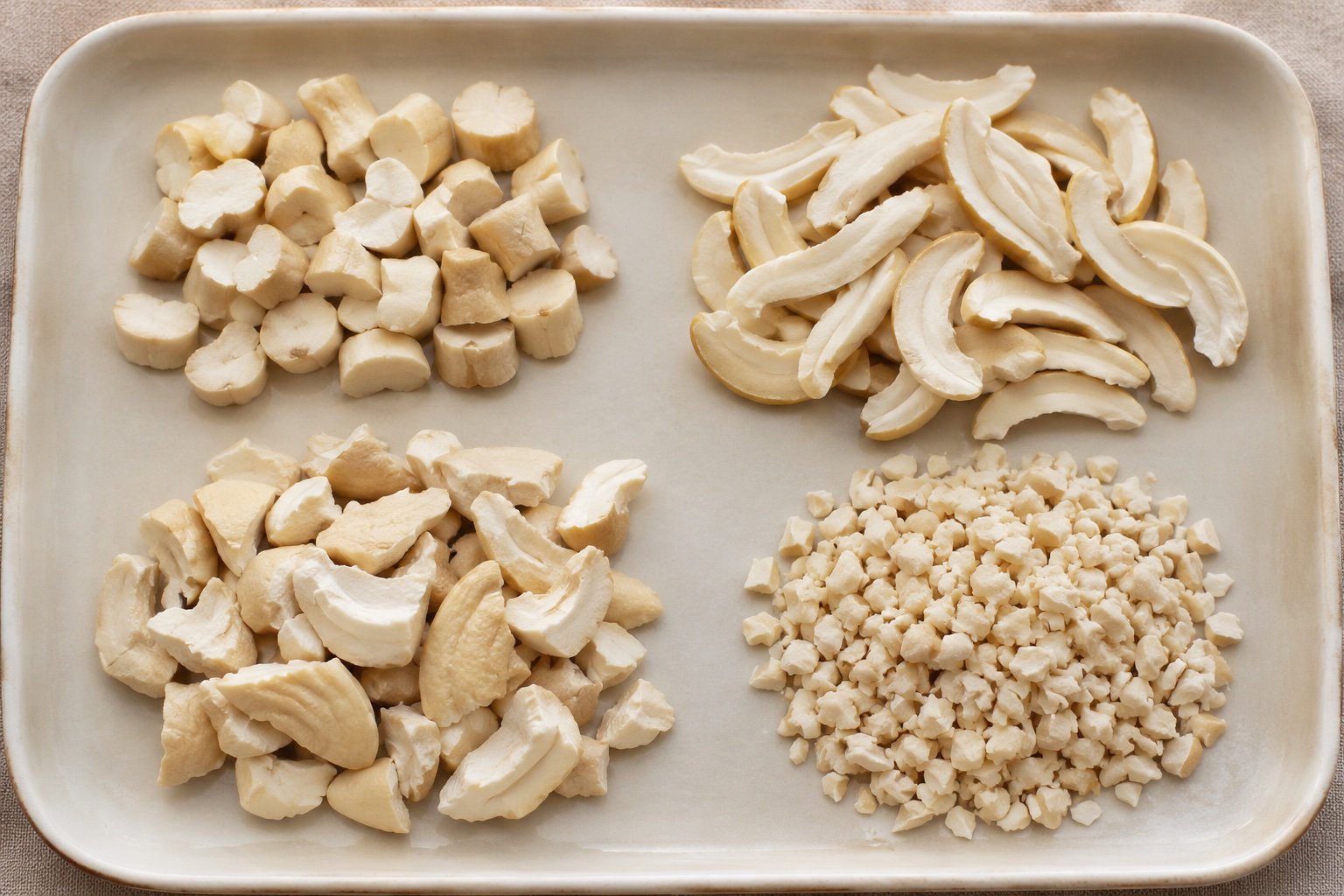
The way a kernel breaks decides its shape name. Every cashew grade list uses the same three shapes:
- Butt: a kernel snapped once across its width, with both halves still joined
- Split: one half of a kernel, parted along its length
- Piece: a kernel broken into more than two parts
Under the US, Vietnam and East African rules, a butt must hold at least three-eighths of the kernel. Smaller bits go to the piece grades.
On the Indian export grade list, butts and splits have no size limit. Piece grades take their size from a sieve. LWP, large white pieces, are too big to fall through a 4.75 mm sieve. SWP, small white pieces, fall through that sieve but rest on a 2.80 mm sieve. BB, baby bits, fall through the 2.80 mm sieve but rest on a 1.70 mm sieve.
Broken grades in five grading standards
A grading standard is a rule book that names each grade and sets its limits. Broken cashew kernels fill 11 of the 26 grades on the Indian list and about half the grades in the world and Vietnam standards. Each standard groups them in its own way.
| Standard | Broken grades | Groups |
|---|---|---|
| Indian export grade list (India) | 11 of 26 | White: B (butts), S (splits), LWP, SWP, BB. Scorched: SB, SS, SP, SSP (the same shapes with heat marks). Dessert: SPS, DP (the darkest pieces) |
| ISO 6477:1988 (world) | 14 of 24 | White pieces (grades XI to XV), scorched pieces (XVI to XIX), others (XX to XXIV) |
| TCVN 4850:2010 (Vietnam) | 22 of 42 | 6 butt, 6 split and 10 piece grades |
| NC 1:2018 draft (East Africa) | Split over three tables | White pieces, scorched pieces, dessert pieces |
| AFI rules (United States, 2023) | No grade codes | Butts, splits and pieces; a separate quality class sets the colour |
Vietnam has the most broken grades. It has a butt, a split and a piece grade for each colour step. The six steps are white, scorched, second scorched, light blemish, blemish and dark blemish. AFI names only the shape, such as butts. A separate quality class, such as first quality, sets the colour.
Rules every Indian broken grade follows
Colour places each broken grade in one of three groups on the Indian list. The white group allows three colours: white, pale ivory and light ash. Scorched grades show light heat marks, and the two dessert grades show the darkest marks, such as black spots or deep blue.
Each grade allows a small share of the grade just below it, such as a few scorched butts in a bag of white butts. B, S and SWP allow 5%, while SB, SS, SP, SPS and DP allow 7.5%. In a 25 lb (11.34 kg) export tin, 5% comes to about 567 g and 7.5% to about 851 g. BB has a rule of its own: up to 1% cashew powder.
Butts, splits and white pieces allow up to 5% moisture. Every broken lot must also be free from live insects, insect damage, mould and rancid (stale-smelling) kernels.
How many kernels break in a factory
Shelling, the step that cracks the hard outer shell, breaks between a quarter and a half of all kernels. Machine shelling breaks about 25 to 40% of kernels. Across factories, only about half the kernels come out whole on average, and about 65% at best. Every lot of raw nuts ends up as both whole and broken grades.
Four factors change how many kernels break:
- Heat: roasting in hot shell oil weakens the shell. Roasted nuts crack open with about 40% less force than raw nuts.
- Water: soaking the nuts in water before steaming makes the biggest difference, more than steaming time or drying heat.
- Nut size: small nuts break more. On one spinning-wheel shelling machine, about 65% of large nuts, 52% of medium nuts and 38% of small nuts came out whole.
- Peeling: taking off the thin brown skin after shelling breaks more kernels. Cashew Butts lists how many break in hand and machine peeling.
Careful steps before shelling cut breakage to a small share. In one tested method, the nuts soak in water, then get 60 minutes of steam and 9 hours of drying at 60 °C. 90% of kernels come out whole. Factory results also depend on nut size, steaming and drying conditions.
Where broken cashew kernels go in food
Broken cashew kernels go into foods that hide the nut shape. In 1982, sweets and baked goods used most broken grades, while whole grades went almost entirely to snacks.
The NutDana Delhi wholesale page matches each tukda grade to its foods:
- JH halves: toppings, biryani and garnish
- JK chunks: bakery, namkeen and fruit cake
- LWP pieces: kaju katli, gravies and fillings
- SWP or BB: paste, kulfi base and ground cashew
For katli and barfi, cooks grind the cashew, and no shape survives. NutDana advises ordering ground cashew fresh each week, as it loses its smell quickly.
Sorting a bag of broken kaju
A bag of broken kaju sorts into its grades on one tray. You need a scale and three woven wire sieves: 4.75 mm, 2.80 mm and 1.70 mm.
- Weigh out 500 g, with scoops from three parts of the bag.
- Remove kernels with one-eighth or less missing. US rules count these as wholes.
- Pick out the splits and the butts on shape.
- Stack the sieves over a pan and shake the rest. The top sieve holds LWP size, the middle sieve SWP size and the bottom sieve BB size.
- Move brown or marked bits from each pile to a separate pile for scorched and dessert grades.
- Weigh each pile and work out its share of the 500 g.
If 60 g rests on the 1.70 mm sieve, 12% of the sample is BB size. Dust in the pan belongs to no grade. For halves, LWP and SWP only, use the NutDana 200 g sieve test.
Common buyer doubts about broken cashews
Are broken cashews lower quality than whole cashews?
Only in shape and size. On the Indian list, white whole and white broken grades allow the same three colours and the same 5% moisture. The same pest, mould and rancid-kernel rule covers both.
How many broken kernels may a bag of whole cashews hold?
Up to 5% of the weight on the Indian list, for white, scorched and dessert wholes alike. In a 10 kg tin of W320 whole cashews, that is 500 g. The Gota Kaju entry compares the limit in six standards. NutDana shows how to check the share in its Insight on bulk cashew checks.
What do Indian customs call broken cashews?
Cashew kernel, broken, under customs code 0801 32 10. A 2012 Jawaharlal Nehru Custom House notice also names three broken groups for import papers: white pieces, scorched pieces and desert (dessert) pieces.
Are splits broken cashews?
Yes, on grade lists. The Indian list, ISO 6477 and AFI all place splits with butts and pieces, apart from the whole grades. In 2026, one Indian customs ruling put lengthwise halves under a different customs code from broken kernels. Cashew Splits has the details.
Does NutDana sell broken cashews?
Yes. NutDana sells four tukda grades: JH (jumbo halves), JK chunks, LWP pieces, and SWP or BB as one item. At NutDana, a JK kernel makes about four chunks, and an LWP kernel about eight pieces.
Sources and further reading
- Product Specifications, Cashew Kernels, CAPEX (Indian export grade list)
- ISO 6477:1988 Cashew kernels: Specification, sample pages, ISO
- TCVN 4850:2010 Cashew kernels: Specification, Vietnam, VINACAS copy
- NC 1:2018 Cashew kernels: Specification, Northern Corridor draft, WTO file
- Specifications for Cashew Kernels, Association of Food Industries, updated September 2023
- Fracture resistance of raw and pre-treated cashew nuts under compression, International Journal of Food Properties, DOI 10.1080/10942912.2011.595026
- Analysis and improvement of the cashew nut shelling process, Madoumier and others, CIRAD, ICEF14, Nantes, 2023
- Design and performance evaluation of centrifugal cashew nut sheller for improving the whole kernel recovery, Kilanko and others, CIGR Journal 20(1), 2018
- The market for cashew nuts and cashew nut shell liquid, J. Coulter, Tropical Development and Research Institute, 1982
- Public Notice 63/2012, Declaration of full description of cashew kernels, Jawaharlal Nehru Custom House, 19 November 2012
- CAAR classifies cashew splits under tariff item 0801 32 90, Taxguru report of a Customs Authority for Advance Rulings, Mumbai ruling, 2026