

Baby bits (BB) are the smallest white cashew pieces in Indian grading: bits that pass a 2.80 mm sieve and remain on 1.70 mm. A BB lot holds tiny broken bits of the cashew kernel and plumules, the first leaf buds of the seed. Cashew grade lists place BB after LWP (large white pieces) and SWP (small white pieces), as the last white piece grade.
Sieves that set the BB cashew size
Two sieves decide if a piece counts as BB. On the Indian cashew grade list, a BB piece falls through the 2.80 mm sieve and remains on the 1.70 mm sieve. Any bit that remains on the top sieve is SWP or a bigger grade. The list also names each sieve with a wire code: 6 mesh 20 SWG on top and 10 mesh 24 SWG below. On woven cloth, the code and the mm size point to different holes. In a wire cloth maker table, 10 mesh cloth of 24 SWG wire has 1.98 mm holes, and a 1.80 mm bit falls through them. A 1.70 mm sieve holds the same bit as BB.
For export orders to the US, the AFI (Association of Food Industries) rules set the test. A grader stacks the larger sieve over the smaller one, puts a pan under both and shakes a 200 g sample for 2 minutes. AFI requires woven-wire sieves for pieces, and its rules state that round-hole sieves differ from them.
Plumules, tips and bits in a BB lot
Besides broken bits, a BB lot holds two small parts of the kernel: plumules and tips. A cashew kernel has two large white cotyledons, the seed halves, and a small embryo between them, all inside the testa, the thin reddish-brown skin. The plumule is the shoot of that embryo, and in a growing seed it becomes the first true leaves above the soil.
The Indian list and the East African NC 1:2018 draft both name plumules in the BB grade. Some printed copies of the Indian list spell the word “plemules”; both spellings name the same part. BB lots can also hold kernel tips, the small end of the kernel.
How each standard defines baby bits
The five standards below set a sieve for baby bits: four at 1.70 mm, and NC 1:2018 at 10 mesh 24 SWG. Their upper limits, colour rules and allowances differ.
| Standard | Code and place | Lower sieve | Upper limit | Colour | Allowance |
|---|---|---|---|---|---|
| Indian grade list | BB, last of 5 White Pieces rows | 1.70 mm (10 mesh 24 SWG) | Under 2.80 mm, smaller than SWP | White, pale ivory or light ash | 1% cashew powder |
| ISO 6477:1988 | BB, grade XV, last white pieces grade | 1.70 mm | Smaller than SWP | As SWP: white, pale ivory or light ash-grey | 5% next lower grade or pieces |
| US AFI, Sept 2023 | Baby Bits, a size grade in Table 2 | 1.70 mm | 2.36 mm | Follows the quality class | 5% may pass 1.70 mm; 1% may pass 1.18 mm |
| TCVN 4850:2010, Vietnam | B-B, grade 42 of 42 | 1.7 mm | None in the row; small pieces start at 2.8 mm | No colour sorting | 5% next lower grade; 5% broken |
| NC 1:2018 draft, East Africa | BB, row v of White Pieces, with BB1 and BB2 | 10 mesh 24 SWG | Smaller than SWP | No colour column | 5% next lower grade or pieces |
NC 1:2018 also lists two sub-grades without sieves: BB1, bits smaller than SWP but bigger than BB, and BB2, a second grade of BB1.
ISO 6477 and NC 1:2018 require white pieces, BB included, to be completely free of testa. The Indian list, ISO 6477 and NC 1:2018 cap moisture at 5%, against 3 to 5% under AFI. Every Indian piece grade, BB included, must be free of insects, mould and rancidity.
SWP, chips, fine grains and BB compared
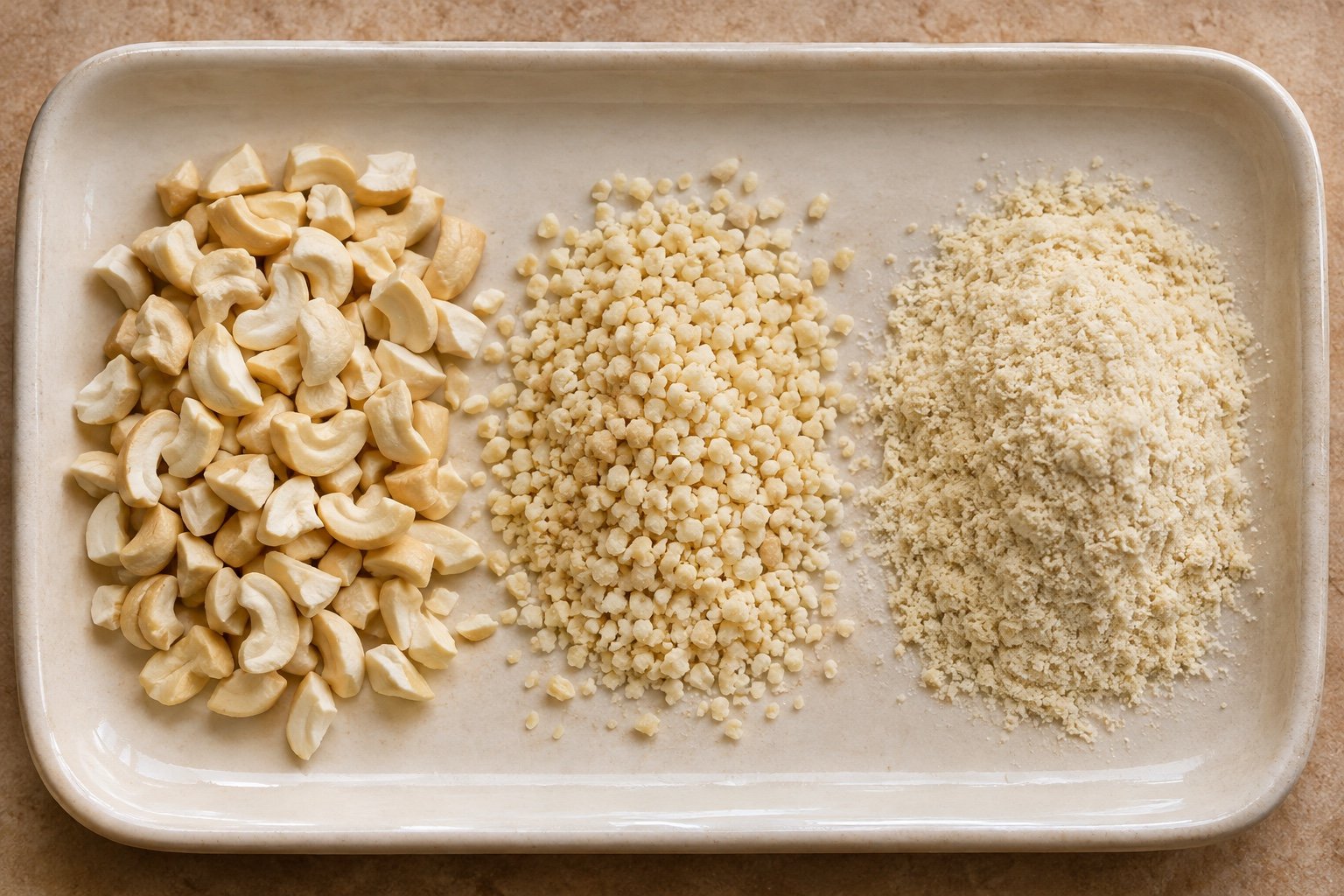
The AFI sizes split the Indian BB band in two: chips from 2.36 to 2.80 mm and baby bits from 1.70 to 2.36 mm. SWP lies above BB, and AFI fine grains and fines lie below it.
| Grade or name | Standard | Size band |
|---|---|---|
| SWP | Indian list | 2.80 to 4.75 mm |
| Small Pieces | AFI | 2.80 to 6.30 mm |
| Chips | AFI | 2.36 to 2.80 mm |
| BB | Indian list, ISO 6477, TCVN 4850 | 1.70 to 2.80 mm |
| Baby Bits | AFI | 1.70 to 2.36 mm |
| Fine Grains | AFI | 1.18 to 1.70 mm |
| Fines | AFI | Under 1.18 mm |
| Cashew powder | Indian list | No size; 1% allowed in BB |
Some Indian BB packs print 1.7 to 3.0 mm, wider than both standards. A sieve test shows the band a pack holds.
How a factory ends up with baby bits
Kernels break at four points: shelling, kernel processing, transport and storage. Graders set aside wholes, splits and butts first. Bits broken into more than two parts then go over vibrating sieves, with screens for white pieces, SWP and BB.
BB was already a set grade in 1982. A cashew market report from that year lists LWP, SWP and BB as the three size grades of Indian white pieces. The same report counted baby bits among the poor grades in trade, with dessert pieces and scorched small pieces. No grade list sets a share of BB in factory output.
Uses of baby bits
Food makers grind, mix or sprinkle BB into foods such as:
- Gravies, sauces and cashew paste
- Cookies, cakes and bakery fillings
- Cashew flour and seasoning coatings
- Toppings for cookies and ice cream
- Chocolate bars with small cashew pieces
Two NutDana Insights cover cooking with pieces: one matches cashew grades to sweets, bakery and catering dishes, and one compares splits, LWP and SWP.
Other names on BB packs and spec sheets
Besides BB, packs and spec sheets use six other names for the same small bits:
- B-B: the Vietnam TCVN 4850 code, grade 42
- BB1 and BB2: sub-grades in NC 1:2018, also printed on some Indian BB 2 packs
- Small bits: a label on some Indian BB packs
- Grains or granules: an export spec sheet name for 1.70 to 2.36 mm pieces
- Cashew granulate: a European pack name for 1.7 to 2.36 mm pieces, sold as Baby Bits, G1, G2 and Grit
- Tukda: the NutDana Delhi wholesale page lists SWP or baby bits among its four tukda grades, tukda being the Hindi word for piece
In Vietnam TCVN 4850, BB also names grade 35, a blemish butt: a kernel broken across its width. The standard printed on a pack decides which BB it holds.
A 200 g sieve check for BB
Two sieves show if a BB pack holds the sizes its standard sets. You need a 2.80 mm sieve, a 1.70 mm sieve, a pan and a scale with 0.1 g steps.
- Read the code and the standard on the pack. For an AFI baby bits pack, use a 2.36 mm top sieve in place of 2.80 mm.
- Stack the top sieve over the 1.70 mm sieve, with the pan below.
- Shake 200 g of the bag for 2 minutes.
- Check the top sieve. Any piece on it is larger than BB.
- Weigh the pan. Under AFI, more than 10 g breaks the 5% rule. Under the Indian list, more than 2 g of powder breaks the 1% powder allowance.
- Pick out brown or dark bits. A BB lot under the Indian list has no scorched allowance.
For large lots, the NutDana Insight on checking bulk cashew quality covers moisture and smell tests.
Buyer questions about BB cashews
Do baby bits have a count per pound like W320?
No. Grades such as W320 use a count per pound, but every standard above sizes baby bits with sieves and sets no count.
Do baby bits follow the same quality rules as SWP?
Yes, under ISO 6477. ISO applies the SWP colour and defect rules to BB, and the two grades differ only in size.
Can baby bits be scorched?
Yes, under TCVN 4850, where grade B-B takes every colour. The Indian list has no scorched grade below 2.80 mm: its smallest, SSP (scorched small pieces), remains on that sieve.
Do baby bits count as cashew powder?
No. The NC 1:2018 draft lists powder as its own scorched pieces grade, apart from BB. Its powder rule names deliberate breaking or hand peeling as the source, in white, light brown or brown.
Does NutDana stock baby bits?
Yes. NutDana sells SWP and BB together as one item.
Sources and further reading
- Cashew grade charts, All India Cashew Association
- ISO 6477:1988 Cashew kernels: Specification, sample pages, ISO
- Specifications for Cashew Kernels, Association of Food Industries, updated September 2023
- Table 2, Cashew Pieces: Size Specification, Association of Food Industries, updated September 2023
- TCVN 4850:2010 Cashew kernels: Specification, Vietnam
- NC 1:2018 Cashew kernels: Specification, Northern Corridor, WTO TBT file
- PROSEA record: Anacardium occidentale, Plant Resources of South-East Asia
- Mesh specifications, Robinson Wire Cloth
- Seed morphology, University of Minnesota open textbook
- The market for cashew-nut kernels and cashew-nut shell liquid, J. Coulter, Tropical Development and Research Institute, June 1982
- Current trends in the cashew kernel market, P. Jaeger, Accord Associates, 2007
- Trade and pack pages: Kimmy Farm, first grade broken kernels, Kimmy Farm, broken kernel types, Hyperpure BB pack, Hyperpure BB 2 pack, TradeIndia pieces sizing machine, Nutrada cashew wholesale, Nuts in Bulk cashew specification, Bode Naturkost cashew granulate