Yes. You can send us one NutDana wholesale enquiry for W320 kaju and kaju tukda. We can review the two grade lines, then check availability, minimum quantities and delivery. The kg you need depends on what your shop plans to make or pack.
There is no fixed 50:50 mix. A Delhi mithai shop making kaju katli may need more pieces. A dry fruit shop filling whole-cashew packs may need more W320. Your planned products decide the split.
Which work needs W320, and which work needs tukda?
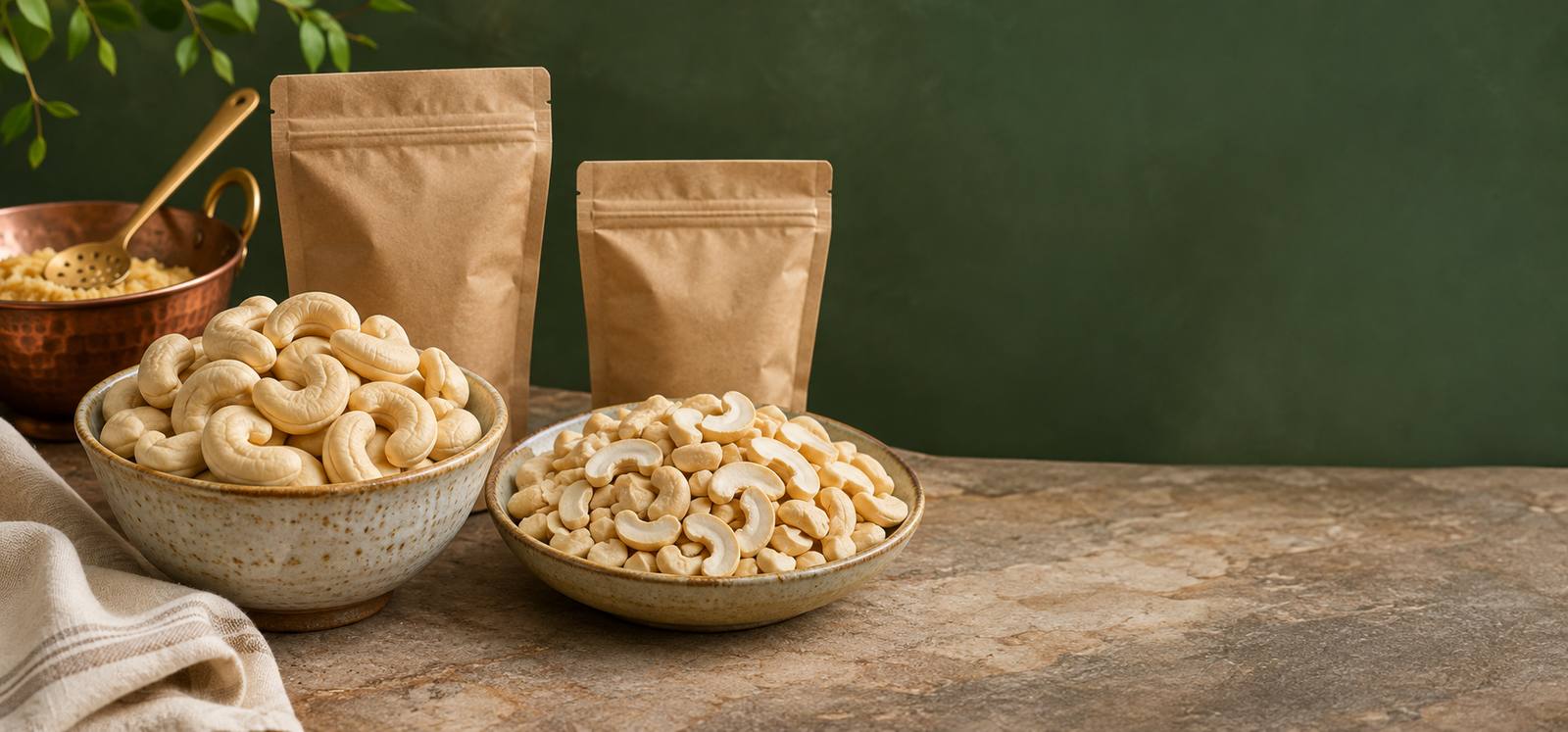
Choose W320 whole cashews when the full shape matters. Retail packs sold as whole kaju, gift boxes with whole nuts and sweets topped with a full cashew all need whole kernels. W320 is a whole-kaju size grade, never a 320 g pack.
Choose kaju tukda when your work calls for chopped or ground cashews. A mithai shop may grind pieces for kaju katli. A bakery may use small chunks inside biscuits or cake fillings. Buying whole nuts only to chop them can cost more when suitable pieces have a lower quoted rate.
Whole kaju can still break during packing or travel. Breakage can vary between packs. Count tukda separately when planning a recipe.
For sweets, count the cashew weight separately from the finished sweet weight. If a batch makes 8 kg of finished kaju katli but uses 5 kg of cashews, count 5 kg toward your tukda need. Counting the full 8 kg would make your order too large.
How do I work out the kg of each grade?
Start with orders your shop expects to make before the next supply. For whole-kaju packs, multiply the number of packs by the kaju weight inside each pack. For sweets, use the weight of cashews in your own recipe. Separate the amounts for whole nuts and pieces. Then take away matching, good-quality kaju already in your shop.
Suppose a Delhi shop plans 80 packs of whole kaju, each containing 250 g. Those packs need 20 kg of W320. Its sweet counter plans 6 batches using 3 kg of ground kaju each. Those batches need 18 kg of tukda. The shop already has 5 kg of W320 and 4 kg of the right piece grade. Its next requirement is 15 kg W320 and 14 kg tukda.
The split is 15:14. A bakery may need more pieces than whole cashews. The ratio changes with the work.
Count only cashews that can go into the planned product. A bag of small pieces cannot fill packs sold as whole W320. Likewise, a few broken kernels left in a whole-cashew pack cannot replace 14 kg of tukda. If the old piece grade differs from the new one, check that it will work in the same recipe before deducting its weight.
What if one product uses whole kaju and pieces?
Divide its cashew use into two parts. Many sweets use ground kaju inside and whole nuts for decoration. The inside can use an approved piece grade. The top may need W320 if customers expect an intact cashew.
For example, your sweet counter plans a batch needing 6 kg of ground kaju and 1 kg of whole cashews for the top. Count 6 kg under tukda and 1 kg under W320. Add those amounts to the needs of your other products. You are buying for two uses, even though the cashews go into one sweet.
A topping made from chopped cashews is different. If your topping uses small chunks, buy that portion as pieces. Decide from the finished product before placing the wholesale order.
Which kaju tukda size is right for my shop?
Kaju tukda is a broad market name covering several piece sizes. The splits, LWP and SWP guide compares these cuts. Splits are halves of cashew kernels. LWP is short for large white pieces. SWP is short for small white pieces. Baby bits are smaller again. Some sellers use names such as 2-piece, 4-piece or 8-piece kaju. Those names need a size description because they differ from formal grade names.
For sweets with visible cashew chunks, LWP is a useful starting point. Compare the pieces with the size you want on the sweet. Small white pieces may disappear into a topping where customers expect larger chunks. Splits suit a different look because they have the shape of half a nut.
For kaju katli that will be ground, whole shape adds little value. SWP may be suitable, provided its quality and price work for your recipe. A finer piece can also work for some ground uses. If a large share is powder, check how much your recipe can use.
Check colour and condition at every size. Pieces should be clean and dry, with no mould, insects or stale smell. Grinding spoiled cashews will never make them suitable for food. We recommend choosing the exact piece grade before comparing bulk prices.
Can the total kg meet the wholesale minimum?
One combined enquiry may still have a minimum for each grade. Read the minimum alongside each grade in the offer. We can check the minimum for each grade before accepting your quantities.
Take a buyer who needs 15 kg W320 and 5 kg tukda. The full requirement is 20 kg. If the seller sets a 10 kg minimum per grade, the 5 kg tukda amount falls short. If the seller permits a 20 kg mixed order, the same quantities may qualify. The total is identical, but the order terms differ.
If you need less than the stated minimum, share the exact requirement. We can check which order options are available. Buying another 5 kg makes little sense if your shop cannot use it. The better choice depends on future production, available grades and the actual quote.
A minimum quantity and a free-delivery limit are also different conditions. A combined order might meet one condition but miss the other. The written quote should settle each condition before payment.
Does buying two grades save money?
It can, when your product can use pieces and their quoted cost is lower. Use whole kernels only where their shape counts. A lower tukda rate loses value when too many pieces are unsuitable for your product.
Suppose a written quote offers W320 at ₹900 per kg and a suitable tukda grade at ₹750 per kg. For 15 kg W320, the item cost is ₹13,500. For 14 kg tukda, the item cost is ₹10,500. The combined item cost is ₹24,000 before GST and delivery. Your quote from us will show the actual rates and charges.
Price per kg also needs a use check. Our W320 quote comparison uses the same cost-per-usable-kg method. Imagine buying 10 kg of large pieces for toppings, but 2 kg is too fine for that work. Only 8 kg works for the topping. At ₹750 per kg, the full bag costs ₹7,500. That is ₹937.50 per kg of topping-ready pieces. Smaller pieces may still work in a ground recipe. Count them as usable if your recipe can take them.
For a buyer making only ground sweets, those smaller pieces may be fully useful. For a buyer selling visible chunks, size changes the amount they can use. Compare the kg your shop can use at each quoted rate.
What should I check before I accept a combined quote?
The two grades need separate names, quantities and rates. A line reading only “30 kg kaju” leaves the grade unknown. It also makes a wrong-grade delivery harder to spot. One invoice can cover the purchase. Each pack should carry its own grade name and net weight.
For W320, look for mostly intact, even-sized kernels. For tukda, look at how much of the pack matches the size you ordered. A photo can help show shape, but a sample from the offered batch is more useful when the size matters to your product. If the batch changes, request a sample from the new batch when available.
Before payment, the written order should show:
- W320: whole grade, kg and price per kg.
- Tukda: agreed piece grade, kg and price per kg.
- Charges: applicable GST, delivery cost and total payable.
- Delivery: Delhi PIN code, planned date and one or separate shipments.
- Packing: net weight and a distinct grade name for each pack.
If your chosen piece grade becomes unavailable, decide on the replacement after seeing its size and new rate. Approve any replacement grade and rate before paying.
How do I request W320 and tukda together from NutDana?
Send your two required quantities and your Delhi delivery PIN code. For the example above, the message can read: “W320 whole kaju, 15 kg. SWP kaju tukda, 14 kg. Delivery PIN 110006. Please share availability, minimum per grade, each rate, GST, delivery cost and expected date.” Use LWP in the message if your shop needs larger pieces.
If one grade is ready earlier than the other, we can check the available dispatch choices. A single delivery may work, or separate deliveries may need different charges and dates. Decide which arrangement matches your shop schedule before paying.
Share your planned quantities and piece grade through our Delhi cashew wholesale page.