Neither Indian-grown nor African-grown kaju guarantees sweeter taste or whiter kernels. Some Indian varieties have scored well in taste tests. African-grown kernels can also be fresh, mild and pale ivory. A country name cannot predict every wholesale batch.
Compare the same grade from the actual lots on offer. Check the taste, colour, usable pieces and growing origin before paying a higher rate for a country name.
What does Indian kaju mean when the raw nuts come from Africa?
The place where a cashew grows can differ from the place where it is processed. India grows cashews, but Indian factories also process imported raw nuts. After shelling, peeling and grading, those kernels can enter the wholesale market from an Indian processor.
For example, a cashew grown in Côte d’Ivoire may be shelled and packed in India. Another cashew may be grown and processed in Maharashtra. Both can reach a Delhi seller as finished kernels. African-grown kernels may also arrive after processing overseas. Ask if the imports were raw nuts or finished kernels. An Indian packing address cannot establish harvest origin.
APEDA confirms cashew cultivation in Indian states such as Maharashtra, Goa, Karnataka, Kerala, Tamil Nadu and Andhra Pradesh. Indian processors also use imported raw nuts, including supplies from Côte d’Ivoire, Benin, Ghana and Tanzania. “African kaju” covers several origins.
Ask the seller for the raw nut growing country, the processing country and the finished kernel grade. If harvest origin is unknown, avoid claiming the crop grew in India.
Does Indian kaju taste sweeter than African kaju?
Some Indian cashew varieties may taste richer or more pleasant to a buyer. But there is no sound basis for calling every Indian batch sweeter. African-grown cashews come from different varieties, farms and processing sites. Their taste varies from batch to batch.
A country label cannot predict the taste of every lot. Compare fresh samples of the same grade without knowing which came from which origin, then test the better one in your finished product.
Sweetness needs a fair taste test. One kernel may taste creamy, another more nutty. Roasting, salt and spices can mask differences found in plain kaju.
For a shop selling plain cashews, tasting a sound sample is useful. For kaju katli, compare the kernels inside your actual recipe. If both finished products taste alike, the origin premium needs a stronger reason.
Is Indian kaju naturally whiter than African-imported kaju?
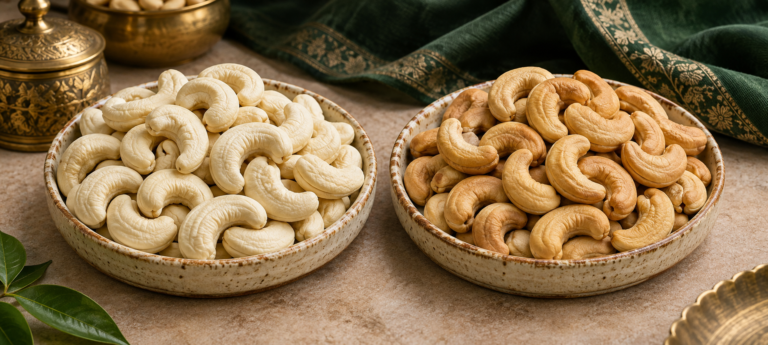
No. White and pale ivory kernels can come from either growing region. Whiteness concerns the colour grade and the particular batch. It cannot identify growing origin. Good processing can preserve a pale shade; too much heat can darken kernels.
The Association of Food Industries cashew specifications allow white, pale ivory and light yellow shades in the first-quality colour class. Paper-white colour is unnecessary. Compare uneven kernels against the quoted grade. White and scorched W320 are separate appearance classes.
Take W320 kaju, a common wholesale whole-kernel grade. The W refers to white wholes; 320 refers to a size band of about 300 to 320 kernels per pound, or 454 g. The size number reveals nothing about harvest country. W320 from two growing regions should be compared for the same size, colour grade and condition.
A yellow-brown patch might come from excess heat during shelling or drying. Other marks appear during roasting. Mould, insects or an unusual smell are grounds for rejecting a sample.
Very bright white kaju also proves little on its own. Colour cannot prove freshness, origin or chemical treatment. Check a sample representing the full lot.
Why can two batches from the same country taste and look different?
Harvest origin is only one part of the finished kernel. Cashew variety, maturity, processing heat, drying, sorting and storage also affect quality.
For instance, shelling uses heat or steam before the kernel is removed. Poor heat control can cause dark areas. Later, workers or machines sort kernels into colour and size grades. The same origin can produce different-looking lots.
Storage also affects quality after processing. Cashew kernels contain oils that can break down and cause an unpleasant smell or taste. The industry calls that defect rancidity. Heat, air and poor storage can make quality worse, regardless of where the crop grew.
A sound African-grown batch may pass your checks while a poorly stored Indian-grown batch fails them. The reverse is possible. Reject any lot with an unusual or stale smell. Compare the actual dispatch lot.
How can you compare Indian and African kaju samples fairly?
Compare W320 with W320, plain kernels with plain kernels, and one identified lot with another. Request samples from the lots the seller can supply.
Check colour, whole pieces and smell first
Spread each sample on a separate white plate under daylight or neutral white light. Check a handful from across each sample. Look for uneven yellow-brown marks, cracked kernels, small pieces and foreign matter. Compare acceptable whole kernels across the sample.
Open and smell each sample before tasting. Fresh kernels should have their normal, mild cashew smell. A sour, paint-like or stale smell needs attention. Reject samples showing mould, insects or a strange odour; never taste them. Visual checks cannot establish food safety.
Taste matched samples without knowing their origin
For sound samples, ask someone to label the bowls A and B. Taste equal portions without seeing which country each came from. Notice the nutty flavour, any bitterness and the finish after chewing. Repeat the comparison if the result seems uncertain.
A one-person tasting is a buying check, never a scientific result. It helps identify a preferred lot. A second buyer may prefer the other sample.
Test the kaju in your finished product
A mithai maker can prepare two small kaju katli trials. Use the same recipe, equal kaju weight and matching cooking conditions. A snack shop can roast both samples for the same time, using the same method and seasoning.
Check the finished taste, colour and rejected pieces. A raw kernel that looks slightly darker may still work in a ground sweet. A batch that tastes pleasant when plain may roast unevenly. The finished food may change your preference.
Save approved sample details with the quoted lot number. If the available lot changes, ask for another sample before accepting the replacement. An earlier taste test cannot approve a different batch.
Which origin should a Delhi shop choose for its product?
There is no single best origin for every shop. Retail packs, kaju katli and roasted snacks use cashews differently. We suggest choosing the grade and lot that work for the product you sell.
For a dry fruit shop selling whole kaju
Prioritise an even white-whole grade, sound kernels and a pleasant plain taste. Buyers see the whole nuts in loose displays and 250 g or 500 g packs. Uneven colour can weaken the pack presentation.
If your product is sold as Indian-grown kaju, ask for supporting batch information before using that claim. A W320 mark or an Indian packing address is insufficient proof of where the crop grew.
For a mithai shop making kaju katli
Judge the kaju after grinding and cooking. Whole-kernel size has less value once every nut enters the paste. Suitable cashew pieces can be worth comparing against whole kernels, provided the grade, smell and taste meet your recipe needs.
Compare the cost per kilo of usable kaju, after removing rejected material. Use delivered cost ÷ accepted kilos for the comparison. If two origins perform alike in the sweet, the lower usable cost may be the better purchase. Any extra payment for origin should have a purpose you can identify.
For a roaster or savoury-snack business
Test a small roast before buying bulk stock. Pale raw kernels can develop different marks during roasting. Check the finished batch for an even colour, pleasant flavour and an acceptable share of damaged nuts.
Origin remains relevant when customers request it. Yet roasted appearance and flavour deserve their own check. Roasting results still depend on the lot.
What should a Delhi wholesale quote confirm?
Ask the seller to identify the grade, growing origin if known, processing location, net weight and lot being offered. Request the delivered price too. A quote for Indian-grown W320 and one for African-grown W320 cannot be compared fairly when their grades or delivery terms differ.
A Delhi buyer comparing Khari Baoli and online quotes should match grade and net weight. The first quote may be for pickup; the second may include delivery. Compare the full cost of each acceptable batch beyond the rate per kg.
If you are paying more for Indian-grown cashews, request that exact claim in writing with the lot details. Also confirm that the approved sample represents the dispatched batch. When harvest origin is unknown, the quote should avoid an unsupported country claim.
What should you check before your next Delhi kaju order?
Judge the batch before paying an origin premium. Choose Indian-grown kaju when its traceable origin or tested flavour benefits your business. African-grown kaju deserves the same quality test.
For your next NutDana enquiry, share the grade, quantity, intended use and Delhi delivery area. Ask which batch, origin details and sample arrangements are available for that order. You can review wholesale cashew nuts in Delhi before requesting the quote.