

Buy Whole Cashews Only When You Need Whole Cashews
Gift boxes need whole cashews that arrive mostly intact. For kaju sweets or grinding, splits and pieces may cost less. A bakery can compare large white pieces (LWP) with small white pieces (SWP). Buy the form your shop will actually use.
Find the Minimum Order for Each Grade
Minimum order quantity (MOQ) is the smallest amount a seller accepts. Some sellers apply it to each grade; others count the complete order. Suppose the minimum is 10 kg per grade. Ordering W240 and W320 would then mean buying 20 kg.
Work out how many weeks that amount will last. At 5 kg a week, 20 kg covers 4 weeks. Freight may also rise when you add another carton. Compare the full cost for the quantity you need.
COMPARE THE SUPPLIERS
Add the MOQ for each grade.
- W240 minimum
- 10 kg
- W320 minimum
- 10 kg
- Total order
- 20 kg
5 kg / week → 4 weeks
Match Cashew Grades Before Comparing Prices
Grade numbers show the size of whole cashews. The 1960 Indian cashew grading schedule records kernel counts for whole grades. It puts W240 at about 485–530 and W320 at 660–705 kernels per kg. W240 kernels are larger, while W320 contains more pieces at the same weight. Both grades can be fresh or stale.
Get the exact grade and form written on each quote. Names such as premium kaju tell you too little. For pieces, ask for the specific piece grade as well.
Use 100 g to Check Size and Broken Pieces
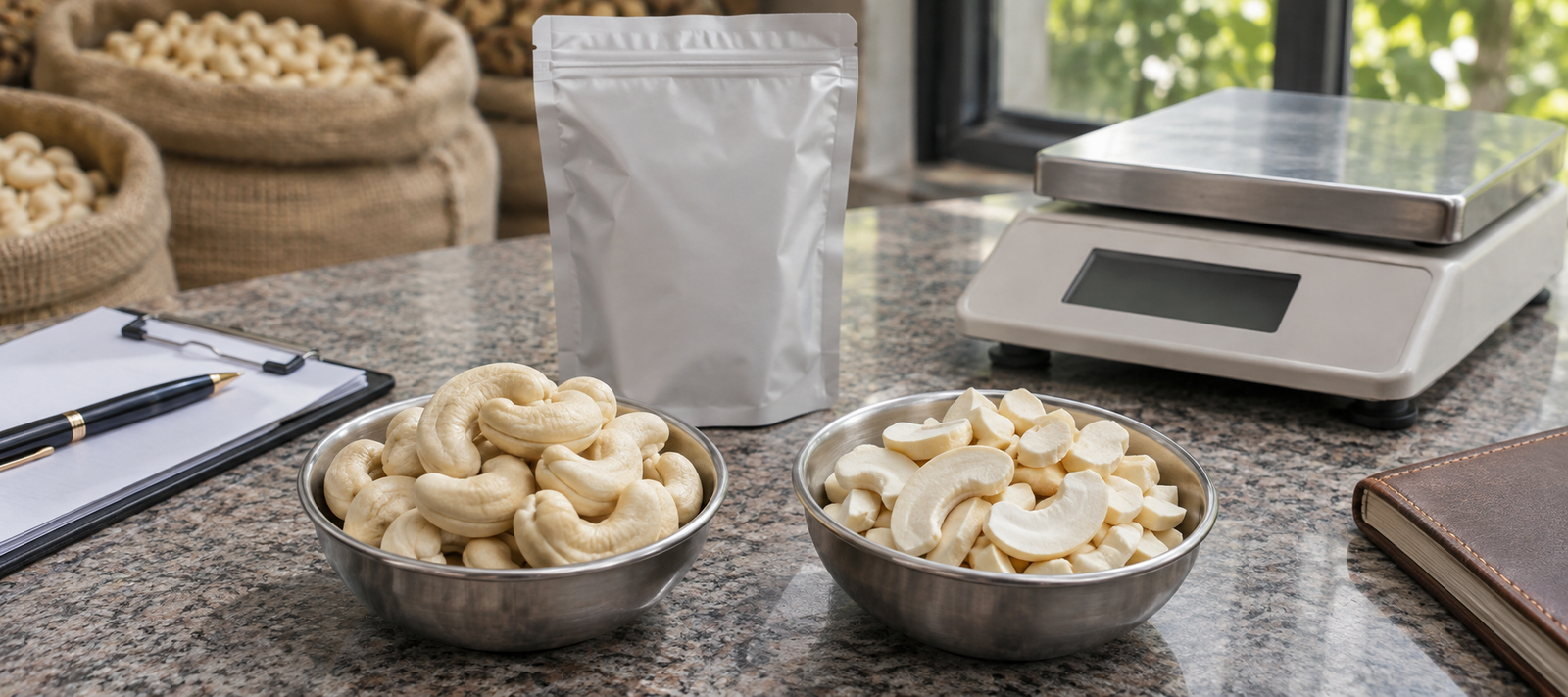
Request a sample from the batch the seller plans to send. Start with 100 g of whole cashews and count them. Under the older grade counts, W240 works out to roughly 49–53 pieces. W320 works out to about 66–71 pieces in 100 g. Treat the count as a quick size check, never proof for an entire shipment.
Next, weigh a fresh 100 g portion with any broken pieces included. Separate the broken cashews and weigh their total. If they weigh 4 g, the sample has 4% broken content. The 1960 grading schedule allowed 5% broken kernels at packing for white whole grades. Set a lower limit in the order if intact kernels are important.
For bigger purchases, request samples from more than one carton. If the seller changes the batch, check a new sample.
COMPARE THE SUPPLIERS
Start with a 100 g sample.
- W240 · whole kernels
- 49–53
- W320 · whole kernels
- 66–71
- Separate breakage sample
- 4 g / 100 g = 4%
Check whole-kernel size and broken content separately.
Smell the Cashews and Check Their Moisture
Spread a few cashews on a clean plate. Look for mould, insects, webbing, dirt or damaged kernels. A stale, musty or sharp oil smell is a warning. Reject suspicious cashews and skip the taste test.
The FSSAI standard for cashew kernels sets a maximum moisture level of 5%. A firm bite or clean smell cannot confirm that number. For larger orders, request a moisture test result for the offered batch. Ask who tested it, when, and which batch they checked.
Choose Pack Sizes That Match Weekly Use
Once you open a pack, its contents meet the air. If your shop uses 2 kg weekly, compare the available sealed sizes. Two 5 kg packs let you open the second pack later. One 10 kg pack exposes the full order once opened.
Cashews may come in tins, vacuum pouches or nitrogen-filled packs. Vacuum sealing removes air, while nitrogen packing replaces some air with gas. Every pack still needs an unbroken seal. Before ordering, check net cashew weight, pack date, batch number and storage directions. The FSSAI food labelling rules cover details required on food packs and bulk containers.
Check Supply for the Next Few Months
Your next order may come from a different batch. For a shop needing 20 kg each month, ask about current ready-to-send quantity. Then ask how early to place the following order. Confirm if any change of grade needs your approval.
India has a main cashew harvest season from February to May. Processors can still sell packed cashews during other months. Ask how the seller stores packed goods and how long each quote lasts. Cold storage alone cannot promise the same price all year.
Look Beyond a Kollam or Mangaluru Address
Cashew processors work in Kollam, Kerala, and Dakshina Kannada, Karnataka, including Mangaluru. Their locations tell you little about the quality of a particular shipment.
Find out who packed the cashews and where dispatch will begin. Compare the sample and transport charge to your PIN code. A trader outside either city may offer the same grade.
Match the Seller Name Before Paying
Request the 14-digit FSSAI licence or registration number. The official FSSAI licence checker lets buyers inspect business details and current status. The 2026 FSSAI licensing update introduced continuing validity for licences and registrations. Authorities can suspend or cancel them, and businesses can surrender them. Use the live status, even when the seller shares a certificate photo.
If the seller provides a GSTIN, use the official GST taxpayer search. The business name should match the invoice and payment details. Resolve any different bank account name before transferring money.
Compare the Cost of Whole Cashews You Can Use
First calculate the full delivered bill, including freight and any packing charge. Compare prices with GST treated the same way. If you sell whole cashews, broken pieces can reduce the weight available for those packs.
Imagine 2 offers for 10 kg of W320. Supplier A charges ₹8,000 delivered with 4% broken pieces. Supplier B charges ₹8,150 delivered with 1% broken pieces. These prices and percentages are only examples.
| For a 10 kg order | Supplier A | Supplier B |
|---|---|---|
| Delivered cost | ₹8,000 | ₹8,150 |
| Broken share | 4% | 1% |
| Whole cashews available | 9.6 kg | 9.9 kg |
| Cost per usable whole kg | ₹833.33 | ₹823.23 |
Supplier B costs more for the order, yet less per whole kg. The calculation assumes broken pieces have no value for your business. If you can use or sell those pieces, count their value too. Selling the broken pieces can reverse that result.

COMPARE THE SUPPLIERS
Compare the whole kilos you can use.
- Supplier A · 9.6 kg whole
- ₹833.33 / kg
- Supplier B · 9.9 kg whole
- ₹823.23 / kg
₹8,000 ÷ 9.6 · ₹8,150 ÷ 9.9
Agree on Payment and Returns Before Paying
Indian wholesalers use different advance and credit terms. There is no single advance percentage across all sellers. Before paying, get the quote and bank details under the same business name.
Your written order should cover 4 things:
- Goods: Exact grade, whole or piece form, total kg and pack sizes.
- Payment: Total with GST and freight, advance amount and balance date.
- Delivery: Dispatch date, destination PIN code and transport charges.
- Problems: Time allowed for complaints, replacement or refund, and return freight.
Start with the smallest order the supplier accepts if the seller is new to you. Agree who will answer a shortage or wrong-grade complaint.
Inspect the First Delivery as Soon as It Arrives
Count cartons and look for wet or torn packing before opening. Match batch numbers, grades and net weights with the invoice. Photograph damaged seals and send the details within the agreed complaint period.
Check the cashews against the sample you approved. Note the broken share and any quality problem in that delivery. Those details help you decide on your next order.
Request a Cashew Wholesale Quote From NutDana
Share your required grade, quantity in kg and delivery PIN code with NutDana. Request the price including freight, available packing sizes and sample terms. Confirm payment and delivery terms before placing the order.