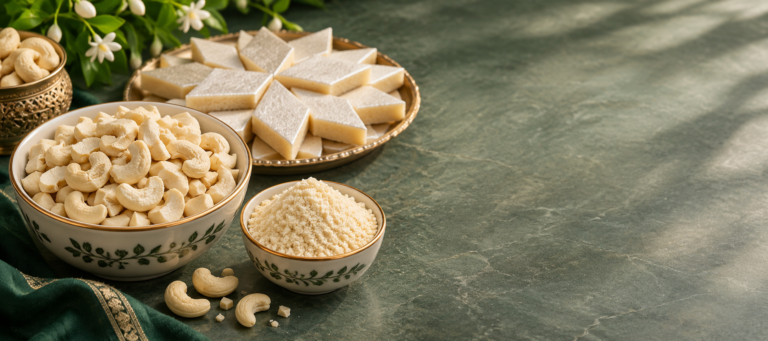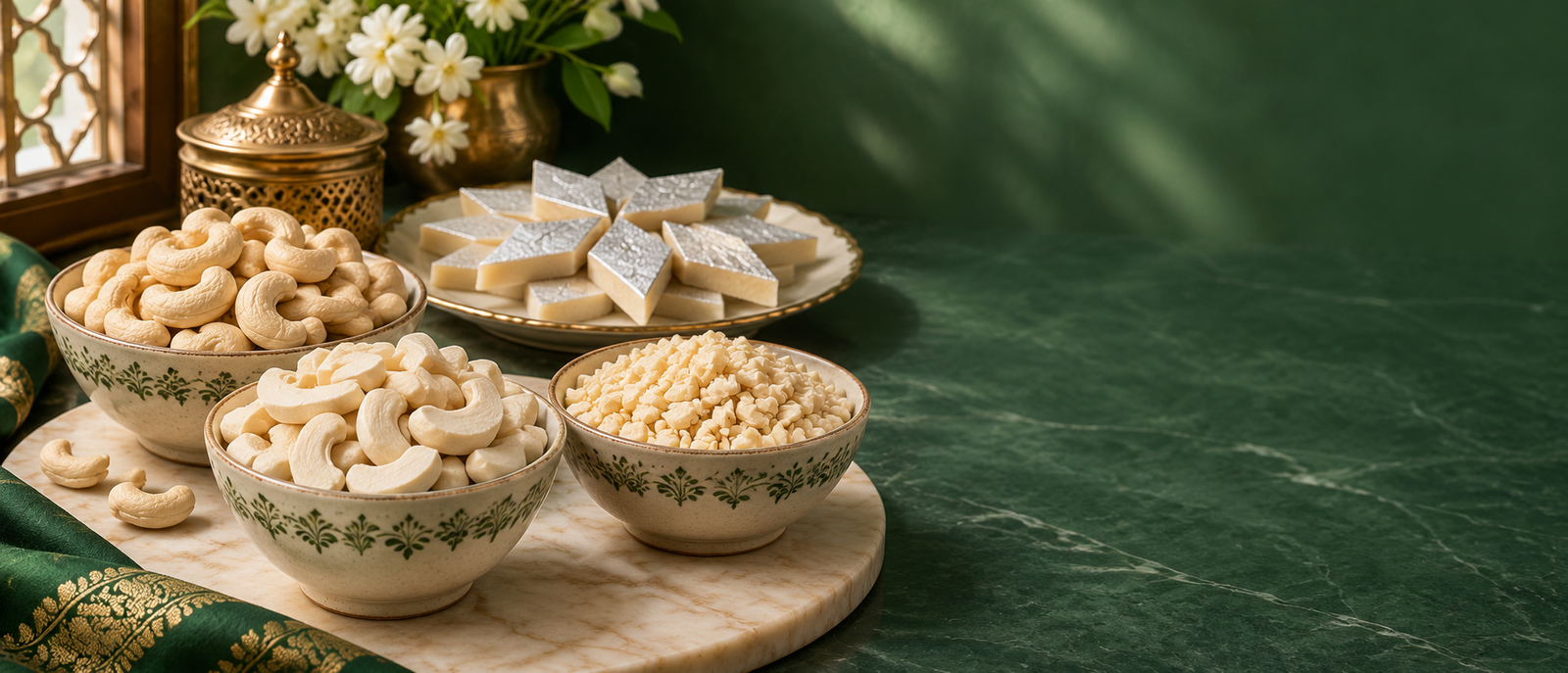
Start with a sample of LWP, or Large White Pieces, for kaju katli. The cashews go into a grinder before cooking. Their whole shape has little value once ground into powder or paste. LWP offers a practical starting choice for a Delhi mithai shop buying cashews in bulk.
SWP, or Small White Pieces, can work just as well. Try SWP when its sample meets your colour, taste and smoothness standard at a lower total cost. Choose whole W320 only when a cooking test supports the extra cost, or when you need whole cashews for another product.
Which kaju grade should a mithai shop buy?
Compare LWP and SWP first when every cashew will become katli. Both are white-piece grades. W320 is a whole-cashew grade, with roughly 300 to 320 kernels in 454 g. That number counts whole nuts in 454 g. The finished sweet needs its own test. Published cashew grading charts define the grades separately.
LWP: our first sample choice
LWP contains large white cashew pieces. The pieces should have the white, pale ivory or light ash colour expected for their grade. For a shop selling pale kaju katli, larger pieces also make a visual check easier before grinding.
Open the sample and check the pieces near the bottom too. Look for unwanted skin, dark spots and a large amount of powder. Then cook a small batch. Our LWP-first advice is a starting point. Judge the cooked sample before ordering.
SWP: a good option when the finished katli passes
SWP contains smaller white cashew pieces. Small size alone causes no problem once the cashews become fine powder. A clean SWP batch can make smooth kaju katli using the same recipe as LWP.
Compare the actual pieces, finished sweet and delivered price. If SWP makes the same katli at a lower cost, there is little reason to pay more for bigger pieces. Check extra-fine dust separately from normal small pieces. A shop may use clean fines in its grinder, provided its own recipe accepts them.
W320 and white halves: when do they earn a higher price?
Whole W320 kaju and white halves also work for katli. Yet their larger shape disappears during grinding. Paying more for whole nuts makes sense when the same batch also serves dry fruit packs, gift boxes or a sweet with visible cashew pieces.
For katli alone, put W320 against LWP in the same cooking test. Compare the cooled sweets. Raw nut size cannot settle the decision. A higher whole-cashew grade cannot promise a smoother or whiter sweet on its own.
Can I buy kaju tukda, kaju kani or baby bits for katli?
Yes, if the pieces are safe, clean and suitable for your recipe. The words kaju tukda describe broken cashews in everyday trade. Ask the seller for the exact grade. LWP, SWP and BB name different piece sizes under Indian grading rules.
BB, or Baby Bits, contains pieces smaller than SWP. Such pieces can enter the grinder, although a very fine sample makes unwanted skin and dark fragments harder to spot. Ask what the supplier calls kaju kani. Kani, SWP and BB name different or seller-specific sizes. The name alone cannot tell you its grade, colour or amount of fine powder.
Ready-made cashew powder needs another check. Ask which cashew lot went into the powder, how the seller packed it and how long the pack has been open. You cannot inspect whole or broken kernel colour once the material becomes powder. Choose a fresh sample with a known source before placing a larger order.
Which kaju colour and condition are right for pale katli?
Choose plain, peeled, unflavoured cashew kernels with an even pale colour. For regular pale kaju katli, avoid salted, masala-coated or heavily roasted snack cashews. Their added flavour or darker colour can change the finished sweet.
Some sellers call plain shelled kernels raw kaju. Ask for edible, peeled kernels ready for sweet making. Cashew nuts inside hard shells are a different raw material. The usual processing of edible kernels already includes heat during shell removal.
Check the lot before any cooking test. Reject packs with visible mould, insects, a stale oily smell or other unwanted material. Sugar and heat cannot turn spoiled cashews into safe food. The FSSAI cashew kernel standard covers whole nuts and pieces, including a maximum moisture level of 5%.
A bite, snap or smell test cannot prove the moisture percentage. Ask for relevant batch test details when your shop requires measured proof. A good colour check also cannot replace food safety checks. Dessert grade for sweets needs its own batch and recipe trial.
How can I test LWP against SWP before a bulk order?
Make two small katli batches using the same recipe and cooking method. Start with 250 g of each grade only if your grinder and pan can process that amount. A larger test works better for industrial equipment.
- Match the samples. Ask for LWP and SWP from the actual lots offered for sale. Note each grade and any available batch details.
- Match the recipe. Weigh the same cashew, sugar and water amounts. Use the same grinding method for both samples.
- Match the cooking. Use one pan type and the same heat control. Compare dough thickness before cutting.
- Check after cooling. Look at both sweets under the same light. Taste for fresh cashew flavour and check for gritty bits or excess oil.
- Weigh the result. Note the finished katli weight and any pieces your shop rejects for its own sale standard.
If your shop grinds dry kaju, use short pulses. Long grinding can release more oil and turn powder greasy. For a soaked-paste recipe, use the same soaking time and water amount for both grades. Changing the method between samples makes the comparison unfair.
What if one test batch makes dark or oily katli?
Check the recipe method before blaming the cashew grade. Extra grinding can make a powder oily. Unequal heat or cooking time can also change the shade of the sweet. Repeat the affected sample with the same method as the better batch.
If both tests use equal heat, sugar and grinding, inspect the rejected sample again. Dark cashew fragments may matter when your shop sells very pale katli. A coarse grind may matter when buyers expect a smooth bite. Write down the exact fault before approving the next batch.
Save a sealed portion of the approved sample for a later delivery comparison. Ask the seller what batch identification can appear on the quote or pack. If the offered lot changes, request a sample from the replacement lot.
Which kaju grade costs less per kilo of finished katli?
Compare the cost of cashews accepted for your recipe. The quote alone misses sorting loss. Sorting loss can change the result even when both lots are safe. An unsafe lot belongs in a rejection claim, never in a cheap-katli calculation.
Consider an example with made-up prices and sorting figures. LWP costs ₹800 per kg delivered. Your extra-pale katli standard accepts 980 g. The accepted kaju costs about ₹816 per kg. SWP costs ₹780 delivered, but the same colour standard accepts 950 g. Its accepted kaju costs about ₹821 per kg.
The cheaper quote now costs slightly more for the kaju your shop will use. If both grades pass with equal accepted weight, SWP wins on price. Only your actual sample results can settle the comparison.
Suppose your own recipe uses 650 g of accepted cashews for 1 kg of finished katli. The example kaju cost becomes about ₹531 per finished kg with LWP, against ₹534 with SWP. Sugar, packing, cooking work and other costs still need adding. The 650 g amount is an example. Your recipe may need a different amount.
What should a Delhi mithai shop confirm before paying?
Ask for a written quote tied to the grade and sample you approved. A product photo cannot confirm the cashews inside your delivery. Check these points before paying:
- Exact grade and colour, such as LWP white or SWP white.
- Available batch details and the approved sample reference.
- Net kaju weight, excluding the bucket, tin or other packing.
- Price per kg, applicable GST and delivery cost to your Delhi area.
- Minimum order, pack type, dispatch date and action for short or damaged delivery.
If comparing a Khari Baoli pickup with a Delhi delivery, include travel, loading and transport costs in your comparison. On arrival, check the seal, net weight and grade details before using the new lot. Save the invoice and packing details if a delivery problem needs review.
What should I ask NutDana for a kaju katli order?
Tell us which katli you make, the kaju grade you want to test and the number of kilos you need. Share your Delhi delivery area and required date. Ask for current LWP and SWP availability, a sample from the offered lot where possible, and the complete delivered quote.
See our wholesale cashew nuts in Delhi page for your bulk buying enquiry. Compare the sample before confirming your order.