

Cashew colour classes are the shade groups, from white through scorched to dessert, that grade lists use to sort cashew kernels. Each kernel, the nut inside the shell, gets a colour class and a size grade. Scorched kernels have turned yellow or light brown from too much heat. Dessert kernels show deep brown, deep blue or black marks. Codes name the class: in SW320 on the cashew grades chart, S marks scorched, W marks whole and 320 marks the size.
What makes a kernel white, scorched or dessert
A cashew kernel comes out white when processing goes well. A darker shade shows a fault on the farm, in the factory or in storage:
- Too much heat: roasting, shelling or drying with too much heat makes a kernel yellow or light brown.
- Iron in water: iron in the water that moistens raw nuts leaves blue patches.
- Unripe nuts: unripe and shrivelled kernels fall into SSW, the seconds class on the Indian list.
- Damage before harvest: an attack on the growing kernel leaves small pits.
- Long storage: in a six-month storage test, cashew kernels turned more yellow the longer the test went on.
Cashew colour classes in eight grade lists
Each grade list splits whole kernels into three to six colour classes, from white to its darkest class.
| Grade list | White class | Middle classes | Darkest class | Classes |
|---|---|---|---|---|
| Indian export list | W, white wholes | SW, scorched; SSW, scorched seconds | DW, dessert | 4 |
| ISO 6477, world standard | Grades I to VII, white | Grade VIII, SW; grade IX, SSW | Grade X, dessert | 4 |
| NC 1:2018, East African draft | W, white | SW; SSW; DW | LDKW, lower dessert wholes | 5 |
| TCVN 4850, Vietnam | W, white | S, scorched; SS, second scorched; LB, light blemish; B, blemish | DB, dark blemish | 6 |
| UNECE DDP-17, 2013 edition | Extra, white | Class I, scorched or lightly blemished | Class II, scorched seconds or dessert | 3 |
| ASEAN Stan 20:2011, Southeast Asia | Extra, White Whole | Class I, Scorched Whole | Class II, Scorched Seconds | 3 |
| US AFI specification | First Quality Fancy | Second Quality Scorched; Lightly Blemished Wholes; Third Quality Special Scorched | Dessert Blemished Wholes | 5 |
| Brazil, farm ministry rule 2 of 2017 | Tipo 1 | Tipos 2 and 3, darker; tipos 4 and 5, spotted | Tipo 6, also written M | 6 |
The Bureau of Indian Standards product manual puts white first, scorched second and dessert last. UNECE DDP-17 is the most widely used cashew standard in Europe, and each of its classes has its own defect limits.
Colour letters in grade codes
In Indian, ISO and Vietnam codes, S marks a scorched grade and D marks a dessert grade. Examples are SW320, SB for scorched butts and DP for dessert pieces. Most white grades have no colour letter: W320 is a white whole, and B is a white butt. Vietnam adds LB for light blemish, B for blemish and DB for dark blemish, as in LBW320.
Brazilian codes leave colour out of the letters. A number after the word Tipo names the colour, with M for type 6. Some spec sheets join the code and the type number, as in W1 for a type 1 whole.
The same letters name different things on different lists:
- SW: scorched wholes in India, ISO 6477 and TCVN 4850; small wholes of any colour in Brazil, 451 to 550 kernels per pound (453.59 g)
- SP: scorched pieces on the Indian list; small pieces in Brazil, held between the 2.80 mm and 6.35 mm sieves
- SSP: scorched small pieces on the Indian list; very small pieces in Brazil, held between the 2.36 mm and 4.75 mm sieves
- B: butts on the Indian list; also the blemish class in TCVN 4850
Shades that count as white
Every list counts white and a cream shade, pale ivory or ivory, as white. Seven of the eight lists add a pale grey shade, called light ash or ash-grey. Lists differ on light yellow: five count it as white, while the Indian list, NC 1:2018 and ISO 6477 leave it out.
| Grade list | White class shades |
|---|---|
| Indian export list | White, pale ivory, light ash |
| ISO 6477 | White, very pale ivory, light ash-grey |
| NC 1:2018 | White, ivory, light ash |
| TCVN 4850 | White, ivory white, light yellow, pale ivory, light ash grey |
| UNECE DDP-17 (2013) and ASEAN | White, pale ivory, pale ash-grey, light yellow |
| US AFI | White, light yellow, pale ivory |
| Brazil, tipo 1 | White, light yellow, pale ivory, light grey |
NutDana buying advice also counts light yellow as a normal shade for white wholes. Full yellow is different: AFI, UNECE, ASEAN, TCVN 4850 and Brazil all place yellow kernels in the scorched class. Deep ivory also counts as scorched in ISO 6477, NC 1:2018, UNECE, ASEAN and AFI. AFI, TCVN 4850 and Brazil ask for one even shade across a white lot, one batch of kernels.
When one shade fits two classes
A few shades appear in two classes of the same list. UNECE DDP-17 names light brown in Class I and again in Class II. A light brown kernel with amber or blue patches, black spots or blemishes goes to Class II. ISO 6477 names light ash-grey for white wholes and for scorched wholes. ISO places the kernel in the scorched class when the shade comes from overheating.
Spots and blemish classes
A blemish is a small dark mark on the kernel surface, and speckles are tiny dots. Vietnam, the United States and Brazil build some colour classes from these marks:
- Vietnam: the Vietnamese text of TCVN 4850 caps light brown speckles on a light blemish whole at 40% of the kernel surface. A blemish whole may show brown speckles on up to 60%. The English text of the same standard reads 40% and 60% of the kernels. A dark blemish whole has no cap.
- United States: AFI counts a blemish once spots from causes other than shelling or blanching add up to more than 3 mm on one kernel. Pits from damage before harvest count once the pits pass 1 mm. Four 1 mm specks on one kernel add up to 4 mm, over the 3 mm limit.
- Brazil: the word brocada names a kernel with pits or dark spots over 1 mm across. Tipo 4 takes tipo 1 and 2 shades with pits or small black dots. Tipo 5 takes darker whole kernels with heavy pitting, and tipo 6 takes reddish or dark brown kernels with heavy stains.
Of the eight lists, only Brazil names a reddish class. Brazil also lists a light purple or blue kernel, called arroxeada, as a minor fault.
Colour classes for broken kernels
On the Indian and Vietnam lists, broken kernels take the same colour classes as whole kernels. The 26 Indian grades split into 11 white, 11 scorched and 4 seconds or dessert grades. Scorched pieces follow the SW shades, and dessert pieces follow the SSW and DW marks.
TCVN 4850 matches each broken grade to the shade of one whole grade. White butts match white wholes, and dark blemish pieces match dark blemish wholes. Its 42 grades split into 13 white, 7 scorched, 5 second scorched, 6 light blemish, 6 blemish and 4 dark blemish grades. Baby bits, the last grade, have no colour class in TCVN 4850, while the Indian list puts baby bits with its white pieces.
How much darker kernel a lot may hold
Most lists let a lot hold a small share of kernels from the next darker class. UNECE DDP-17 (2013) allows up to 5% in the Extra class and in Class I. In a 1 kg Extra bag, 5% comes to 50 g of Class I kernels.
The Indian list sets one limit at each step:
- A white whole lot may hold 5% of SW kernels. For W180 to W450, smaller kernels count in the same 5%.
- An SW lot may hold 7.5% of SSW kernels. For SW180 to SW450, smaller kernels count in the same 7.5%.
- An SSW lot may hold 7.5% of DW kernels.
- A DW lot has no darker class below it.
TCVN 4850 sets a 5% cap for the next lower grade, with neither colour nor size named for that grade. AFI sets no colour share and counts a lower-grade kernel as a defect. The Lower-Size Cashew Kernels entry covers limits for smaller kernels.
How to check cashew colour
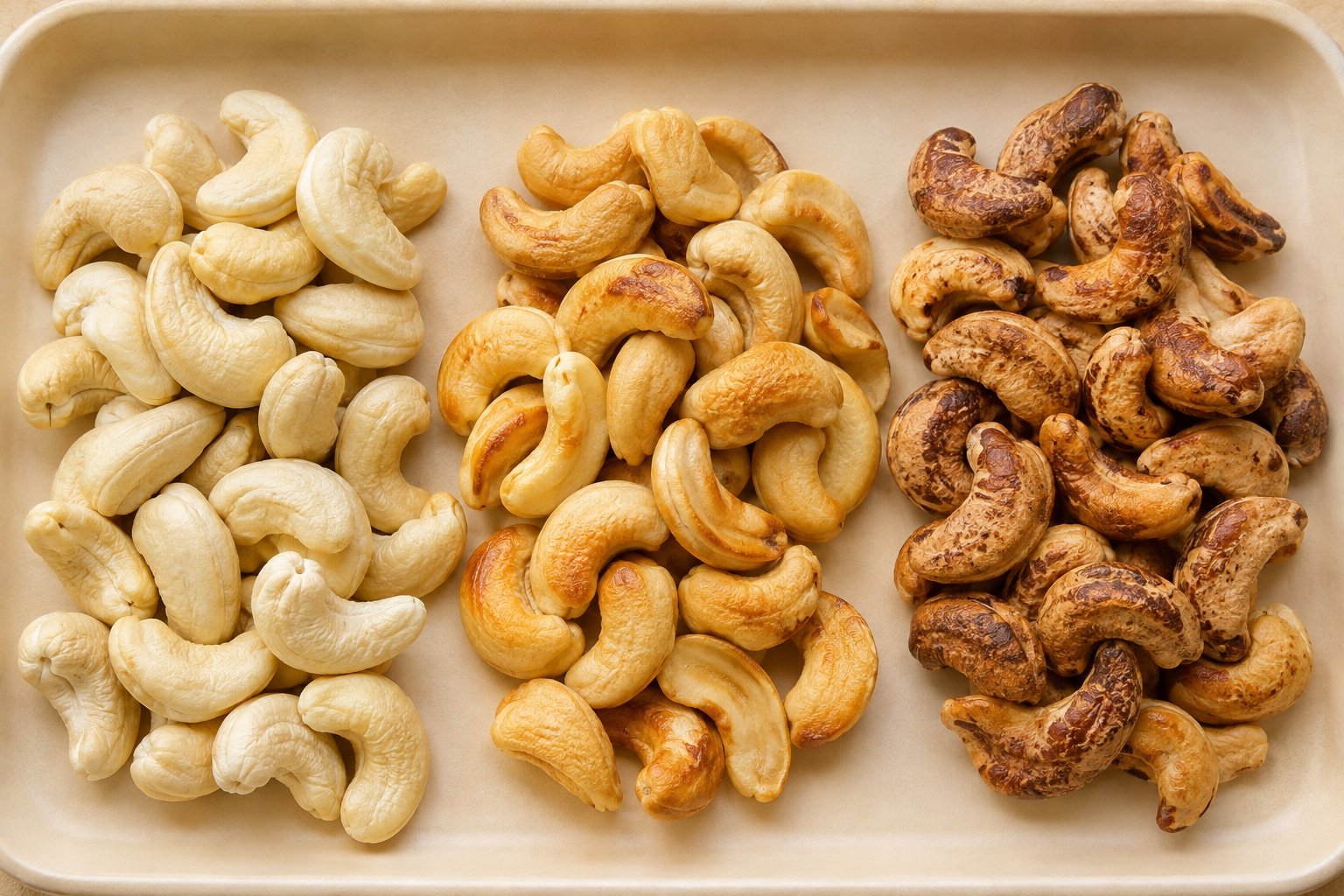
TCVN 4850 sets the most detailed colour check. The tester spreads the sample in a thin layer on a white surface and looks with the naked eye. The light is indirect daylight or a daylight lamp. AFI asks for full spectrum light, a lamp with the whole colour range of daylight. ISO 6477 asks for a visual check and names no light.
Steps for a table check:
- Mix about 500 g of kernels from several spots in the lot.
- Spread them in one layer on a white sheet.
- Look under indirect daylight or a full spectrum lamp.
- Pick out each kernel whose shade or marks match a darker class on the quoted grade list.
- Weigh the picked kernels. A 20 g pile out of 500 g is 4%.
NutDana advises naming the colour class on every purchase order, next to the grade and the form. The bulk buying checklist adds moisture and defect checks for large orders.
In Indian factories, trained workers do the colour grading with the eye. In one camera test, every model told white from scorched kernels with over 98% accuracy.
Marks that show after roasting or packing
AFI names five colour faults that show up only after roasting or packing:
- Brown spots that never show on a raw kernel can appear after roasting.
- Scraped areas turn lighter than the rest of the kernel after roasting. AFI calls a roast uneven once spotted kernels, scorched tips and similar colour faults pass 7%.
- A lot made from mixed raw nuts, or from mixed processing, can roast into light and dark kernels.
- Flux, a material used to seal tins, can drip onto kernels and leave black or brown marks.
- Cashew meal stuck to the surface can leave a lasting stain.
NutDana notes that a top white grade loses its bright white colour once roasted.
Colour class questions
Does a white colour mean the cashews are fresh?
No. Colour alone cannot show how old a kernel is, as NutDana buying advice points out. A fresh, mild smell and a moisture test are better freshness checks.
Is it a fault to find white cashews in a scorched lot?
No. The colour limits in the eight lists cap darker kernels only, and none sets a cap for lighter kernels in a darker lot.
Which colour class does NutDana sell?
White. NutDana sells W180 to W450 white wholes and white halves and pieces, with no scorched or dessert grade.
Sources and further reading
- CAPEX, Kollam: copy of the Indian cashew kernel export grade list
- ISO 6477:1988 Cashew kernels: Specification, sample pages
- Northern Corridor NC 1:2018 Cashew kernels: Specification (WTO notification)
- VINACAS: TCVN 4850:2010 Specification for cashew kernels, Vietnamese and English
- INC: Cashew technical information, with UNECE DDP-17 (2013) tables
- ASEAN: ASEAN Stan 20:2011 Standard for cashew kernels
- AFI: Cashew kernel specifications, updated September 2023
- Brazil MAPA: Instrução Normativa 2, 6 February 2017, cashew kernel standard
- Bureau of Indian Standards: Product manual for cashew kernels, IS 7750:2013, May 2021
- CBI: Entering the European market for cashew nuts
- Bhattacharjee and others: Compositional profiles of gamma-irradiated cashew nuts, 2003 (AGRIS record)
- Ganganagowdar and Siddaramappa: Recognition and classification of White Wholes grade cashew kernel using artificial neural networks, 2016
- Baitu, Gadalla and Öztekin: Traditional machine learning-based classification of cashew kernels using colour features, 2023