
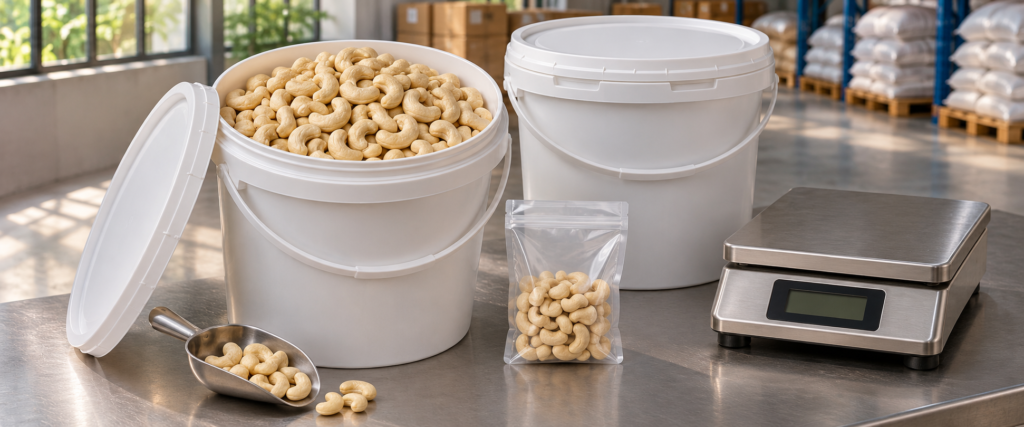
When a bulk kaju delivery reaches your Delhi shop, check four things before you sign: the bucket count, the seals, the batch code on each label and the papers. The batch code is the lot number printed on the label. Then weigh every sealed bucket and open one bucket of each grade before you mix the new kaju with old stock. Follow the delivery checklist below one step at a time. For a five-bucket order, the door checks take about ten minutes. Those ten minutes save a long argument later about a short or wrong delivery.
What should you set up before the kaju arrives?
Get four things ready on the morning of delivery:
- Your approval record: the grade, batch code and photo of the kaju sample you approved, along with the quote or invoice.
- A tested scale: a platform scale that holds at least 15 kg and shows weight in steps of 5 g or less. In Delhi, a verification stamp on an electronic scale lasts one year, as per the Delhi Legal Metrology department. Check that the stamp is current.
- A known weight: a stamped 5 kg or 10 kg weight. Put it on your scale before the delivery. If a 10 kg weight reads 9.95 kg, your scale reads 50 g low. Add 50 g back to every reading that day.
- The empty bucket weight: ask your supplier for the weight of one empty bucket with its lid, seal and inner bag. Ask for it with the quote, and note it on your order.
If your shop is in a narrow lane of Khari Baoli or Chandni Chowk, the driver may stop at a main-road drop point. Do the door checks there, before a handcart takes the order to your shop.
What should you check before you sign?
Check the outside of every bucket while the driver waits. Each of these four checks takes a minute or two.
- Count: match the number of buckets for each grade with the invoice. An order of 50 kg of W320 with 10 kg of LWP should arrive as six sealed buckets, with two kinds of label.
- Seal: check that the plastic ring under each lid is whole. The ring breaks the first time anyone opens the lid. The lid should lie flat, with no cracks in the plastic. A wet or torn carton needs a closer look inside, as our steps for checking cashew moisture show.
- Label: each label should show the grade, the net weight and a batch code. The batch code should match the sample you approved.
- Papers: the driver should hand over a GST tax invoice with your name, the grade, the kilos and the rate. To check each line of the bill, use our notes on reading a kaju invoice. A delivery worth more than ₹50,000 that crosses a state line, such as Delhi to Noida or Gurugram, needs an e-way bill. Within Delhi, the e-way bill limit is ₹1 lakh.
If anything fails, photograph it before the driver leaves. Write the problem on the delivery slip in plain words, such as “Bucket 4 lid seal broken”. Our answer on matching a delivery to your approved batch covers what to write when a batch code differs.
When the driver has no time for weighing, write “Received 6 sealed buckets, weight check pending” on the slip, and sign under that line.
Should you pay the balance before or after the checks?
Pay after the count, seal and weight checks. If your quote asks for a balance on delivery, finish the door checks first, then pay.
Pay only to the bank account printed on the tax invoice, and avoid sending money to a driver or to a personal UPI number. A push to pay before any check is one of the red flags in a wholesale kaju quote. Save the payment receipt with the invoice and your weight readings. If one bucket fails, tell the supplier before you pay, and agree on the amount for that bucket in writing.
How do you weigh every sealed bucket in a few minutes?
Take off any outer carton or plastic wrap, and press zero on the scale. Then weigh each sealed bucket and take away the empty bucket weight. The result is the net kaju inside.
Take a sealed W320 bucket that reads 10.66 kg, with an empty bucket weight of 0.62 kg. The kaju inside weighs 10.04 kg. Number the buckets 1, 2, 3 with a marker, and write each reading next to its number and batch code.
Weigh all of them, and avoid checking just one. One reading of 10.04 kg tells you nothing about the other four. Even a 250 kg order takes only 25 readings. If the supplier has no empty bucket weight for you, weigh the sealed buckets now and weigh the kaju alone after opening. Our steps for weighing kaju without the bucket cover that method.
How short can a 10 kg kaju bucket be?
Treat 150 g as the limit for a single bucket, and expect the full weight across the whole order.
The Indian packaged goods rules allow a single 10 kg retail pack to fall up to 150 g short. The same rules pass a batch only when the average of the packs reaches the declared weight. A quote for 10 kg net per bucket promises 10 kg in every one, and the average is the fair test of that promise.
Take five W320 buckets that weigh 10.04, 9.97, 9.86, 10.02 and 9.96 kg net. No single bucket is more than 150 g short. Together, the five hold 49.85 kg, or 150 g less than 50 kg. At ₹920 per kg, that shortfall is worth about ₹138. Raise it with your supplier on the same day, with the readings.
A single bucket more than 150 g short needs a scale photo and a same-day report, whatever the average.
Which buckets should you open, and what do you check inside?
Open one bucket of each grade, and open any bucket with a damaged seal or a wet carton. Do it on the same day, before the new kaju touches your old stock.
Inside each open bucket, check six things:
- Inner bag: look for a heat seal or tie, no holes and no water drops.
- Smell: good kaju has a mild, nutty smell. Set it aside at any musty or old-oil smell.
- Snap: break a few kernels. Dry kernels snap cleanly, while damp kernels bend.
- Colour: white grades should look pale ivory, with no dark spots or scorched patches.
- Grade: count the kernels in 100 g. For W320, the count should fall between 66 and 71, as listed in our W320 cashew wiki. For pieces such as LWP, compare the piece size with your approved sample.
- Broken share: weigh the broken pieces from that 100 g, and compare the figure with your approved sample.
If the first bucket of a grade passes, the sealed ones from the same batch can go into stock. If it fails, open a second one from that batch before you decide.
What proof should you save on delivery day?
Save proof for every problem, and file it with the invoice:
- Photos of each label, seal and batch code, taken before opening
- A photo of the scale display for every reading
- A short video as you open the first bucket
- The delivery slip, with your written remarks
- The damaged bucket, lid, inner bag and carton
Take every photo before you move or repack the kaju. Once the kaju goes into your shop jars, nobody can prove which bucket it came from.
What if one bucket fails the check?
Set the failed bucket aside, accept the rest, and tell your supplier on the same day.
Send the order number, the bucket number, the batch code, your weight readings and the photos in one message. Ask in writing what happens next: a top-up of the missing kilos, a replacement bucket or a credit on the next bill. Hold the failed bucket closed, and avoid using or selling any kaju from it until you have a written reply.
Before you order, ask the supplier how many hours or days you have to report a problem, and get the answer on the quote. A report sent within hours, with photos and readings, is easier to settle than a complaint a week later.
How does NutDana pack bulk kaju for Delhi delivery?
We seal every NutDana bucket, and each one holds 10 kg net of kaju. Each order comes with a GST tax invoice that shows HSN code 0801. Ahead of bulk payment, we share a sample, or photos of the lot. Dispatch follows within three to five days of your go-ahead, with free delivery across Delhi NCR from 250 kg of a single grade.
When you order, ask us to note the empty bucket weight and the batch code on each one on your quote. You can then check the delivery against both at your door. For grade-wise rates, see wholesale kaju in Delhi.
NutDana Editorial Team. We seal and deliver 10 kg kaju buckets for shops, mithai kitchens and resellers in Delhi NCR. Every rule, rate and link here matches what we found on 16 November 2026.