To source wholesale cashews for a private label kaju brand, buy one grade first and test it in a small trial lot. Choose a supplier who sends a GST tax invoice, a lot code and a packing date with every order. Before you sell cashews on Amazon, put four things in place: an FSSAI licence, a GSTIN, a Legal Metrology packer registration and a trademark application.
Which kaju grade should a new private label brand start with?
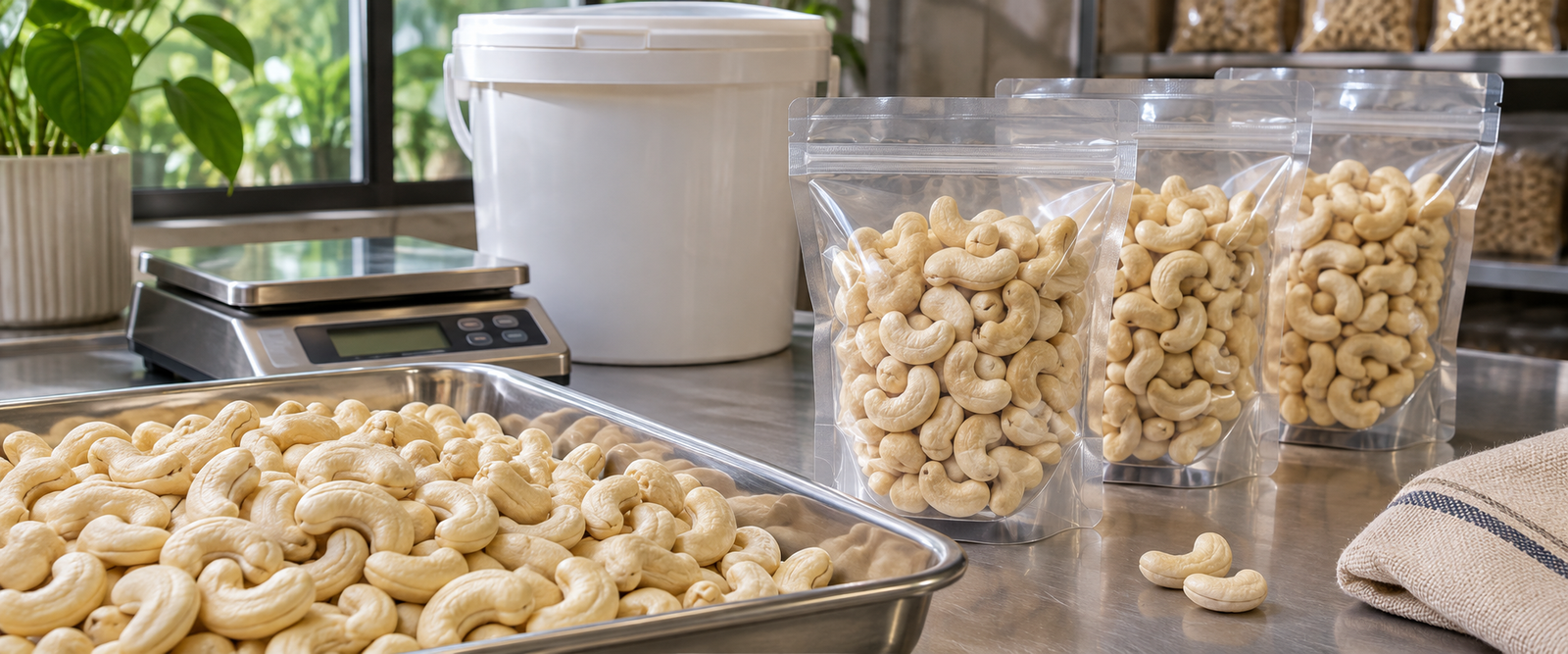
Start with W320 in a 250 g pouch and a 500 g pouch. W320 is the most traded whole grade, its size looks good in a see-through pouch, and it costs less per kg than W240 or W180. Add a W240 pouch later, as a premium choice, once the first product sells well.
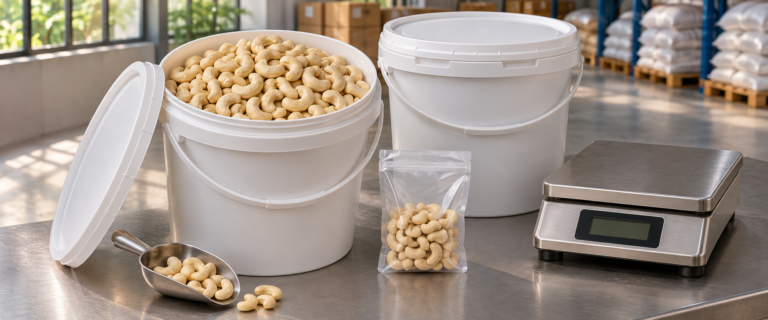
Buy one 10 kg or 20 kg lot for your trial. A 10 kg bucket fills 40 pouches of 250 g. Sell those pouches and read the first reviews before you place a big order. Amazon buyers post photos of broken kernels, dark spots and soft kaju, and one bad lot can bring a string of low ratings.
Check your trial lot in two ways before you pack it:
- Kernel count: 100 g of W320 should hold about 66 to 71 kernels, as our W320 grade facts show.
- Broken share: pick out the halves and pieces from 100 g and weigh them. Our answer on broken kernels in a W320 lot covers how much is normal.
To compare the profit on a W240 pouch against a W320 pouch, read our answer on the best kaju grade for retail profit.
Which registrations do you need before you pack kaju in Delhi?
Get these four in place before launch. The first three are legal requirements, and the trademark protects your listing:
- FSSAI licence or registration. Every food business that packs or sells kaju needs one. FSSAI has told online platforms that no food business may sell without a valid licence or registration. FSSAI raised its turnover limits in April 2026. Basic registration now covers up to ₹1.5 crore a year, and a state licence covers up to ₹50 crore. Amazon asks for your FSSAI number before it approves grocery listings.
- GSTIN. Kaju sells at 5% GST, with HSN code 0801. A small seller can skip GST registration only for sales inside one state. A brand that ships across India through Amazon needs a GSTIN.
- Legal Metrology packer registration. Anyone who packs goods for sale with a printed weight must register as a packer under Rule 27 of the packaged goods rules. In Delhi, you apply to the Delhi Legal Metrology department, and the online fee for a packer is ₹500.
- Trademark application. File your brand name in Class 29, the class for processed nuts. As per Amazon India, a filed application number can be enough to join Brand Registry. Brand Registry lets you lock your listing and report fake copies.
If Amazon will store and ship your stock from its warehouse (FBA), ask Seller Central if your FSSAI licence must list that warehouse address. Rules and fees change, and a food law or GST adviser can confirm each step for your business.
What must a private label kaju pouch show?
Your pouch needs two sets of details: weight and price lines under the Legal Metrology rules, and food lines under FSSAI.
Under the packaged goods rules:
- Name and address of the packer, and of the brand owner if different
- Common name, such as “Cashew Kernels (W320)”
- Net quantity, such as 250 g
- Month and year of packing
- MRP inclusive of all taxes, with the unit sale price per gram for packs under 1 kg
- Best before date
- Customer helpline phone number and email
Under FSSAI:
- Green veg logo and the product name on the front of the pouch
- FSSAI logo and your licence number
- Nutrition facts per 100 g and per serve, from a lab report on your kaju
- Batch or lot number
A pouch with only cashew inside can skip a separate allergen line, because the cashew itself is the allergen. Add one if you pack other nuts or seeds on the same machine.
Print MRP and dates on the pouch itself. The packaged goods rules bar a separate sticker for one detail, such as the MRP. For pouch types and seals, see our notes on bulk cashew packaging.
How do you cost a 250 g pouch of wholesale cashews?
Start from the kaju cost before GST. A regular GST taxpayer can claim back the 5% paid on the purchase. A composition-scheme seller cannot claim it, and cannot ship to other states either.
Take a W320 rate of ₹920 per kg with GST included. Before GST, the rate is about ₹876 per kg, and 250 g of kaju costs about ₹219. Fill 252 g in each pouch, as kaju can lose a little weight in dry Delhi air. The 2 g extra adds about ₹1.75. Our walk-through of a Delhi W320 kaju invoice shows how the GST credit appears on the bill.
Add every other cost from your own quotes:
- Pouch, label and nitrogen or zip seal
- Packing labour and spilled kaju
- Amazon referral and closing fees, from the fee tool in Seller Central
- Shipping to the buyer or to the Amazon warehouse
- Returns and damaged pouches
- Ads in the first months
Fix the selling price only after every line has a number. A price based on the kaju cost alone can leave no margin once Amazon takes its fees.
How fresh should wholesale kaju be when it reaches you?
Buy kaju packed within the last few weeks, and ask for the packing date before you pay. In November 2024, FSSAI asked online sellers to deliver food with at least 30% of its shelf life or 45 days left.
Count the days from your supplier to the buyer. Your kaju waits in your store, then at an Amazon warehouse, then with the courier. If you print a best before of six months from packing, 30% of that is about 55 days. Every week the bulk kaju sat with the supplier before packing cuts into the freshness you can promise on the pouch.
Reorder every three to four weeks, in lots you can pack and sell within a month. Small, frequent lots hold the dates on your pouches close to the packing day.
Which papers should come with every wholesale kaju lot?
Ask your supplier for five papers with each order:
- GST tax invoice with the supplier GSTIN, HSN 0801, grade, kilos and rate
- FSSAI licence number of the supplier
- Lot code on every bucket, matching the invoice
- Packing date of the bulk kaju
- Lab report for the lot, when the supplier has one
On the lab report, look for moisture, free fatty acids and aflatoxin. FSSAI caps whole kernels at 5% moisture, with free fatty acids at 1.25% or less, under its kaju quality rules. Its aflatoxin limit for ready-to-eat nuts is 10 micrograms per kg, as per the FSSAI contaminants note. If the supplier has no report, test part of your trial lot at a food lab approved under FSSAI or NABL.
Before you pay, approve a kaju sample tied to your order batch and check its lot code.
How do you match every reorder to your first batch?
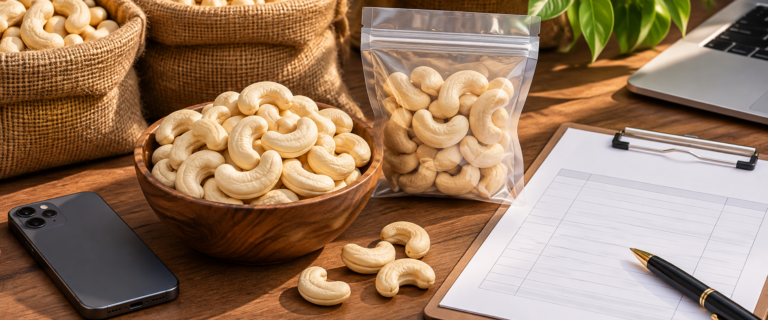
Record what you approved, and check every new lot against that record. Buyers of a private label kaju brand expect the same kernels in every pouch, and a sudden change in size or colour brings bad reviews.
Write four details for each approved lot:
- Grade and colour, such as white W320
- Kernel count and broken share from the two trial-lot checks
- Lot code and invoice number
- A photo of 100 g spread on a white plate
Before you pack a new lot, compare a sample with the record. If the kernels look smaller or darker, ask for another lot, or sell it under the correct grade name.
Should you pack the kaju yourself or use a contract packer?
Pack it yourself for full control over every pouch. Use a contract packer to start with less money and fewer licences of your own.
To pack in Delhi yourself, you need a clean room, a sealing machine and a calibrated scale. You also hold the packer registration and an FSSAI licence that covers packing. In return, you can pack small lots every week and check each pouch.
A contract packer holds the packing licences and machines. The pouch then shows the packer name and address next to your brand name. As the seller on Amazon, you still need your own FSSAI licence and GSTIN, and you still own the brand, the listing and the reviews. Visit the packing room once, and ask how the packer stores open bulk kaju between your orders.
How does NutDana supply private label sellers?
We supply whole kaju and kaju pieces in sealed 10 kg buckets, from 10 kg per grade. Every bill is a GST tax invoice under HSN 0801. You get a sample or lot photo ahead of bulk payment. For a repeat order, send the order number printed on your previous bill, and we supply kernels matched to that lot while its stock lasts.
Tell us your grade, monthly kilos and pouch plan when you ask for wholesale dry fruits for online resellers. For grade-wise rates, see our Delhi kaju wholesale prices.
NutDana Editorial Team. We supply wholesale kaju to shops, kitchens and online sellers across Delhi NCR. We checked the rules, rates and links in the answer above on 16 November 2026.