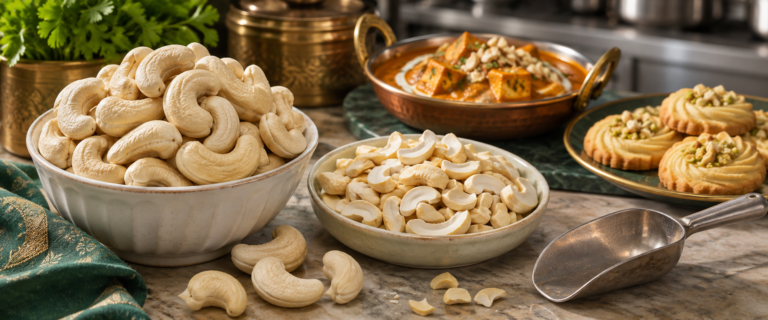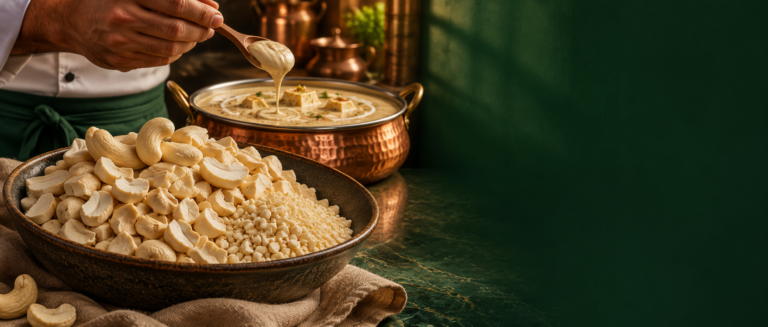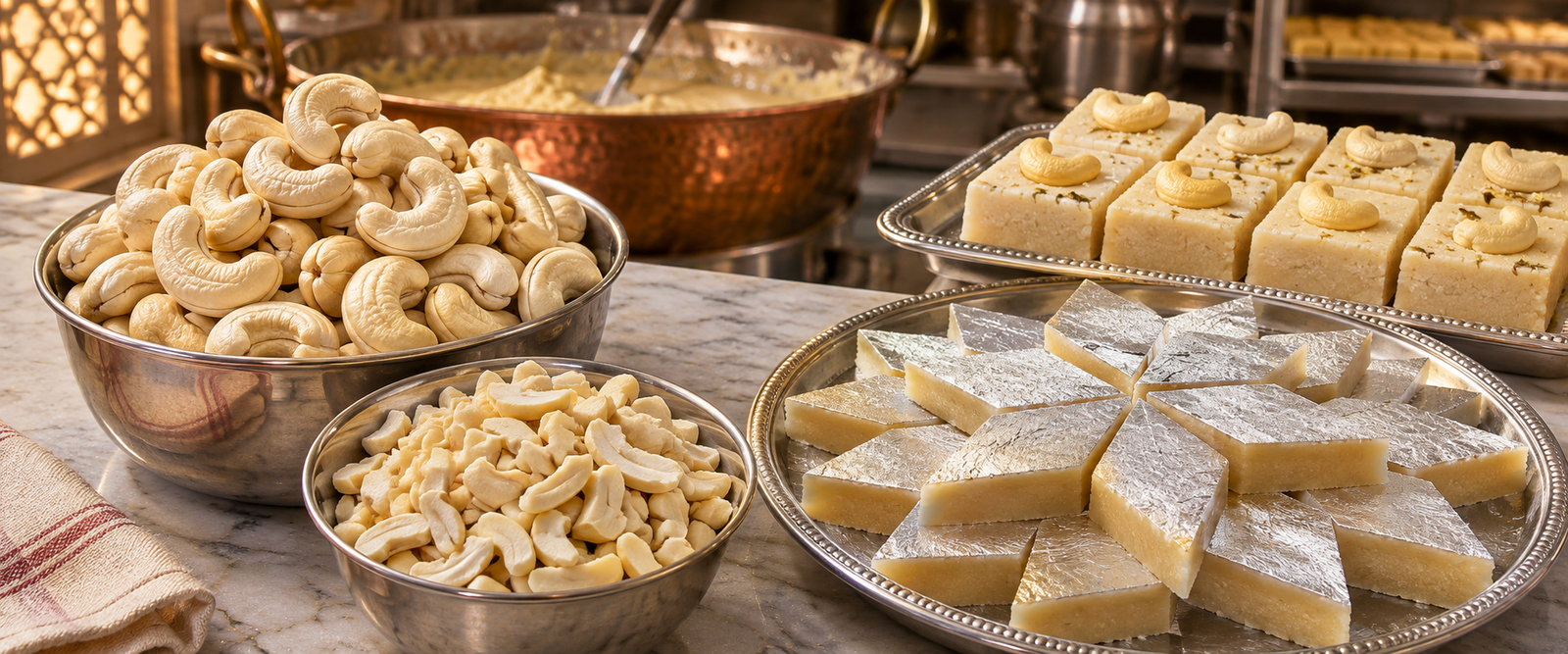
Most Delhi sweet shops need three cashew grades for daily mithai. Use LWP for paste and fried chunks, SWP or baby bits for kheer and kulfi, and JH halves for toppings. Add JK, W320 or W240 only when your menu has namkeen, big laddoo chunks or premium boxes. With the right cashew grade for each mithai, you pay less for every tray, and your customers taste no difference.
How do you pick the right kaju for each mithai?
Pick the cashew grade from the job it does in the sweet. Each piece of cashew does one of three jobs:
- Paste: you grind it into kaju katli, kaju barfi or kaju rolls. Nobody sees the shape of the nut, and broken white pieces cost less than wholes.
- Chunk: the customer bites into a piece, as in dry fruit laddoo, pinni or gajar halwa. The piece must be large enough to notice.
- Topping: you press one kernel or half on each piece of barfi. The customer sees it first, and it must look even and white.
Katli, barfi tops and halwa need only LWP and JH. Kheer and kulfi add a third grade. Every extra grade adds one more open bucket and one more line on your weekly order, with no gain at the counter.
If a supplier quotes a grade name you have never seen, look it up in our cashew grades size chart.
Which kaju grade goes into each mithai on your counter?
| Mithai | What the kaju does | Grade to buy |
|---|---|---|
| Kaju katli, kaju kesar barfi | Paste | LWP or SWP |
| Kaju roll, kaju pista roll, kaju apple, kaju kalash | Paste | LWP |
| Dry fruit laddoo, pinni, kaju anjeer roll | Visible chunk | JK or LWP |
| Gajar halwa, moong dal halwa | Chunk fried in ghee | LWP |
| Kheer, rabri, kulfi | Small crumb | SWP or baby bits |
| Kaju barfi, besan barfi, ghevar | Topping | JH halves |
| Kaju namkeen mixture | Fried chunk or small whole | JK or W450 |
| Premium boxes, wedding trays, loose kaju at the counter | Whole kernel | W240 or W320 |
Baby bits brown much quicker than larger pieces in hot ghee. Fry LWP for halwa, and save baby bits for sweets you never fry, such as kulfi and kheer.
For kaju katli, LWP and SWP can both work. A side-by-side batch with your own recipe decides the winner, and our answer on which kaju to buy for kaju katli walks through that test.
Should you top barfi with whole kaju or halves?
Top daily barfi with halves. A half costs less than half the price of a whole kernel, because split grades sell at a lower rate per kg.
Take W320 at ₹920 per kg. A kilo holds about 660 to 706 kernels, as our W320 count per kg shows, and one whole kernel costs about ₹1.35. Halves cut from kernels of the same size come to about 1,366 per kg. At ₹835 per kg for JH, one half costs about ₹0.61. A counter that tops 300 pieces of barfi a day spends about ₹404 on whole W320 or ₹183 on halves. Over 26 working days, halves save about ₹5,700.
Halves from different suppliers vary in size. Count the halves in 100 g of each sample before you compare quotes. Our answer on 2-piece kaju and cashew splits lists what else to check.
Use whole W320 or W240 for gift boxes and wedding trays. There, a full kernel on each piece helps the box sell at a higher price.
Why grind LWP and never whole W320?
A kilo of W320 at ₹920 and a kilo of LWP at ₹765 make the same paste in the grinder. On our Delhi rates, W320 costs about ₹155 more per kg. A shop that grinds 6 kg of W320 a day for katli loses about ₹930 a day, or more than ₹24,000 over 26 working days.
Grind wholes only when your supplier has no white pieces left, and ask for SWP before you reach for W320. Broken kernels from your W320 and JH buckets belong in the paste bin too, and every handful saves the same amount of LWP.
How much kaju does a sweet shop use in a week?
Work out one day of cashew use from your sales, then turn the week into 10 kg buckets.
In our sweet shop kaju example, 3 kg of LWP makes about 4.5 kg of katli. That works out to about 0.67 kg of LWP in each kilo of katli. A counter that sells 9 kg of katli a day uses about 6 kg of LWP. Over a six-day week, that comes to 36 kg, or four buckets, with 4 kg left for the next week.
Repeat the same sum for each grade:
- Write down the kilos of each mithai you sell on a normal day.
- From each recipe, work out the kaju in 1 kg of finished sweet.
- Multiply that figure with your daily kilos, and add up every sweet on the same grade.
- Multiply the total with your working days, and round up to whole 10 kg buckets.
Grind only what the day needs. Ground kaju loses its fresh smell quickly, and a fresh grind each morning protects the flavour of your katli.
Finished katli lasts longer than raw paste. FSSAI lists kaju katli among sweets that last about seven days in its shelf life list for sweets. A best-before date on loose sweet trays has been voluntary since November 2023. Still, a date on each tray tells your staff which katli to sell first.
How do you store a garnish grade that moves slowly?
Open the garnish bucket once a week, and move one week of halves into a small airtight jar for the counter.
Toppings move much slower than paste cashews. At 300 halves a day, a counter uses about 0.22 kg, and one 10 kg bucket lasts about 45 working days. A bucket opened at every tray takes in damp air and kitchen smells for six weeks. A bucket opened once a week holds its crunch and colour much longer.
For opened packs and store humidity, read our notes on bulk dry fruit storage.
How do Delhi festivals change your kaju order?
Each festival season pulls on a different grade:
- Sawan, Teej and Raksha Bandhan (July and August): ghevar tops and Rakhi gift boxes use more JH halves and whole W320.
- Navratri to Bhai Dooj (late September to November): kaju katli and kaju barfi boxes push LWP to its highest use of the year.
- Winter and the wedding season (November to March): gajar halwa, pinni and dry fruit laddoo use more LWP and JK chunks.
Cashew rates climb before the first two seasons. The APEDA cashew market dashboard puts the usual price peak from July to October, when raw nuts are scarce and festival buying begins. Pieces and halves rise the most, because every sweet maker buys them in the same weeks.
Fix your weekly bucket count for each grade before mid-July. From then until Diwali, order the same lots every week, and avoid one large panic order in the final week before Diwali.
Do dark sweets need white kaju?
Pale sweets need white kaju, while dark sweets can use cheaper, darker cashew grades.
Kaju katli, kaju rolls and kaju barfi show every brown speck, and these sweets need white LWP and white halves. Pinni, gajar halwa and besan laddoo are brown already, and you fry the kaju for them. Scorched pieces or a dessert grade can cost less there. Test one batch first, since some darker grades have a stronger roasted taste. Our answer on dessert grade kaju for sweets covers what to check.
What should your sweet shop kaju order include?
Write one line per grade with five details:
- The grade name, such as LWP, JK or JH, with “white” or “scorched”.
- Kilos per week, in 10 kg buckets.
- The mithai it goes into, such as “katli paste” or “barfi topping”.
- A sample from the supply lot before the first bulk order.
- The delivery day that matches your production week.
The mithai name helps your supplier spot a cheaper grade that works equally well, such as LWP in place of W320 for katli paste.
How does NutDana supply Delhi sweet shops?
Our 10 kg buckets cover LWP, SWP, baby bits, JK, JH and every whole grade, with a 10 kg minimum for each grade. One order can mix grades in a single delivery. Before your bulk payment, you get a sample or photo from the lot.
Send us your weekly kilos for each mithai. We will match a grade to each job and send a written rate for wholesale kaju in Delhi.