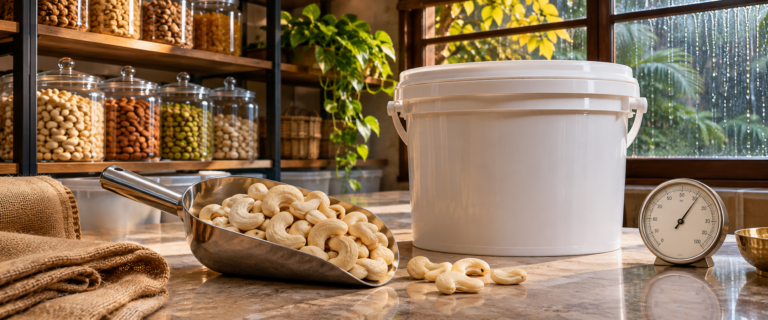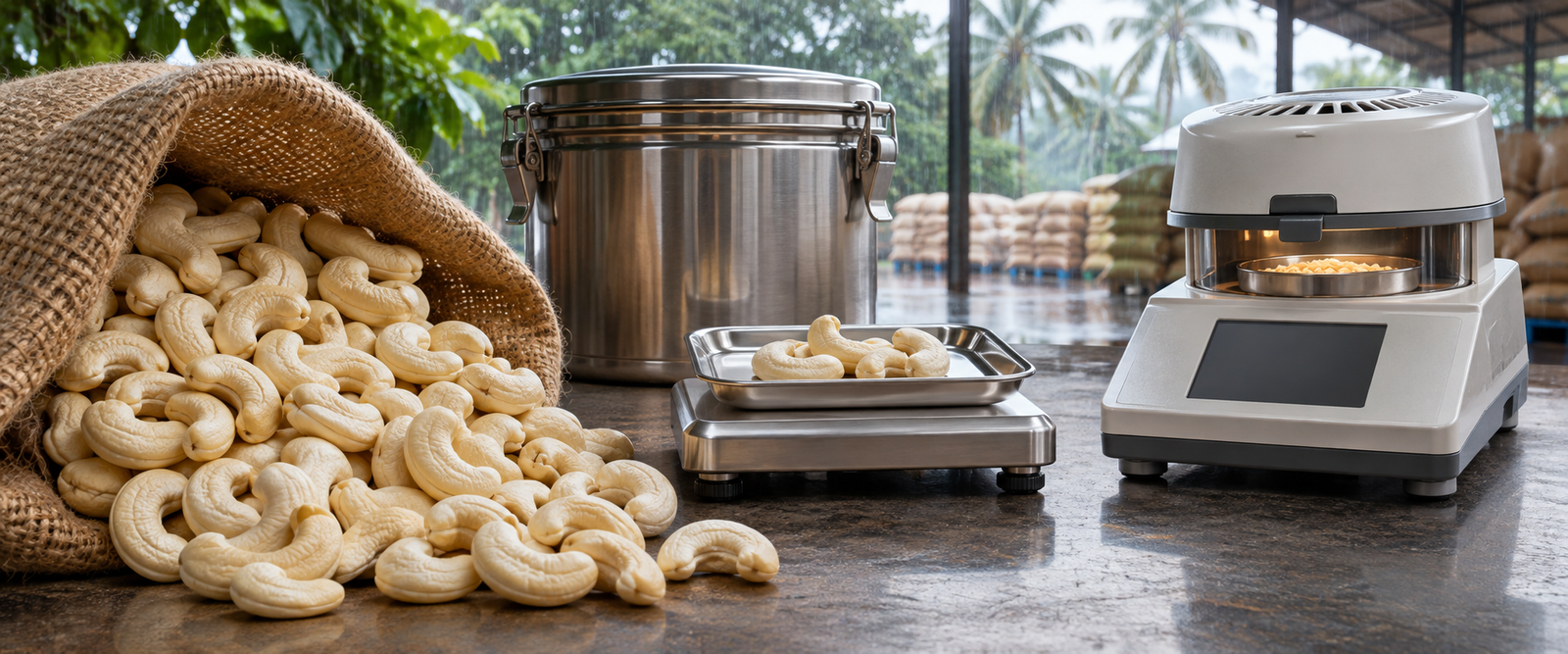
The safe cashew moisture level is 5% or less. FSSAI sets 5% as the top limit for cashew kernels sold in India. Above 5%, wet kaju costs you money in three ways. You pay the kaju rate for water, the lot loses weight in your shop, and the cashews go mouldy or stale sooner.
What moisture level should cashew kernels have?
Cashew kernels should test at 5% moisture or lower. The FSSAI standard for cashew kernels applies to every lot. A lot above 5% fails it, even when the kaju looks white, whole and fresh.
Food scientists treat 5.8% as the highest safe moisture for storing cashews. Above that point, kaju becomes easy food for mould. Cashews pick up moisture from damp godowns, torn inner bags and open buckets. A lot packed at 4.5% can cross 5% after it leaves the factory.
Your hands and eyes cannot read a moisture percentage. A soft kernel or a musty smell is only a warning sign, and our hand checks for cashew moisture cover those signs. A lab test is the one way to get the exact cashew moisture content.
How much do you pay for water in wet kaju?
You pay the full kaju rate for every kilo of water in the lot. At 5% moisture, 100 kg of kaju holds 5 kg of water. Each extra point of moisture adds 1 kg of water to every 100 kg. At ₹900 per kg for W320 cashews, each extra point costs you ₹900 on 100 kg.
| Kaju moisture | Water in 100 kg | Price of that water at ₹900 per kg | Extra cost against a 5% lot |
|---|---|---|---|
| 4% | 4 kg | ₹3,600 | ₹900 less |
| 5% (FSSAI limit) | 5 kg | ₹4,500 | ₹0 |
| 6% | 6 kg | ₹5,400 | ₹900 more |
| 7% | 7 kg | ₹6,300 | ₹1,800 more |
| 8% | 8 kg | ₹7,200 | ₹2,700 more |
On a 250 kg order of W320 at 7% moisture, you pay ₹4,500 for 5 kg of water above the 5% limit.
Can a cheaper kaju quote cost more because of moisture?
Yes. A lower rate on wet kaju can cost more for each kilo of dry cashews you get. Dry kaju is the cashew weight left after you take out the water. Use one sum for each quote: cost per dry kilo = total price ÷ kilos of dry kaju.
Supplier A quotes W320 at ₹890 per kg, and the lab report shows 7% moisture. 100 kg costs ₹89,000 and holds 93 kg of dry kaju, about ₹957 per dry kilo. Supplier B quotes ₹900 per kg with 4.5% moisture. 100 kg costs ₹90,000 and holds 95.5 kg of dry kaju, about ₹942 per dry kilo. The quote that looks ₹10 cheaper costs about ₹15 more per dry kilo.
Compare moisture only when both figures come from the batch you will receive. Broken kernels and net weight can also change which W320 quote wins.
How much weight does wet kaju lose in your shop?
Wet cashews dry out in dry air and lose weight. In Delhi, the air dries once the monsoon ends. A 100 kg lot at 7% moisture holds 93 kg of dry kaju. If the lot dries to 5% on your shelf, it weighs about 97.9 kg. You lose about 2.1 kg, worth about ₹1,895 at ₹900 per kg, before you sell a single kernel.
The same loss can leave a 10 kg bucket short when you weigh it weeks later. Weigh the kaju without the bucket, as our answer on 10 kg kaju bucket net weight shows.
How does high moisture spoil kaju?
High moisture spoils kaju in three ways: mould, a stale taste and soft kernels.
- Mould: Retail cashews at 6.7% moisture showed at least 13 times more mould than cashews at 4.1% in lab counts. Some moulds make poisons called mycotoxins. The World Health Organization warns that most of these poisons survive food processing.
- Stale taste: Water wakes up a natural enzyme that breaks cashew fat into free fatty acids. Research on stored cashew kernels links higher moisture to more of these acids. The acids leave a sour, soapy or old-oil taste. In storage tests, roasted cashews stored at 70% humidity or more went stale within 12 days. Cashews stored at 30% humidity showed no stale taste.
- Soft kernels: Wet kaju bends where dry kaju snaps, and it loses its crunch.
One stale 10 kg bucket at ₹900 per kg is ₹9,000 of cashews you cannot sell or cook. Stale kaju in kaju katli or a shahi gravy can also cost you repeat customers.
Can you sell kaju with moisture above 5%?
No. Kaju above 5% moisture fails the FSSAI standard, and the law calls such food sub-standard. Section 51 of the food safety law of 2006 covers anyone who stores, sells or supplies sub-standard food. The penalty can reach ₹5 lakh. The rule covers resellers and sweet shops as well as the packer. For your own case, ask a food law expert.
Does the Delhi monsoon raise kaju moisture?
Yes. Cashews take in water from humid air, and Delhi air is most humid from July to September. On 24 July 2025, IMD recorded 88% humidity in Delhi at 5.30 pm.
The 5.8% safe level for cashews matches air at about 70% humidity, and Delhi monsoon air goes well above that mark. In storage tests, raw kernels took in twice the water when the air held four times more humidity. An open bucket in a damp back room can cross 5% even when the lot arrived dry.
Four monsoon habits protect your money:
- Order smaller lots that you can finish within 15 to 20 days.
- Close the bucket lid right after each scoop.
- Store buckets on a rack, off the floor and away from damp walls.
- Move the cashews for daily use into a small airtight jar, and leave the main bucket closed.
A sealed bucket or vacuum pouch blocks damp air until you open it. Compare pack types in our notes on tins, vacuum pouches and buckets for bulk cashews. To check humidity in your store, follow our steps for storing dry fruits and seeds in bulk.
How do you test cashew moisture before you pay?
Send a sample from your order batch to a food lab. The lab weighs the kaju, dries it in an oven and weighs it again. The weight lost is the moisture.
- Ask the supplier for a kaju sample from your order batch, with the batch code on the pouch.
- Send half of the sample to an FSSAI-notified or NABL-approved food lab. NABL is the national board that approves test labs in India. Hold the other half for checks at delivery.
- Ask the lab for moisture and free fatty acids. FSSAI allows up to 1.25% free fatty acids in whole cashew kernels and 2.0% in pieces.
- Write “moisture 5% max” and the batch code on your purchase order.
- At delivery, check the delivered batch code against your approved sample.
A lab test pays off on big orders. On 500 kg of W320 at ₹900 per kg, kaju at 7% moisture costs you ₹9,000 more than kaju at 5%. On a 20 kg order, the same 2 points cost about ₹360, and a same-batch sample with hand checks makes more sense.
What should you do if your kaju moisture is above 5%?
Move the lot away from your other stock. Inform the supplier the same day with the lab report, the batch code and photos of the packs. Your next step depends on the state of the kaju:
- Musty smell, clumps, soft kernels or mould: return the full lot. Never roast it or mix it with good stock.
- Fresh smell and firm kernels: ask for a replacement lot. If you used part of the lot, claim a credit for the extra water in the kilos you used. For example, 40 kg used at 6.5% moisture holds 0.6 kg of extra water, worth ₹540 at ₹900 per kg.
How does NutDana protect kaju from moisture?
We pack whole kaju and kaju tukda in 10 kg buckets with lids that close again after each scoop. You can check a sample from the batch before you pay for a bulk order, and we share the packing date on request. Each written rate holds for 24 hours.
From July to September, ask for the packing date with your rate. Send your grade, kilograms and delivery area for a quote on wholesale kaju in Delhi with GST and freight.