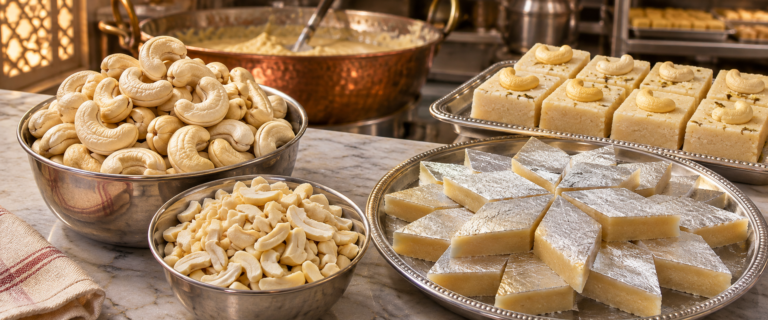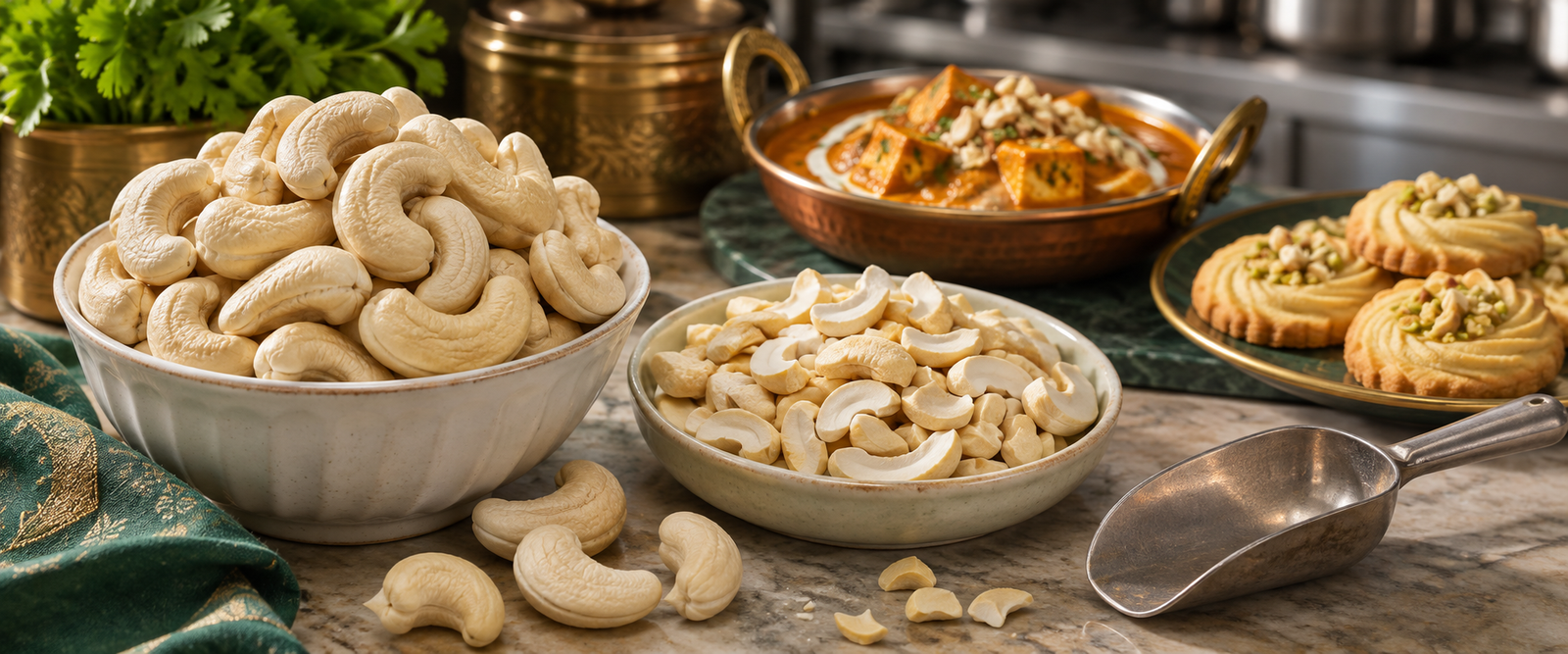
Most kitchens need two kinds of cashew, and neither is a top grade. Buy pieces for any kaju the customer never sees, such as gravy paste or cookie dough. Buy whole nuts or neat halves only for kaju that shows on the plate. Grinding whole W320 into paste costs about ₹2.40 to ₹2.50 more per 10 g than SWP pieces. The grinder then destroys the shape you paid for.
Which Cashew Grade Does Each Kitchen Job Need?
Cashew grades for bakeries and restaurants depend on one question for every dish: will the customer see the cashew? If no, buy pieces. If yes, buy the smallest whole nut or cut that still looks good.
| Kitchen job | Grade to buy |
|---|---|
| Gravy paste for shahi paneer, korma or malai kofta | SWP or BB |
| Kulfi or ice cream base | SWP or BB |
| Cookie and rusk dough | JK for visible chunks, SWP for small bits |
| Namkeen and snack mixes | JK |
| Cake and pastry toppings | JK or LWP |
| One whole kaju on each nankhatai or biscuit | W450 or W400 |
| Biryani, pulao and kheer garnish | JH halves or W320 |
| Kaju curry, where whole nuts are the main part of the dish | W240 or W320 |
| Fried or roasted kaju on the menu | W320 or W400 |
For trial methods for each dish, read our article on cashew grades for sweet shops, bakeries and catering.
What Does Cashew Cost per Plate, Batch or Biscuit?
Price per 10 g is the easiest number to use with any recipe. Our Delhi kaju wholesale prices below include 5% GST and apply to a 10 kg order of a single grade. We checked them on 16 November 2026.
| Grade | Price per kg | Cost per 10 g |
|---|---|---|
| SWP or BB | ₹650 to ₹700 | ₹6.50 to ₹7.00 |
| LWP | ₹750 to ₹780 | ₹7.50 to ₹7.80 |
| JK | ₹770 to ₹800 | ₹7.70 to ₹8.00 |
| JH | ₹820 to ₹850 | ₹8.20 to ₹8.50 |
| W450 | ₹800 to ₹840 | ₹8.00 to ₹8.40 |
| W400 | ₹830 to ₹900 | ₹8.30 to ₹9.00 |
| W320 | ₹900 to ₹940 | ₹9.00 to ₹9.40 |
| W240 | ₹950 to ₹1,000 | ₹9.50 to ₹10.00 |
In a restaurant, a plate of shahi paneer with 15 g of cashew costs ₹9.75 to ₹10.50 in SWP. The same plate costs ₹13.50 to ₹14.10 in W320. A kitchen that grinds 1 kg a day uses about 30 kg a month, and SWP saves it ₹7,200 to ₹7,500 a month.
In a bakery, 500 g of JK in a 5 kg batch of cookie dough costs ₹385 to ₹400. One whole W450 nut costs about 81 to 95 paise, against ₹1.27 to ₹1.42 for a W320 nut. On every 1,000 biscuits, W450 saves about ₹470, and a smaller nut looks better on a small biscuit.
Kaju prices move with the crop and the rupee. Ask for a fresh rate before you price a new menu.
Why JK or LWP Can Mean a Different Cut at Each Supplier
Piece names are trade habits with no fixed standard. Compare the cut, never the name alone.
- At NutDana: JH is one kernel split into two halves. JK is about four pieces per kernel, and LWP is about eight.
- At some other sellers: JK can mean a three-piece cut.
- On some restaurant-supply apps: LWP appears as a four-piece cut and SWP as an eight-piece cut.
Two quotes for “LWP” can hold pieces of very different sizes at very different prices. Ask each supplier how many pieces one kernel makes, and write that number on your order. Our article on splits, LWP and SWP shows the main piece grades, and our cashew grade chart lists the standard piece sizes.
How Much Kaju Should Your Kitchen Order at a Time?
Our minimum order is 10 kg per grade. Check how many days that lasts at your daily use.
| Kaju used per day | One 10 kg order lasts |
|---|---|
| 250 g | 40 days |
| 500 g | 20 days |
| 1 kg | 10 days |
| 2 kg | 5 days |
Reorder when about a week of stock is left. We send out your order 3 to 5 days after you confirm, which leaves a short buffer for travel.
If one 10 kg bucket lasts you more than a month, ask us to pack the order in smaller sealed packs. Each opened pack then holds only a few days of stock. Smaller packs can add a packing charge, which we show as a separate line on the quote. Our note on bulk cashew packaging compares tins, vacuum packs and buckets.
Using less than 250 g a day? First check our retail vs wholesale price check for 10 kg. Restaurant chains that pool orders across outlets reach 100 kg of one grade sooner. At that level, our rate drops ₹10 per kg.
Can Your Kitchen Claim Back the 5% GST on Kaju?
Every kaju bill includes 5% GST. You can claim it back as input tax credit only if your own sales allow it.
| Your business | GST on your sales | Claim back GST on kaju? |
|---|---|---|
| Restaurant or cafe outside a hotel | 5% | No |
| Cloud kitchen | 5% | No |
| Restaurant inside a hotel with room rates above ₹7,500 a night | 18% | Yes |
| Bakery selling factory-made items with no cooking at the shop | Rate for each item | Yes |
| Bakery that cooks or puts together food at the counter | 5% | No |
CBIC placed cloud kitchens under restaurant service in Circular 164/20/2021-GST. On Swiggy or Zomato orders, the app pays the 5% GST for you, and you still get no credit on the kaju. A restaurant outside a hotel cannot pick the 18% rate to claim credit. The GST Council confirmed that point in September 2025.
The bakery rows come from tax rulings given to single bakeries. Those rulings apply only to the bakery that asked, and your CA can confirm where your shop falls. If you cannot claim the 5% back, price your dishes on our GST-included rate.
Do You Need to Show Cashew as an Allergen on Your Menu?
Yes, if FSSAI menu labelling covers your business. Diners cannot see kaju ground into a gravy, and the menu is where diners look for a warning.
FSSAI menu labelling applies to:
- food businesses with a Central Licence
- brands with outlets at 10 or more locations, including cloud kitchens
- online platforms that sell food from these businesses
State-licensed restaurants with fewer than 10 outlets are free from the rule. Covered businesses must show allergens on menu cards, menu boards, booklets and digital menus. The FSSAI labelling guidance note lists “groundnut, tree nuts and their products” as allergens, and a symbol can replace the words.
Whatever your size, mark every dish with kaju paste on your delivery app menu. A nut symbol next to shahi paneer takes a minute to add. If you sell nut-free dishes too, grind kaju paste in its own grinder jar.
How to Hold Kaju Fresh in a Hot Kitchen
Cashew is more than 40% fat. That fat going stale is the main way kaju spoils, as a 2017 food science study notes. Heat and open air speed up the damage.
- Store buckets in the dry store, away from the tandoor, fryer and dishwash area.
- Fill a small working jar for one service, then close the bucket at once.
- Soak only the kaju you will grind that day.
- Use a dry steel scoop. A wet hand or ladle brings water into the bucket.
- Open one bucket of each grade at a time, and finish it before you open the next.
For opened packs, pests and printed dates, read our article on storing bulk dry fruits and seeds.
Delivery to Delhi Restaurants, Bakeries and Cloud Kitchens
We deliver across Delhi, from Connaught Place and Karol Bagh to Hauz Khas, Saket, Rajouri Garden and Laxmi Nagar. Kitchens across the Yamuna can buy wholesale cashews in Noida, and kitchens to the south-west can order bulk kaju in Gurgaon.
Two receiving tips for busy kitchens:
- Malls and market complexes: share the service gate and its opening hours.
- Shared cloud kitchen sites: share your unit number and a phone that someone answers during prep hours.
For a quote, send us three things: your dishes, the grams of kaju each dish uses per day and your PIN code. Share them when you order bulk kaju in Delhi, and we can send pieces and whole nuts together in one delivery.
About the author: NutDana Editorial Team, a wholesale dry fruit and seed supplier to food businesses in India. The prices, GST rules and FSSAI rules in the article were current on 16 November 2026.