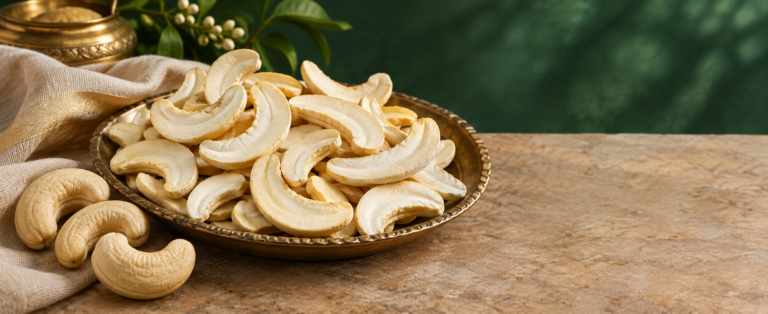
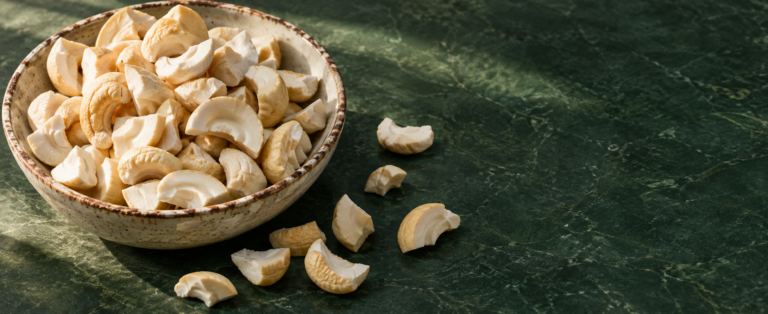
Start with the kaju pieces inside your order.
- JH: Jumbo Half. A large half of a cashew kernel.
- JK: Commonly Jumbo Kudka, meaning chunky broken kaju. Some sellers use other names for JK.
- LWP: Large White Pieces. Larger broken pieces of light-coloured kaju.
- SWP: Small White Pieces. Smaller light-coloured pieces, below the LWP size.
JH describes a half kernel. LWP and SWP describe pieces sorted into different sizes. JK needs another check because its trade name and piece size vary between sellers. All four can appear in Delhi kaju wholesale quotes. Before paying, check the offered pieces, their condition, and the usable weight. A kernel is the edible kaju inside its shell.
Is JH the same as ordinary split kaju?
JH refers to a jumbo half; S refers to a regular split. Two-piece kaju and splits should be checked by shape and size. Each has a curved half-kaju shape. A split forms when the 2 sides of a cashew kernel separate lengthwise. JH is the larger-half trade category. The term jumbo alone cannot tell you the exact size of every half.
For a mithai shop, the difference becomes useful when the half remains visible. A large JH piece may cover the top of a sweet. A smaller split may suit a smaller sweet at a different quoted price. The buyer needs to see both sizes before paying extra for JH.
Check the number of complete halves in a sample. A JH batch with many broken corners can leave fewer pieces suitable for topping. If your recipe crushes every half into paste, paying more for the large curved shape may add no value.
Why can JK mean different things on 2 wholesale quotes?
JK commonly refers to Jumbo Kudka, but there is no single trade description across all sellers. Some use Jumbo King Broken. Another catalogue expands JK as Jumbo Kernels. That last name can even refer to large whole kernels. Confirm that your quote offers chunky kaju tukda when broken kaju is your requirement.
The piece count also changes between listings. Some sellers call JK three-piece kaju. Others call it four-piece kaju. One JK batch may have big chunks, while another may contain smaller pieces. Never treat a JK label as proof of one exact cut.
If a seller quotes JK for biryani or namkeen, ask for a photo of the available batch spread on a plate. Place a ruler beside the pieces. Check the smallest pieces too, since a photo of only the biggest chunks can mislead.
How are LWP and SWP graded in India?
LWP is larger than SWP. Published Indian grade charts use different screen sizes to separate them. LWP pieces remain on a screen with 4.75 mm holes. SWP pieces are smaller and remain on a screen with 2.80 mm holes. A screen sorts kaju when smaller fragments fall through its holes.
Those numbers describe the openings in the screen. A 4.75 mm opening never promises every LWP piece is exactly 4.75 mm long. Pieces have different shapes. For an order, the seller should identify the size rule and match the supplied batch to it.
The W in LWP and SWP refers to white. The accepted colour can include pale ivory or light ash. White is a colour class, never a test for freshness. Both grades still need checking for stale smell, insects, visible mould, shell fragments, and dirt.
SWP is also different from BB, or Baby Bits. BB is a finer piece grade. A buyer ordering SWP for visible bits in cookies should check how much BB-sized material appears in the sample. If the food requires a smooth paste, finer pieces may still serve the recipe.
Does 2-piece, 4-piece, or 8-piece kaju describe an exact cut?
No fixed number of equal pieces comes with those market names. A four-piece label does not always mean LWP. Delhi sellers may refer to halves as two-piece kaju, larger broken pieces as four-piece kaju, and small pieces as eight-piece kaju. JK may also appear as three-piece kaju.
Cashews break into uneven pieces during processing. One kernel can form one large chunk and several small fragments. The names help start a buying conversation. Actual size and the share of crumbs settle the order.
Which grade should I choose for sweets, gravies, or namkeen?
Choose according to the job your kaju must do in the finished food. Large halves cost money for their shape. Smaller pieces earn their place when you will cut, mix, or grind them anyway.
For a visible kaju half on mithai
Start with JH when each sweet needs a curved half. The curved shape counts more than weight alone. Count how many usable halves come from a sample of the quoted batch. If many halves break before topping, the cheaper looking quote can cost more per finished sweet.
For sweets that need chunks beyond half-kaju toppings, compare JK and LWP samples. Check the piece after the normal cooking or topping step. Your customers will see the finished piece, never the code on the carton.
For kaju katli or restaurant gravy
Start with LWP and SWP if the cashews will enter a grinder. Both are broken grades. Large, neat halves bring little benefit when every piece becomes paste.
For kaju katli, test the sample in the recipe you already make. Look at the finished colour and check for any unwanted smell. For gravy, check how the paste mixes into the dish. The smaller grade can be a good purchase when all pieces work in your recipe.
A lower-priced batch can still be a poor purchase if you must remove many damaged pieces. A smaller grade and a poorer-quality batch are different things. Freshness and food safety need their own checks.
For bakery topping, ice cream, and namkeen
For visible chunks on cookies or namkeen, compare JK and LWP. For small bits mixed into dough or ice cream, SWP may suit the job. Think about the finished bite. A large chunk can be too big for one cookie, while tiny crumbs may disappear from a namkeen mix.
If your bakery machine cuts every piece, buying larger chunks may add cutting work. Check the size after mixing or roasting, since handling can create new crumbs. Choose the grade that reaches your wanted size with less sorting.
How should I check a broken-kaju sample before ordering in Delhi?
Compare the offered batches at the same weight, using the same test. A photo of a few selected pieces can hide the fine material in the pack. Ask for a sample from the batch linked to your quotation.
Take 100 g from each sample and spread it on separate clean plates. First separate pieces large enough for your food. Place fine crumbs and damaged pieces in other small bowls. Weigh each group with a kitchen scale. You can now compare the amount usable for your recipe.
Check colour and smell before any food trial. Look for insects, mould, dirt, shell fragments, or a stale oil smell. Reject a sample with such problems. A plate check only finds some visible or noticeable problems. It cannot prove a batch is safe from every hidden risk.
Can a cheaper JK or SWP quote cost more per usable kilo?
Yes. Compare usable kaju, beyond the price written per kg. Suppose JK costs ₹800 per kg in an example quote. A 100 g sample has 20 g of pieces too small for your topping. Only 80 g meets your need. The estimated cost becomes ₹1,000 for each usable kg.
Now imagine LWP costs ₹900 per kg, with 95 g usable from 100 g. Its estimated cost is about ₹947 per usable kg. The ₹900 quote produces a lower usable cost in that example. Both prices are examples, outside any current NutDana quote.
The test depends on the food. Tiny pieces rejected for topping may work fully in gravy paste. A 100 g sample provides an estimate, never a guarantee for a full bulk order. Ask for an agreed batch and inspect more than one part of a large lot when possible.
What should I ask for on a Delhi wholesale kaju quote?
Ask for a quote that identifies the kaju you approved, beyond its letters. Confirm the full trade name, the accepted piece size, and the grade. Add the net weight, packing type, available batch reference, and accepted share of smaller pieces. Net weight counts the kaju alone, without its container.
The total price also needs a proper check. Ask for the per-kg rate, applicable GST, delivery charge, and final amount. A Khari Baoli pickup quote and a delivered Delhi quote belong on the same cost basis before you compare them.
For repeat purchases, refer to the earlier approved sample and invoice. If the seller offers a fresh batch, check the new pieces before agreeing. A familiar grade name can still arrive with a different mix of sizes.
What should you confirm before your first order?
Choose the grade after checking what your kitchen or shop can use. Choose JH for large halves, compare JK for chunky tukda, pick LWP for larger pieces, and check SWP when smaller bits serve the recipe. Compare offered samples before choosing from 2 Delhi wholesale quotes.
Tell us the food you make, the grade or piece size you need, the required net weight, and your Delhi delivery area. Request the batch details and full delivered quote before confirming your order. Start from our Delhi wholesale cashew nuts page.